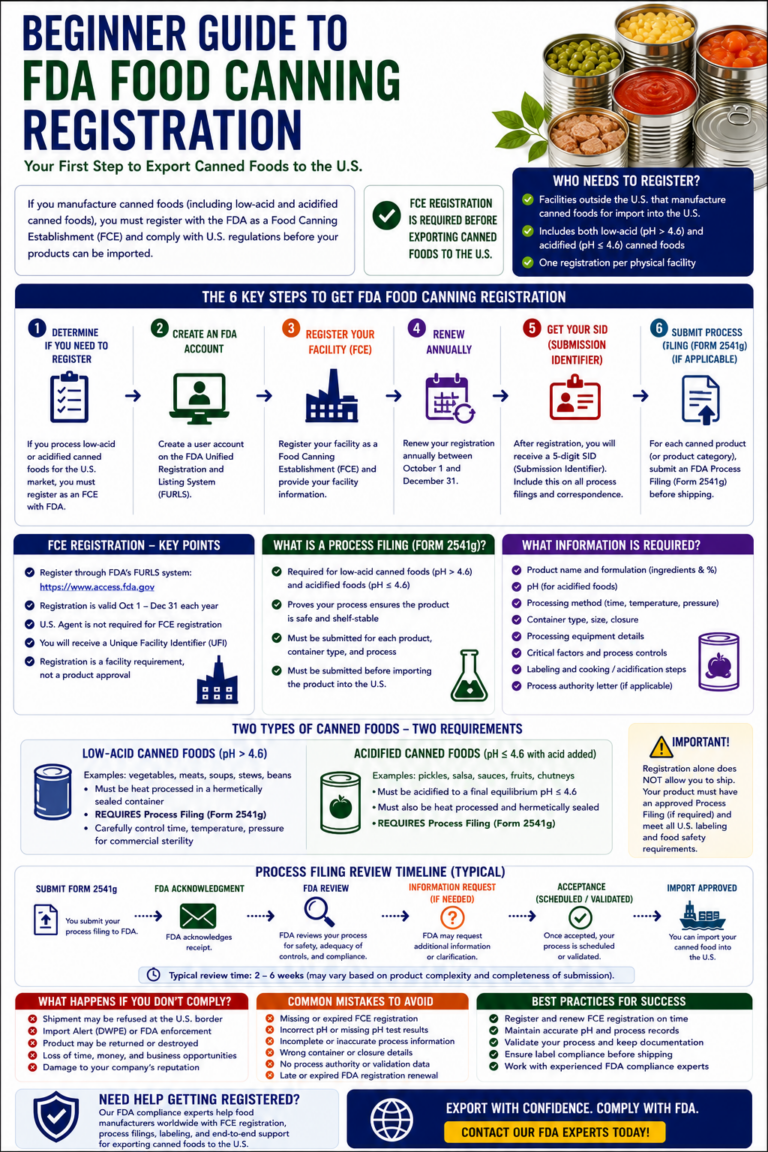
Beginner's Guide to FDA Food Canning Registration
Start here: understand the words, figure out what applies, then follow the detailed guides.
Key Takeaways
- "Canning registration" = four pieces — Facility Registration, FCE, scheduled process, process authority.
- Food Facility Registration ≠ FCE — they're separate, and you may need both.
- FCE/SID only apply to LACF & acidified foods — not every food in a can.
- Classification decides what applies — confirm it before assuming.
- A process authority must validate — the scheduled process rests on it.
- All pieces go in before you ship — they can't be fixed at the border.
The Four Things People Call "Canning Registration"
Get these four straight and the whole topic stops being confusing:
FDA Food Facility Registration
The base requirement for essentially all food facilities — manufacturers, processors, packers, and warehouses. It lists your facility with FDA. Foreign facilities also designate a U.S. Agent.
Who: every food facilityFood Canning Establishment registration
A separate registration (Form FDA 2541) that identifies your plant as one making low-acid canned or acidified foods. Being a registered food facility doesn't cover this — it's an additional step, and it comes before any process filing.
Who: LACF & acidified processorsScheduled process filing
A filing that describes exactly how one product is made safe — its time, temperature, pH, and other critical factors. Filed per product and container; "SID" is the common shorthand. The FCE identifies your plant; this describes each product.
Who: one per product/containerProcess authority
A qualified expert who establishes and validates your scheduled process — confirming the parameters truly achieve safety. Your filing rests on their validation, and FDA generally won't accept a scheduled process without it.
Who: validates before you fileThe Gate: Which Pieces Do You Need?
The FCE and scheduled process only kick in for certain products. Here's the quick gate:
| Your product | FCE + scheduled process? | Still need |
|---|---|---|
| Low-acid canned food (LACF) | Yes | Facility Registration too — pH > 4.6, aw > 0.85 Part 113 |
| Acidified food (acid added to pH ≤ 4.6) | Yes | Facility Registration too Part 114 |
| Naturally acidic food (pH ≤ 4.6, no acid added) | Usually no | Facility Registration |
| Other foods (not low-acid, not acidified) | Usually no | Facility Registration |
Ready for the Step-by-Step?
Once the terms make sense and you know what applies, these walk through the actual process in order:
Canned food market entry
The full ordered path for getting a canned food into the U.S. market.
Canned food guide →Process filing explained
The FCE and scheduled process filing, the forms, and what goes in one.
Process filing →FCE/SID readiness checklist
A quick check that your canning filings are actually in order.
Run the checklist →Shelf-stable foods
How canning fits the wider shelf-stable picture — and when it doesn't apply.
Shelf-stable guide →New to Canning? We'll Handle the Filings
FDA Registration Assistance starts by confirming your classification and which of the four pieces you actually need — then handles the FDA side end to end: Food Facility Registration and U.S. Agent, FCE registration, and the scheduled process filings, coordinating with a process authority for the validation. We also review labels and documentation before you ship.
Contact us at info@fdaregistrationassistance.com or call +1 (928) 275-8333. Food Facility Registration is available starting at $858. Trusted by companies across 135+ countries, with 15+ years of experience.
Frequently Asked Questions
1. What is FDA food canning registration?
It isn't a single registration — it's shorthand for a bundle of separate requirements that apply to certain canned foods: FDA Food Facility Registration, Food Canning Establishment (FCE) registration, a scheduled process filing (often called SID) for each product, and process-authority validation behind those filings. Understanding that it's four distinct pieces is the first thing a beginner should grasp.
2. What's the difference between Food Facility Registration and FCE?
Food Facility Registration applies to essentially all food facilities and is the base requirement. FCE — Food Canning Establishment registration — is an additional, separate registration only for facilities making low-acid canned or acidified foods. You can be registered as a food facility and still need a separate FCE.
3. What is a scheduled process (SID)?
A scheduled process is the validated description of exactly how a specific product is made safe — its time, temperature, pH, and other critical factors. It's filed per product and container, and "SID" is the common shorthand for that filing. The FCE identifies your plant; the scheduled process describes each product.
4. What is a process authority?
A process authority is a qualified expert who establishes and validates your scheduled process — confirming the parameters genuinely achieve safety. Their validation is what your filing rests on. FDA generally won't accept a scheduled process without a process authority behind it.
5. Does canning registration apply to my product?
The full set (FCE and a scheduled process) applies if your product is a low-acid canned food — finished pH above 4.6 with water activity above 0.85 — or an acidified food, meaning a low-acid food brought to a finished pH of 4.6 or below by adding acid. If it's neither, you generally still need Food Facility Registration, but not FCE/SID. A process authority can confirm your classification.
6. Do all canned foods need FCE registration?
No. The word "canned" doesn't decide it — the classification does. Low-acid canned and acidified foods need FCE and a scheduled process; a naturally acidic product in a can may not. This is why beginners should classify the product before assuming which requirements apply.
7. Do I need a U.S. Agent?
Yes, if your facility is outside the United States. Every foreign food facility must designate a U.S. Agent as its FDA point of contact when it registers. Domestic facilities don't need one.
8. Which comes first, FCE or the scheduled process?
FCE first. You register the Food Canning Establishment and receive an FCE number, and only then can you file scheduled processes for your products. And before the scheduled process can be finalized, a process authority needs to have validated it.
9. Does labeling matter for canned foods?
Yes. Beyond the standard label requirements — identity, Nutrition Facts, ingredients, allergens, net quantity, responsible party — the label for a canned or acidified food must match the formulation and process on file. A mismatch between the label and the filing is a common cause of holds.
10. Can I export before finishing all the pieces?
No. Missing FCE, a scheduled process, or process-authority validation can lead to your shipment being held, detained, or refused. For low-acid canned and acidified foods, all the pieces must be in place before you ship — they can't be fixed at the border.
11. How long does it take?
Food Facility Registration and FCE can be relatively quick, but process-authority validation and the scheduled process filings take longer because they involve technical review of each product and container. The safe approach is to start well before your intended ship date.
12. What do beginners most often get wrong?
Assuming Food Facility Registration alone is enough, not realizing FCE and the scheduled process are separate, misclassifying the product, skipping process-authority validation, and filing a process that doesn't match production. Almost every one traces back to not understanding that canning registration is several distinct pieces.
13. Is this the same as shelf-stable food requirements?
There's overlap. Canned low-acid and acidified foods are a subset of shelf-stable foods, and the FCE/SID requirements are triggered by the low-acid or acidified classification — not by the can itself. Some shelf-stable foods that aren't low-acid or acidified don't need FCE/SID at all.
14. How does FDA Registration Assistance help beginners?
We start by confirming your classification and which of the four pieces you actually need, then handle the FDA side end to end: Food Facility Registration and U.S. Agent, FCE registration, and the scheduled process filings, coordinating with a process authority for the validation. We also review labels and documentation before you ship. Starting at $858 for registration, for companies across 135+ countries. Contact info@fdaregistrationassistance.com or +1 (928) 275-8333.