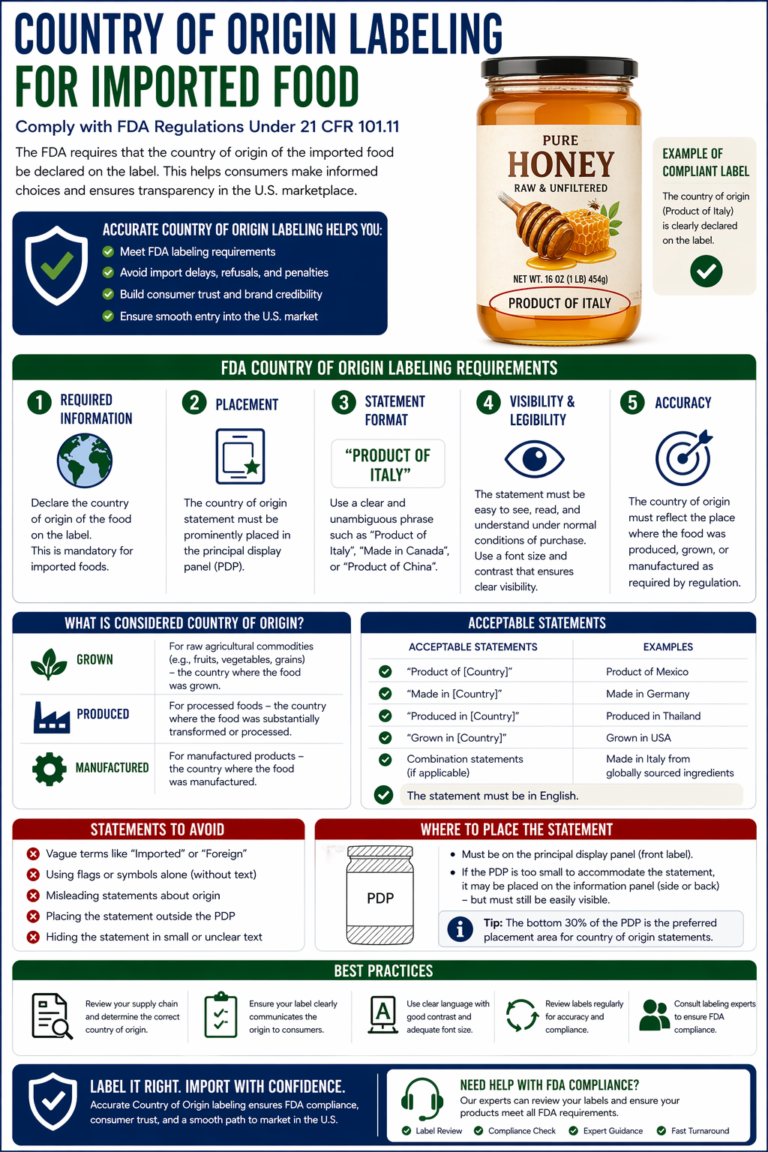
Country of Origin Labeling for Imported Food
Who regulates origin, what "country of origin" means, and how to mark imported food correctly.
Key Takeaways
- Origin marking is Customs, not FDA — CBP enforces it under the Tariff Act.
- FDA governs the label content — Part 101, not the origin statement.
- USDA COOL covers certain commodities — fish, shellfish, produce, some nuts.
- "Made in USA" is mainly FTC — all or virtually all made in the U.S.
- Multi-country origin turns on "substantial transformation" — where it last changed.
- Mark it in English, legible and permanent — or risk detention at the port.
Who Regulates "Country of Origin"
"Country of origin" isn't one rule from one agency — it's several, depending on your product. Here's who owns what:
| Requirement | Agency | Applies to |
|---|---|---|
| Origin marking ("Product of [Country]") | U.S. Customs (CBP) | Virtually all imported goods, food included — Tariff Act, 19 CFR 134 |
| COOL (Country of Origin Labeling) | USDA (AMS) | Covered commodities at retail — fish & shellfish, fresh/frozen produce, peanuts, pecans, macadamias, ginseng |
| The food label content | FDA | Identity, Nutrition Facts, ingredients, allergens, responsible firm — Part 101 (not origin marking) |
| "Made in USA" claims | FTC (USDA for meat/poultry) | Voluntary U.S.-origin claims — "all or virtually all" standard |
What "Country of Origin" Means
Country of origin is the country where a product was produced, manufactured, or substantially transformed. For a single-country product it's straightforward — honey produced and packed in one country is a product of that country.
It gets more complex when a product is grown in one country and processed in another. The origin generally follows the last substantial transformation — a process that turns the item into a new and different article with a new name, character, or use. Repackaging alone usually doesn't change origin; genuine processing may. For multi-country products, a statement like "Processed in Canada from imported ingredients" reflects the reality accurately.
How to Mark Imported Food Correctly
- Use a clear form — "Product of [Country]," "Made in [Country]," or similar, accurately stated
- In English — legible to the U.S. purchaser, not only the exporting country's language
- Conspicuous and permanent — findable, not hidden by design, and not easily removed
- Consistent with the rest of the label — the address and any claims shouldn't contradict the origin
- Reflecting substantial transformation — for multi-country goods, mark where it truly originates
Common Origin-Marking Mistakes
Get Origin and Labeling Right Before You Ship
FDA Registration Assistance reviews imported food labels across the requirements that actually apply — CBP origin marking, USDA COOL where relevant, and the FDA label content under Part 101 — and flags inconsistencies before you ship, so origin marking, address, and claims all line up.
Contact us at info@fdaregistrationassistance.com or call +1 (928) 275-8333. Food Facility Registration is available separately, starting at $858. Trusted by companies across 135+ countries, with 15+ years of experience.
Frequently Asked Questions
1. Is country-of-origin labeling an FDA requirement?
Not primarily. General country-of-origin marking on imported food is a U.S. Customs and Border Protection (CBP) requirement under the Tariff Act, not an FDA rule. FDA governs the food label content — identity, Nutrition Facts, ingredients, allergens, and the responsible firm — under 21 CFR Part 101. So origin marking and the FDA label are two different things, enforced by two different agencies, and both apply to an imported food.
2. Who actually regulates country of origin on food?
It's shared. CBP requires origin marking ("Product of [Country]") on virtually all imported goods, including food. USDA runs Country of Origin Labeling (COOL) for certain commodities at retail — fish and shellfish, fresh and frozen produce, and some nuts. FDA governs the food label content but not origin marking. And voluntary "Made in USA" claims are primarily an FTC matter. Which rules apply depends on your product.
3. What's the difference between CBP marking and USDA COOL?
CBP marking is the broad requirement that virtually every imported article show its country of origin, under the Tariff Act. USDA COOL is a narrower program requiring specific covered commodities — like fish, shellfish, fresh produce, peanuts, pecans, and macadamia nuts — to carry origin information at retail, under the Agricultural Marketing Act. "COOL" is often used loosely to mean any origin labeling, but strictly it's the USDA program.
4. How must country of origin be marked?
The marking must be legible, conspicuous, and permanent, in English, using a form like "Product of [Country]." It has to be placed where a consumer can find it and can't be hidden by other design elements. The exact wording and placement depend on the product and how it's packaged, but the marking must accurately reflect the true country of origin.
5. What does "substantial transformation" mean?
It's the test for origin when a product is made or processed in more than one country. The country of origin is generally where the product last underwent a substantial transformation — a process that changes it into a new and different article with a new name, character, or use. Simple steps like repackaging usually don't count; genuine processing may. For multi-country products, this determination drives the label.
6. How are processed or multi-country foods labeled?
The label has to reflect where the product was actually produced or substantially transformed — which may differ from where the ingredients were grown. A product processed in one country from ingredients grown elsewhere might carry a statement like "Processed in Canada from imported ingredients." Misrepresenting where a processed food is really from is a common and serious compliance problem.
7. Can I use "Made in USA" on my product?
Only if it qualifies. "Made in USA" is primarily governed by the FTC, which requires that a product be "all or virtually all" made in the United States for an unqualified claim. For meat and poultry, USDA has its own standard for U.S.-origin claims. An unsubstantiated "Made in USA" claim can trigger enforcement, so it's not a label to use loosely.
8. Does every imported food need an origin marking?
As a general rule, yes — CBP requires imported articles, food included, to be marked with their country of origin, with limited exceptions. On top of that, covered commodities may carry USDA COOL. Because the baseline marking requirement is broad, the safer assumption is that your imported food needs a compliant origin marking unless a specific exception clearly applies.
9. What happens if origin isn't declared or is wrong?
A shipment can be detained, held for marking, or refused entry, and you may be required to mark or re-mark the goods — sometimes under CBP supervision — before release. Misleading origin claims can also draw enforcement. Because these problems surface at the port, correcting origin marking before shipment is far easier than fixing it after arrival.
10. Does the origin marking have to match the rest of my label?
Yes. The origin marking has to be consistent with the rest of the label — the manufacturer or distributor address, any origin-related claims, and the product identity. A label where the address implies one country and the origin marking says another invites scrutiny. Consistency across CBP marking and the FDA label content is part of getting an imported product cleared.
11. Does the marking have to be in English?
Yes. The country-of-origin marking must be in English and legible to the ultimate purchaser in the U.S. A marking only in the exporting country's language doesn't satisfy the requirement. This is a frequent issue on labels carried over from another market without adaptation for the U.S.
12. Do seafood and produce have extra origin rules?
Yes. Fish and shellfish, and fresh and frozen fruits and vegetables, are covered commodities under USDA COOL, which requires origin (and, for fish, wild vs farm-raised) information at retail — on top of CBP marking. So these products carry both the general Customs marking and the USDA COOL information. If you import seafood or produce, both sets of rules are worth checking.
13. Does correct origin marking mean my product is FDA approved?
No. Origin marking is a Customs requirement, and FDA doesn't pre-approve food or labels at all. Marking your product correctly satisfies the origin rule; it doesn't certify the product or its FDA label. The food still has to meet all applicable FDA labeling and safety requirements, which are separate from the Customs origin marking.
14. How does FDA Registration Assistance help with origin labeling?
We review imported food labels across the requirements that actually apply — CBP origin marking, USDA COOL where relevant, and the FDA label content under Part 101 — and flag inconsistencies before you ship, so origin marking, address, and claims all line up. Food Facility Registration is available separately, starting at $858, for companies across 135+ countries. Contact info@fdaregistrationassistance.com or +1 (928) 275-8333.