FDA Compliance for “Sulphate-Free” Products
This guide explains exactly how MoCRA applies to sulphate-free cosmetics, where a cleansing claim can cross into over-the-counter drug territory, and how to keep your “sulphate-free” claim truthful and not misleading.
What MoCRA Compliance Costs for a Sulphate-Free Brand
There is no single flat fee, because cosmetic compliance scales with how many products and labels you sell. The core components are priced separately so you only pay for what your range needs.
“Sulphate-Free” Is a Marketing Claim — Not an FDA Category
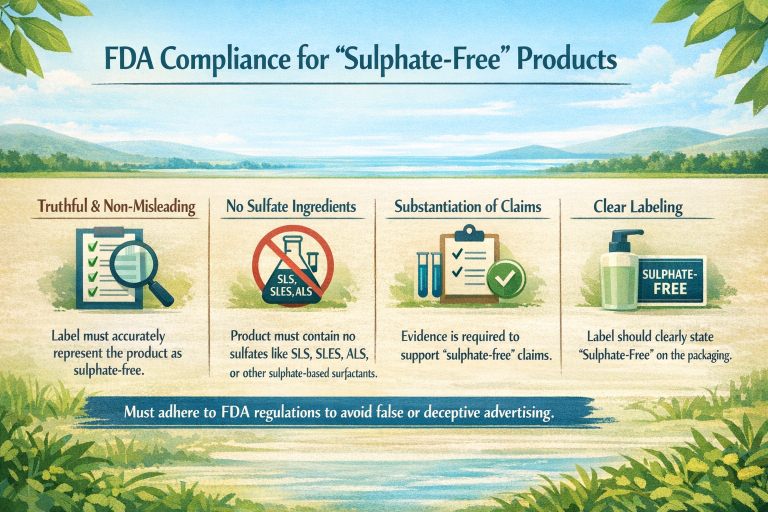
The FDA does not define or separately regulate the term “sulphate-free” (also spelled “sulfate-free”). It is a voluntary claim brands use to signal the absence of sulphate surfactants such as SLS and SLES. Sulphates themselves are permitted, commonly used cleansing agents — they are not banned by the FDA — so removing them is a formulation and branding choice, not a regulatory requirement.
Because the term is undefined, the burden sits with the company: the claim must be accurate, substantiated where it implies a benefit, and consistent with the ingredient declaration required under 21 CFR Part 701.
Where a Sulphate-Free Shampoo Crosses the Line Into a Drug
A sulphate-free product stays a cosmetic as long as its claims are about cleansing and beautifying. The moment it makes a therapeutic claim, it becomes an over-the-counter drug — a separate, stricter pathway with its own monograph and labeling rules.
What MoCRA Requires for Your Sulphate-Free Products
The Modernization of Cosmetics Regulation Act of 2022 applies in full to sulphate-free cosmetics. These are the obligations every Responsible Person must meet before and after the product reaches the U.S. market.
Small Businesses and Foreign Brands
Is there a small-business exemption?
Businesses averaging under $1,000,000 in annual cosmetic gross sales over the prior three years are exempt from facility registration and product listing. The exemption does not apply to products that contact the mucous membrane of the eye, are injected, are for internal use, or alter appearance for more than 24 hours. All other MoCRA duties still apply.
Do foreign brands need a U.S. Agent?
MoCRA does not impose a codified U.S. Agent requirement for cosmetics the way the food, drug, and device rules do — it centers on the Responsible Person. Foreign brands still need a dependable U.S.-based contact to register, list, and handle FDA communications; U.S. Agent services can fill that role.
Authoritative text for these obligations lives in the FD&C Act sections added by MoCRA and in the cosmetic labeling rules at 21 CFR Part 701 on eCFR.
Keep Your Sulphate-Free Line FDA-Compliant
If you manufacture or sell sulphate-free cosmetics in the United States, we handle the full pathway — classification, cosmetic facility registration, product listing, safety substantiation, and label and claim review. Trusted by 1,000+ companies across 135+ countries, with 15+ years of FDA regulatory experience. Email info@fdaregistrationassistance.com or call +1 (928) 275-8333.
Frequently Asked Questions — Sulphate-Free Products & MoCRA
Are “sulphate-free” products regulated by the FDA?
Yes. “Sulphate-free” products are regulated as cosmetics under the Modernization of Cosmetics Regulation Act (MoCRA). “Sulphate-free” is a marketing claim, not a regulatory category, so shampoos, body washes, and cleansers labeled this way must still meet every cosmetic obligation: facility registration, product listing, safety substantiation, labeling, and adverse-event reporting.
Does the FDA define “sulphate-free”?
No. The FDA has no formal definition of “sulphate-free” (also spelled “sulfate-free”). It is a voluntary claim indicating a product contains no sulphate surfactants such as sodium lauryl sulfate (SLS) or sodium laureth sulfate (SLES). Because the term is undefined, the company is responsible for making sure the claim is truthful and not misleading.
Are sulphates banned or restricted by the FDA?
No. Sulphates such as SLS and SLES are permitted cleansing agents in cosmetics when used safely. Choosing to market a product as sulphate-free is a branding decision, not a regulatory requirement, and removing sulphates does not reduce your compliance obligations.
What is MoCRA and when did it take effect?
MoCRA is the Modernization of Cosmetics Regulation Act of 2022, enacted December 29, 2022 — the largest expansion of FDA cosmetic authority since 1938. It added mandatory facility registration, product listing, safety substantiation, adverse-event reporting, and records access. FDA exercised enforcement discretion on registration and listing until July 1, 2024, so those requirements are now fully in effect.
Do I have to register my facility if I make sulphate-free products?
Yes, unless you qualify for the small-business exemption. Facilities that manufacture or process cosmetics for the U.S. market must register with the FDA and renew every two years — see who must register a cosmetic facility. This applies to both domestic and foreign facilities.
How often is cosmetic facility registration renewed?
Every two years (biennial). The registration must also be updated within a short window after certain changes to facility or contact information. Keeping the registration active and current is what allows your products to keep entering the U.S. market.
Do I need to list each sulphate-free product separately?
Yes. Each marketed product — each distinct formulation or variation — must have its own product listing identifying the product, its ingredients, the product category, and the Responsible Person. Product listings are updated annually.
Who is the “Responsible Person” under MoCRA?
The Responsible Person is the manufacturer, packer, or distributor whose name appears on the product label. The Responsible Person is accountable for product listing, safety substantiation, adverse-event reporting, and recordkeeping. MoCRA's cosmetic framework centers on the Responsible Person rather than a formal U.S. Agent designation.
Do foreign companies need a U.S. Agent for cosmetics?
MoCRA does not create a codified “U.S. Agent” requirement for cosmetics the way the food, drug, and device rules do — the cosmetic framework centers on the Responsible Person. In practice, foreign brands still need a dependable U.S.-based point of contact to register the facility, list products, and manage FDA communications, which is where U.S. Agent services can help.
What is safety substantiation?
Safety substantiation is adequate evidence that the product is safe under labeled and customary conditions of use, kept on file by the Responsible Person. It is required for every cosmetic, including sulphate-free ones. If you replace sulphates with alternative surfactants, those alternatives must be substantiated for safety as well — removing sulphates does not remove the safety obligation.
Can a “sulphate-free” claim be misleading?
Yes. Labeling a product sulphate-free when it actually contains a sulphate, or implying that sulphates are unsafe or that sulphate-free products are “FDA-approved,” can make the label misleading under both FDA and FTC standards. The FDA does not approve cosmetics, so no cosmetic may claim FDA approval.
Does “sulphate-free” mean the product is “natural” or “organic”?
No. “Natural” and “organic” are separate claims with their own substantiation expectations and, for organic, separate USDA rules. “Sulphate-free” addresses only the absence of sulphate surfactants and says nothing about whether a product is natural or organic.
What labeling rules apply to sulphate-free cosmetics?
Standard cosmetic labeling under the FD&C Act and the Fair Packaging and Labeling Act (21 CFR Part 701) applies: an ingredient declaration, the net quantity of contents, and the name and place of business of the manufacturer, packer, or distributor. Under MoCRA, the label must also identify a Responsible Person contact for reporting adverse events.
Are there new fragrance allergen labeling rules?
Yes. MoCRA directs the FDA to require disclosure of certain fragrance allergens on cosmetic labels through rulemaking. Brands should track the final allergen list as it is issued and prepare to declare any listed allergens present in their sulphate-free formulations.
What are the adverse-event reporting requirements?
The Responsible Person must report serious adverse events associated with a cosmetic to the FDA within 15 business days, and must keep records of adverse events. Records are generally retained for six years, or three years for certain small businesses.
When does a “sulphate-free shampoo” become an OTC drug?
When it makes a therapeutic claim. A shampoo that simply cleanses is a cosmetic, but an anti-dandruff, antifungal, or hair-restoration claim makes it an over-the-counter drug subject to an OTC monograph or approval — a separate and stricter pathway. See FDA rules for hair products under MoCRA for where that line falls.
Is there a small-business exemption?
Yes. Businesses averaging under $1,000,000 in annual cosmetic gross sales over the prior three years are exempt from facility registration and product listing. The exemption does not apply if the product regularly contacts the mucous membrane of the eye, is injected, is intended for internal use, or is intended to alter appearance for more than 24 hours. All other MoCRA duties still apply.
Does the FDA “approve” sulphate-free cosmetics or their ingredients?
No. The FDA does not pre-approve cosmetics or most cosmetic ingredients; color additives are the main exception. The Responsible Person is accountable for ensuring a product is safe and compliant before it is marketed, and no cosmetic may state or imply FDA approval.
Can sulphate-free products be held or refused at the border?
Yes. Imported cosmetics that are not properly registered or listed, or that are misbranded or adulterated, can be detained or refused entry into the United States. See our cosmetics & MoCRA services for the full compliance pathway before shipping.
Do online and Amazon sellers of sulphate-free cosmetics need to comply?
Yes. The sales channel does not change MoCRA obligations. If you are the manufacturer or the Responsible Person, the facility registration, product listing, safety substantiation, labeling, and adverse-event reporting duties apply regardless of whether you sell through a marketplace, your own site, or retail.
What records do I need to keep for sulphate-free products?
You must keep safety substantiation records, adverse-event records, and product and formulation documentation, all available to the FDA on request. Adverse-event records are kept for six years, or three years for certain small businesses.
How is a sulphate-free body wash or bar soap treated?
It is treated as a cosmetic when it is intended to cleanse or beautify. “True soap” has a narrow regulatory definition, but most modern syndet bars and liquid washes are cosmetics subject to MoCRA — see FDA requirements for bar soaps.
Do antiperspirant or other “active” claims change anything?
Yes. An antiperspirant claim makes a product an over-the-counter drug rather than a cosmetic, even if it is also marketed as sulphate-free — see FDA rules for antiperspirants. Once a drug claim is present, the OTC drug pathway governs.
What about “clinically proven” or efficacy claims on sulphate-free products?
Efficacy claims must be substantiated and must not cross into drug territory. “Clinically proven” raises the substantiation bar and can push a cosmetic into drug classification depending on wording — see FDA requirements for clinically proven skincare.
How do I get my sulphate-free line reviewed for FDA compliance?
Contact FDA Registration Assistance for a compliance review covering classification, cosmetic facility registration, product listing, safety substantiation, and label and claim review. Contact our team, email info@fdaregistrationassistance.com, or call +1 (928) 275-8333 to start.