FDA Registration for Bulk Food Suppliers
Why holding food triggers registration, what the traceability rule means for you, and when it lands.
Key Takeaways
- Holding food triggers registration — you don't have to manufacture.
- Warehouses & distributors register — as holding facilities.
- FSMA 204 traceability applies to FTL foods — lot codes and records.
- Compliance date is now July 20, 2028 — extended 30 months, made binding by Congress.
- The requirements didn't change — only the date; build records now.
- Importers still hold FSVP — often the biggest workload for bulk suppliers.
Holding Food Triggers Registration — Not Just Making It
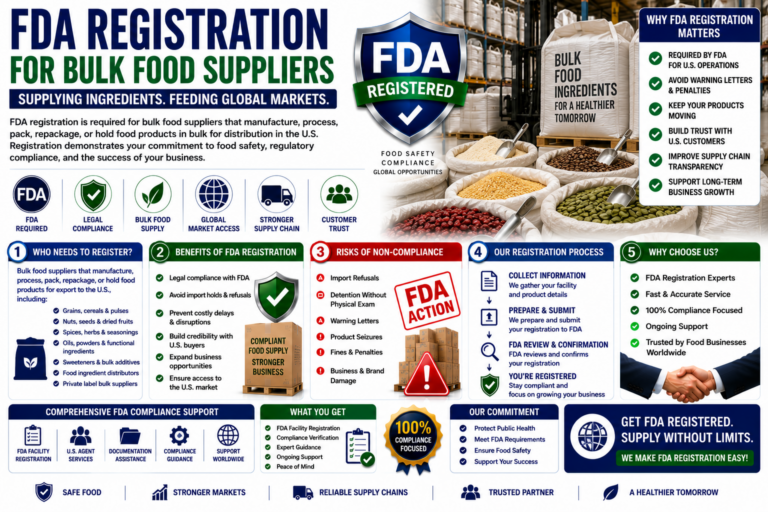
The most common mistake bulk suppliers make is assuming that only manufacturers register. FDA registration applies to any facility that does any of four things: manufacture, process, pack, or hold food. That last one — hold — is what catches distributors and warehouses.
So the first step is simply recognizing that your operation is a registrable facility. From there, the supply-chain rules are where the real work lives.
The FSMA 204 Food Traceability Rule
Because bulk suppliers sit in the middle of the supply chain, the Food Traceability Rule (FSMA Section 204) is the requirement most likely to reshape how you operate. It applies to anyone who manufactures, processes, packs, or holds foods on the Food Traceability List (FTL), and requires you to:
- Assign traceability lot codes (TLCs) — a unique code that follows each lot of an FTL food
- Capture Key Data Elements (KDEs) — at each Critical Tracking Event (CTE), like shipping, receiving, or transformation
- Produce records to FDA within 24 hours — of a request, in the required format
The compliance date — what actually happened
- Nov 2022FDA publishes the final Food Traceability Rule.
- Jan 20, 2026Original compliance date (superseded).
- 2025FDA proposes a 30-month extension; Congress makes it binding in November 2025, directing FDA not to enforce before the new date.
- July 20, 2028Current compliance and enforcement date.
FSVP & the Rest of the Baseline
Bulk suppliers who import carry the importer's obligations on top of everything else:
- FSVP — verify each foreign supplier meets U.S. standards; across a large supplier base, often the single biggest workload
- Prior notice — before each shipment arrives
- Bulk labeling — product shipped for further processing may use the 21 CFR 101.100 exemption, but still needs identity and handling info
- Preventive controls / process filing — if you manufacture; low-acid canned and acidified products need FCE + a scheduled process
Get Your Bulk Supply Operation Compliant
FDA Registration Assistance handles facility registration — including holding facilities — and U.S. Agent, FSVP for imported products, guidance on FSMA 204 traceability readiness for Food Traceability List commodities, bulk labeling, and process filing where you manufacture low-acid or acidified products.
Contact us at info@fdaregistrationassistance.com or call +1 (928) 275-8333. Food Facility Registration is available starting at $858. Trusted by companies across 135+ countries, with 15+ years of experience.
Frequently Asked Questions
1. Do bulk food suppliers need FDA registration?
Yes — and importantly, even if you only store or distribute food rather than manufacture it. FDA registration applies to any facility that manufactures, processes, packs, or holds food. A warehouse or distribution center that holds food is a "holding facility" and must register, and foreign facilities need a U.S. Agent. Many bulk suppliers assume that only manufacturers register; that's a common and risky misconception.
2. I only warehouse and distribute — do I really have to register?
Yes. "Holding" food is one of the four activities that trigger facility registration, alongside manufacturing, processing, and packing. So a purely storage-and-distribution operation still registers as a holding facility. The main exceptions are farms, retail food establishments, and restaurants — a bulk distributor is none of those, so registration applies.
3. What is the FSMA 204 Food Traceability Rule?
It's the FDA's Food Traceability Rule (FSMA Section 204), which requires enhanced recordkeeping for anyone who manufactures, processes, packs, or holds foods on the Food Traceability List (FTL). Covered entities have to assign traceability lot codes, capture Key Data Elements at Critical Tracking Events, and be able to provide those records to FDA within 24 hours of a request. It's designed to make outbreak investigations and recalls dramatically faster.
4. When does the Food Traceability Rule take effect?
The original compliance date was January 20, 2026, but it has been extended by 30 months to July 20, 2028. FDA proposed the extension in 2025, and Congress made it binding in November 2025 by directing FDA not to enforce the rule before that date. Importantly, only the date moved — the rule's requirements, the Food Traceability List, and the recordkeeping obligations are all unchanged.
5. Does the extension mean I can ignore traceability for now?
No. The requirements haven't changed — only the enforcement date. Building traceability records across a supply chain is a big, multi-party project, so the extra time is meant for preparation, not delay. On top of that, major buyers (large retailers, for example) are already requiring traceability data from suppliers ahead of the federal date, so waiting can cost you business well before 2028.
6. Which foods are on the Food Traceability List?
The FTL covers specific higher-risk foods, including fresh soft and semi-soft cheeses, shell eggs, many fresh fruits and vegetables (such as leafy greens and fresh-cut produce), seafood (finfish, crustaceans, and molluscan shellfish), nut butters, and ready-to-eat deli salads, among others. If you supply bulk quantities of these, or foods containing them as ingredients, the traceability rule likely reaches you. FDA maintains the current list.
7. Is any bulk supplier exempt from the traceability rule?
There are exemptions. The most commonly used is for businesses (other than farms) whose average annual food sales over the prior three years are below $250,000 — they're exempt from most of the rule's recordkeeping requirements. Other partial exemptions exist too. But if you're a sizable bulk supplier handling FTL foods, you should assume the rule applies and confirm any exemption carefully.
8. What are traceability lot codes and Critical Tracking Events?
A traceability lot code (TLC) is a unique identifier assigned to a lot of an FTL food, which follows it through the supply chain. Critical Tracking Events (CTEs) are points where the food is handled — like shipping, receiving, or transformation — and at each one you record Key Data Elements (KDEs), the specific data FDA wants captured. Together they let regulators trace a food back and forward quickly during an outbreak.
9. Do bulk food suppliers need FSVP?
If you import, yes. The U.S. importer holds FSVP and must verify each foreign supplier produces food meeting U.S. standards, with records available to FDA, plus prior notice before each shipment. For a bulk supplier importing large volumes from multiple sources, FSVP across the supplier base is often the biggest single compliance workload.
10. How does bulk labeling work for suppliers?
If you ship bulk product to be further processed, labeled, or repacked at another establishment, a labeling exemption under 21 CFR 101.100 may apply, so the bulk container may not need a full retail label — though it still needs identity and handling information, and registration and traceability still apply. Retail-ready product needs the full label. There's a dedicated guide on bulk food ingredients for the labeling details.
11. Do bulk suppliers need process filing or preventive controls?
It depends on what you do. If you manufacture or process, you likely need a food safety plan with preventive controls (or, for low-acid canned and acidified foods, FCE registration and a scheduled process). A pure holding facility generally doesn't file processes but still has to meet applicable good manufacturing and (where relevant) storage-related preventive-control requirements. The activities you perform determine which apply.
12. Does registration mean FDA approved my operation?
No. FDA doesn't pre-approve facilities or food — registration just puts your facility on record. It doesn't certify your traceability program, your FSVP, or your products; those remain your responsibility. Registration is one required step among several, and FDA can inspect and act on a noncompliant operation regardless of registration status.
13. What are the biggest compliance gaps for bulk suppliers?
Assuming a storage/distribution operation doesn't need to register (it does); treating the traceability extension as a reason to do nothing; incomplete FSVP across a large supplier base; missing traceability lot codes and records on FTL foods; and unclear labeling on bulk shipments. Most are avoidable by mapping which rules apply to your specific activities and products early.
14. How does FDA Registration Assistance help bulk food suppliers?
We handle facility registration — including holding facilities — and U.S. Agent, FSVP for imported products, guidance on FSMA 204 traceability readiness for FTL foods, bulk labeling, and process filing where you manufacture low-acid or acidified products. Starting at $858 for registration, for companies across 135+ countries. Contact info@fdaregistrationassistance.com or +1 (928) 275-8333.