
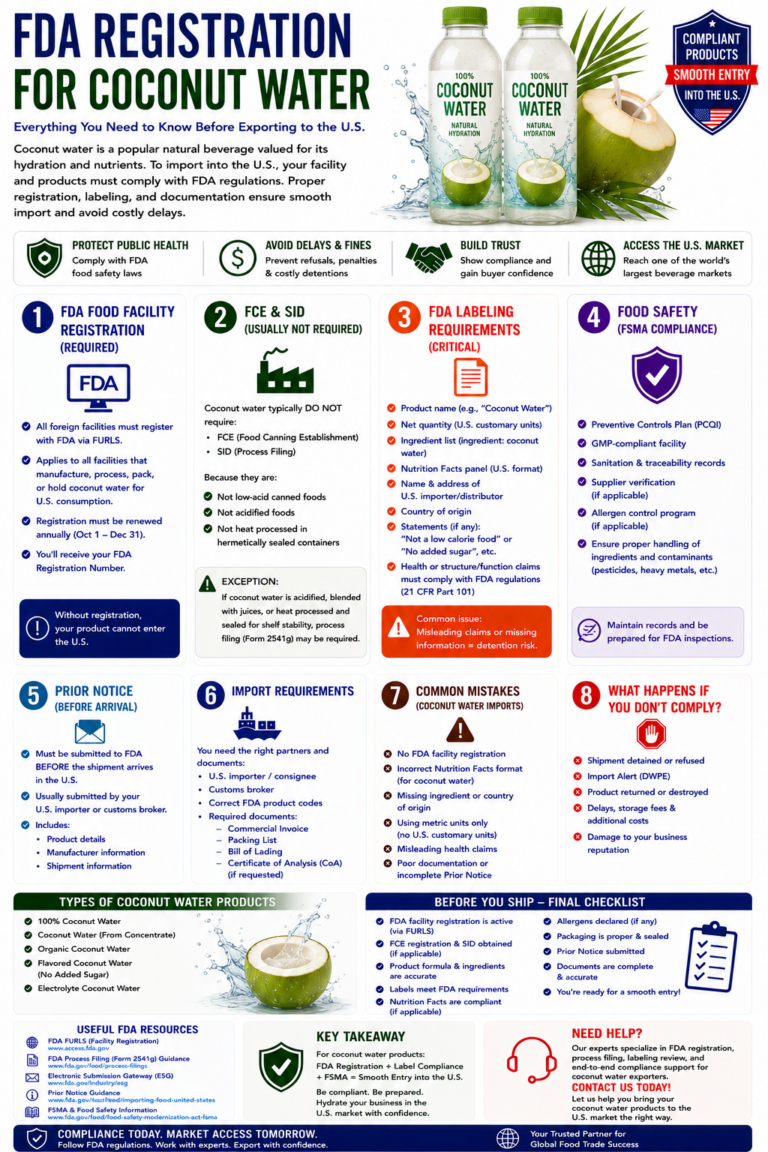
FDA Registration for Coconut Water
Why shelf-stable coconut water needs process filing, how aseptic fits in, and the 2025 coconut allergen change.
Key Takeaways
- Coconut water is a low-acid food — its natural pH is above 4.6.
- Shelf-stable = low-acid canned food — needs FCE + a scheduled process (SID).
- Aseptic isn't an exemption — aseptic coconut water is still LACF, with its own SID.
- Refrigerated/fresh is different — not shelf-stable, so no LACF filing.
- Coconut is no longer a major allergen — FDA's January 2025 guidance removed it.
- Coconut still goes in the ingredient list — just without "Contains: tree nuts."
Coconut Water Is a Low-Acid Canned Food
This is the point the "coconut water is easy to import" assumption misses. A low-acid canned food is one with a finished equilibrium pH above 4.6 and high water activity. Coconut water's natural pH is above 4.6 — so it's a low-acid food, not an acidified one. And when it's made shelf-stable in a hermetically sealed container, it becomes a low-acid canned food (21 CFR 108 & 113):
- FCE registration — the facility files as a Food Canning Establishment
- A scheduled process (SID) — filed for the product, container, and processing method, validated by a process authority
- The reason it matters — a low-acid, shelf-stable liquid must be commercially sterilized to prevent Clostridium botulinum; the scheduled process documents that safety
Shelf-Stable vs Refrigerated
Whether your coconut water needs process filing comes down to how it's made shelf-stable — or whether it's shelf-stable at all:
| Coconut water type | Classification | Process filing |
|---|---|---|
| Shelf-stable, thermally processed (retort / hot-fill) | Low-acid canned food | FCE + SID |
| Shelf-stable, aseptic (carton / Tetra Pak) | Low-acid canned food (aseptic) | FCE + aseptic SID |
| Refrigerated / fresh / high-pressure (HPP) | Low-acid, but not shelf-stable canned | No FCE/SID — different controls |
Coconut Is No Longer a Major Allergen (2025)
Here's an update many labels and older guides haven't caught up with. Coconut was long treated as a tree nut, which meant coconut products needed a "Contains: tree nuts (coconut)" allergen statement. That changed:
Claims, Nutrition Facts & Imports
- "100% coconut water" / "not from concentrate" — fine if genuinely accurate; "100%" has to mean 100%
- Hydration & electrolyte claims — must be truthful and can't imply the drink treats or prevents disease
- Added sugars, flavors, preservatives — declared in the ingredient list and reflected in the Nutrition Facts
- Nutrition Facts — accurate calories, total and added sugars, and electrolytes (potassium, sodium)
- FSVP for imports — the importer verifies the supplier; for shelf-stable coconut water, the FCE and scheduled process are core evidence
Get Your Coconut Water U.S.-Ready
FDA Registration Assistance starts by classifying your product — shelf-stable low-acid canned food (retort/hot-fill or aseptic) or refrigerated — then handles registration and U.S. Agent, FCE and scheduled process (SID) filing with process-authority coordination, current labeling (including the 2025 coconut allergen change) and claim review, and FSVP for imports.
Contact us at info@fdaregistrationassistance.com or call +1 (928) 275-8333. Food Facility Registration is available starting at $858. Trusted by companies across 135+ countries, with 15+ years of experience.
Frequently Asked Questions
1. Do coconut water products need FDA registration?
Yes. Coconut water is a conventional beverage, so any facility that manufactures, processes, packs, or holds it for the U.S. market must be registered with FDA, and foreign facilities need a U.S. Agent. But for coconut water, registration is just the start — the bigger driver is classification, because shelf-stable coconut water is usually a low-acid canned food with additional process-filing requirements.
2. Is coconut water a low-acid canned food?
Usually, if it's shelf-stable. A low-acid canned food is one with a finished pH above 4.6 (and high water activity), and coconut water's natural pH sits above 4.6 — so it's a low-acid food. When it's packaged to be shelf-stable in a sealed container, it becomes a low-acid canned food (LACF), which requires FCE registration and a scheduled process (SID). This is the key point the "coconut water is easy" assumption misses.
3. Does shelf-stable coconut water need FCE and SID filing?
Yes. Shelf-stable coconut water is a low-acid canned food, so the facility needs a Food Canning Establishment (FCE) registration and a scheduled process (SID) filed for the product, container, and processing method. Whether it's retort/hot-fill or aseptic changes which SID form applies, but either way, shelf-stable coconut water needs process filing. It's not optional for a shelf-stable low-acid product.
4. What about aseptically packaged coconut water?
Aseptic packaging (the familiar carton/Tetra Pak format) is extremely common for coconut water. Aseptically processed and packaged coconut water is still a low-acid canned food — it's just made shelf-stable by commercially sterilizing the product and filling it into pre-sterilized packaging. It requires FCE registration and a scheduled process for the aseptic process (the aseptic SID). Aseptic isn't a way around process filing; it's a different route to it.
5. Does refrigerated or fresh coconut water need process filing?
Generally no. Coconut water that relies on refrigeration (or is fresh, or preserved by high-pressure processing) rather than shelf-stable canning doesn't fall under the LACF process-filing rules — it follows a different path with its own controls. The FCE/SID requirement applies to shelf-stable, hermetically sealed low-acid products stored at room temperature. So whether your coconut water is shelf-stable or refrigerated changes the requirement significantly.
6. Is coconut a major food allergen that has to be declared?
Not anymore, as of 2025. Coconut was previously treated as a tree nut and required a "Contains: tree nuts (coconut)" allergen statement. But FDA's revised (5th edition) food allergen guidance, issued in January 2025, removed coconut from the list of major food allergens — so the "Contains: tree nuts" declaration for coconut is no longer required. This is a recent change many older labels and guides haven't caught up with.
7. Do I still have to list coconut on the label?
Yes. Even though coconut is no longer a major allergen, it must still be listed by its common name in the ingredient statement (21 CFR 101.4), like any ingredient. What changed is only the major-allergen treatment: you no longer need the "Contains: tree nuts (coconut)" statement. For plain coconut water, "coconut water" appears in the ingredient list as normal — just without the tree-nut allergen callout.
8. Is there a deadline to update coconut labels?
No firm compliance date is attached to the coconut allergen change. FDA considers it acceptable to update labeling at the next label printing, and stickers can be used to update existing stock. Because the change removes a requirement rather than adding one, there's no penalty for a label that still carries the old "Contains: tree nuts (coconut)" statement — but new labels can drop it. It's a change you can phase in.
9. What claims can I make on coconut water?
Descriptive claims like "100% coconut water," "not from concentrate," or "no added sugar" are fine if accurate and if any nutrient content claim meets its FDA definition. Coconut water is marketed heavily on hydration and electrolytes, so those claims must be truthful and not imply unapproved health benefits — a beverage can't claim to treat or prevent disease. Any added sugars, flavors, or preservatives must be declared, and "100%" has to genuinely mean 100%.
10. What does the Nutrition Facts panel need for coconut water?
The panel must follow FDA's beverage format and accurately reflect calories, total and added sugars, and the electrolytes (like potassium and sodium) the product is often marketed on. If you make a claim about a nutrient, the panel has to support it. Flavored or blended coconut beverages show the nutrients from their added ingredients too. Accurate sugar and electrolyte values are especially important given how coconut water is positioned.
11. Do imported coconut water products need FSVP?
Yes. Most coconut water is imported, so the U.S. importer holds FSVP and must verify the foreign supplier meets U.S. standards, with prior notice before each shipment. For shelf-stable coconut water, the supplier's FCE registration and scheduled process are core evidence for that verification — so FSVP and LACF process filing connect directly for imported coconut water.
12. What are the most common compliance mistakes for coconut water?
The biggest is treating shelf-stable coconut water as a simple beverage and skipping FCE/SID, when it's actually a low-acid canned food that needs process filing. Others include misjudging shelf-stable vs refrigerated, overstated hydration or health claims, inaccurate "100%" or sugar claims, and outdated labels (either missing required elements or, now, still carrying the old coconut tree-nut statement). Classification first prevents most of these.
13. Does registration or filing mean FDA approved my coconut water?
No. FDA doesn't pre-approve food — registration and the FCE/SID filings are compliance steps, not an approval. The filings put your facility and validated process on record; they don't certify the product. Your coconut water still has to meet all applicable requirements, including labeling and, for imports, FSVP, at the port and on the market.
14. How does FDA Registration Assistance help with coconut water?
We start by classifying the product — confirming whether your coconut water is a shelf-stable low-acid canned food (and if so, retort/hot-fill or aseptic) or a refrigerated product — then handle facility registration and U.S. Agent, FCE and scheduled process (SID) filing with process-authority coordination, current labeling (including the 2025 coconut allergen change) and claim review, and FSVP for imports. Starting at $858 for registration, for companies across 135+ countries. Contact info@fdaregistrationassistance.com or +1 (928) 275-8333.
