
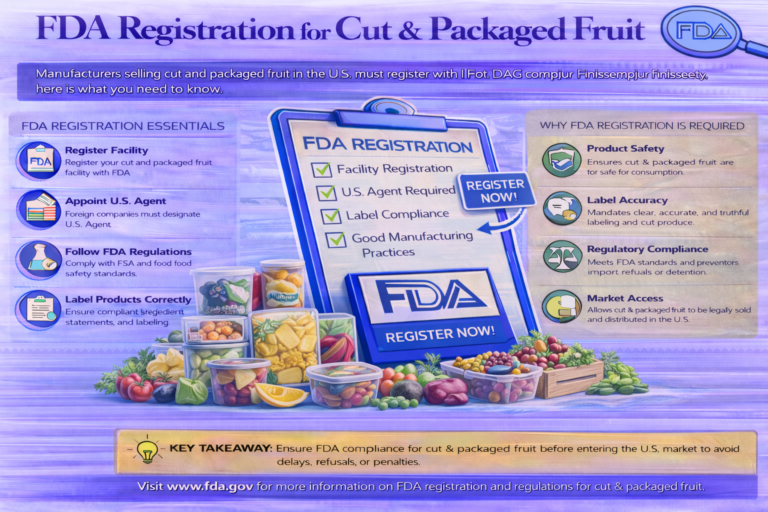
FDA Registration for Cut & Packaged Fruit
Why cutting is the hazard, why low-acid melons are high-risk, and the cold-chain and traceability rules that follow.
Key Takeaways
- Fresh-cut RTE produce — same framework as salads: Produce Safety Rule, preventive controls, FSMA 204.
- Cutting is the hazard step — a blade drags rind contamination into the flesh.
- Low-acid melons are high-risk — cantaloupe caused one of the deadliest U.S. outbreaks.
- Acidic fruits are lower-risk — citrus and pineapple limit growth (not to zero).
- Cut melon is a TCS food — hold at 41°F or below; Listeria grows even refrigerated.
- Shelf-stable fruit cups are different — those are canned/acidified foods.
Cutting Is the Hazard Step
A whole fruit is remarkably safe — its peel or rind is a barrier. The danger begins at the knife. When a blade passes through a rind carrying soil bacteria or pathogens, it drags that contamination straight into the edible flesh, and the moist, sugary interior is an ideal place for anything transferred to grow. That single mechanic is why a whole melon is low-risk while pre-cut melon is one of the most-recalled fresh foods there is.
Acidity Decides the Risk
Not all cut fruit is equally risky — the fruit's acidity is the key variable:
| Fresh-cut fruit | Acidity | Risk |
|---|---|---|
| Melons — cantaloupe, watermelon, honeydew | Low-acid | HIGH — pathogens grow; ground-grown; cut melon is a TCS food |
| Apple, pear | Mildly acidic | Moderate — anti-browning dips; pathogens can persist |
| Citrus, pineapple | Acidic | Lower — acidity limits growth (not to zero) |
| Berries, grapes | Acidic | Lower — but surface contamination still possible |
Cut Melon Is a TCS Food
- Hold at 41°F (5°C) or below — under the Food Code, cut melon (like cut leafy greens and cut tomatoes) is a Time/Temperature Control for Safety food
- Listeria grows even refrigerated — so cold slows it but sanitation and monitoring still matter
- Date marking + unbroken cold chain — from the moment of cutting through storage, transport, and display
- Melon rind sanitizing before cutting — a key preventive control specific to melons
Fresh-Cut vs Shelf-Stable Fruit Cups
- Refrigerated fresh-cut fruit (even in a little juice) — follows the produce/RTE rules on this page
- Shelf-stable fruit cups in syrup or juice, processed for room-temperature storage — are canned/thermally processed foods (low-acid or acidified) with Food Canning Establishment and scheduled-process rules
- Anti-browning dips on cut apples/pears (ascorbic acid, calcium) — additives/processing aids to use within permitted limits and declare
- Pressed into juice — pulls in Juice HACCP
Get Your Cut & Packaged Fruit Compliant
FDA Registration Assistance handles registration and U.S. Agent, reviews your label (identity, added ingredients, keep-refrigerated), and helps align what makes cut fruit distinct: preventive controls with Listeria monitoring and melon rind sanitizing, cold-chain/TCS control, and FSMA 204 traceability — plus FSVP for imports. If your product is actually a shelf-stable fruit cup, we point you to the canned-foods pathway.
Contact us at info@fdaregistrationassistance.com or call +1 (928) 275-8333. Food Facility Registration is available starting at $858. Trusted by companies across 135+ countries, with 15+ years of experience.
Frequently Asked Questions
1. Do cut and packaged fruits require FDA registration?
Yes — a facility that cuts, processes, packs, or holds fresh-cut fruit for the U.S. registers with FDA (foreign facilities also need a U.S. Agent). Cutting and packaging is a facility activity, not just farming. The exception is fruit cut in-store for direct sale to consumers, which is generally a retail food establishment and exempt from FDA registration, though still state/local-regulated.
2. Why is cut fruit riskier than whole fruit?
Because cutting is the hazard step. Whole fruit is protected by its peel or rind; but when a blade passes through a contaminated rind, it drags that contamination straight into the edible flesh — and the moist, sugary interior is an ideal place for pathogens to grow. That's why a whole melon is low-risk while pre-cut melon is high-risk, and why washing cut fruit doesn't fix the problem: any pathogen already embedded and multiplying in the flesh won't rinse away.
3. Why are melons the highest-risk cut fruit?
Two reasons: melons grow on the ground (picking up soil bacteria on a rough, netted rind), and their flesh is low-acid, which lets pathogens grow rather than being held in check. Salmonella grows rapidly on cut cantaloupe, watermelon, and honeydew, and Listeria grows on cut melon even under refrigeration. Cantaloupe caused one of the deadliest U.S. foodborne outbreaks — roughly 147 illnesses across 28 states and 33 deaths in 2011, from a single farm — and a 2018 Australian cantaloupe outbreak killed seven. Cut melon deserves the most rigorous controls of any fruit.
4. Does the fruit's acidity matter?
Yes — it's the key variable. Low-acid fruits (melons) support pathogen growth and are high-risk. Acidic fruits (citrus, pineapple) are lower-risk because their acidity limits growth. But "lower-risk" isn't "no-risk": pathogens can survive in acidic environments — they persist in apple and orange juice despite the natural acidity — so acidic cut fruit still needs proper handling and cold chain. Acidity changes the degree of risk, not whether you need controls.
5. Is cut melon a TCS food?
Yes. Under the FDA Food Code, cut melon (along with cut leafy greens and cut tomatoes) is a Time/Temperature Control for Safety food, meaning it must be held at 41°F (5°C) or below. Because Listeria grows even at refrigeration temperatures, an unbroken cold chain plus date marking is essential from the moment the fruit is cut through storage, transport, and display.
6. What food-safety plan does a fresh-cut fruit facility need?
A preventive-controls food-safety plan under 21 CFR 117, centered on the RTE nature of the product. Key elements: sanitation and Listeria environmental monitoring (especially on cutting equipment and contact surfaces), control of the incoming whole fruit (including rind washing/sanitizing before cutting for melons), cold-chain control, and date marking. The hazard analysis should reflect that cutting can transfer rind contamination to flesh.
7. Is cut fruit covered by FSMA 204 traceability?
Yes. Fresh-cut fruits are on FDA's Food Traceability List, so fresh-cut fruit businesses must keep enhanced, lot-level records (Key Data Elements at Critical Tracking Events) and be able to produce them to FDA within 24 hours of a request, retaining them for two years. The compliance date was extended from January 2026 to July 20, 2028, but the records should be built now — fruit recalls are exactly what the rule targets.
8. How is this different from a packaged salad?
The framework is the same — both are fresh-cut RTE produce under the Produce Safety Rule, preventive controls, and FSMA 204 traceability. The hazards differ: salads center on leafy greens and E. coli O157:H7, while cut fruit centers on melons, acidity, and the rind-to-flesh transfer during cutting. We cover the salad and broader ready-meal side in a companion guide.
9. What about fruit cups in syrup or juice?
That depends on whether they're refrigerated fresh-cut or shelf-stable. Refrigerated fresh-cut fruit (even in a little juice) follows the produce/RTE rules on this page. Shelf-stable fruit cups packed in syrup or juice and processed to be stored at room temperature are canned/thermally processed foods — low-acid or acidified — which pull in the Food Canning Establishment and scheduled-process rules instead. Which one you have determines the whole regime.
10. Are browning-control dips on cut apples an issue?
They need to be handled correctly. Anti-browning treatments (ascorbic acid, calcium ascorbate, and similar) used on cut apples and pears are additives/processing aids that must be used within their permitted uses and declared as appropriate. They're a normal part of fresh-cut apple production, but they're a labeling and additive-compliance point, not a food-safety kill step.
11. What labeling does cut fruit need?
A compliant Nutrition Facts panel, ingredient list (including any anti-browning agents or added ingredients), accurate identity, and — in practice — clear keep-refrigerated and use-by information given the perishability. Plain single-fruit packs are usually allergen-light, but mixed products or those with added ingredients (yogurt dips, granola) can introduce allergens that must be declared.
12. Does importing cut fruit require anything extra?
Yes. The foreign facility registers with FDA and keeps a U.S. Agent, and the U.S. importer runs FSVP with prior notice per shipment. Imported fresh-cut fruit is also an FSMA 204 traceability food, so records must extend across the border, and the cold chain has to hold through international transit — a frequent failure point for a highly perishable, temperature-sensitive product like cut melon.
13. Does FDA approve cut fruit?
No. FDA doesn't pre-approve food. You register your facility, run the preventive-controls plan (with Listeria control and, for melons, rind sanitizing), maintain the cold chain, keep traceability records, and label correctly; FDA enforces at the facility and, for imports, at the border. Given the outbreak history of cut melon, these products are among the most closely watched fresh-cut foods.
14. How does FDA Registration Assistance help with cut and packaged fruit?
We handle registration and U.S. Agent, review your label (identity, any added ingredients, keep-refrigerated), and help align what makes cut fruit distinct: preventive controls with Listeria monitoring and melon rind sanitizing, cold-chain/TCS control, and FSMA 204 traceability — plus FSVP for imports. If your product is actually a shelf-stable fruit cup, we point you to the canned-foods pathway. Registration is available starting at $858, for companies across 135+ countries. Contact info@fdaregistrationassistance.com or +1 (928) 275-8333.
