FDA Registration for Juice Products
Most beverages just register and label. Juice adds a validated food-safety system on top — which is exactly where shipments get held.
Key Takeaways
- Juice HACCP is mandatory — 21 CFR Part 120, unlike most beverages.
- 5-log pathogen reduction is the core requirement (120.24).
- Untreated juice needs a warning label (101.17(g)).
- Percent juice must be declared (101.30); "100% juice" must be accurate.
- Retail-direct juice is exempt from HACCP — but still needs the warning if untreated.
- Juice importers follow 120.14, not standard FSVP; registration ≠ approval.
The 5-Log Pathogen Reduction
Pasteurization and UV treatment are the usual ways to hit the 5-log standard, but the specific time/temperature (or UV dose) has to be validated for your product and process — it isn't a fixed recipe. There are limited exemptions:
Exempt from the 5-log
- Shelf-stable juice made stable by a single thermal step
- Juice under the LACF/acidified rules (Parts 113/114)
Still required
- A HACCP plan and hazard analysis
- CGMP — HACCP sits on top of CGMP, not instead of it
The Untreated-Juice Warning
Not every juice is 5-log treated — fresh-pressed and unpasteurized juices exist. FDA's answer is a mandatory warning:
Percent Juice, and the Import Path
| Requirement | What it means | Cite |
|---|---|---|
| Percent juice | Declare % juice; "100% juice" must be accurate | 21 CFR 101.30 |
| Nutrition Facts & claims | Panel, ingredients; "fresh/natural" must meet definitions | 21 CFR Part 101 |
| Warning (if untreated) | Required on non-5-log juice | 101.17(g) |
| Import path | Juice HACCP importer rules — not standard FSVP | 21 CFR 120.14 |
| Prior notice | Before each shipment arrives | Per shipment |
Bringing a Juice to Market
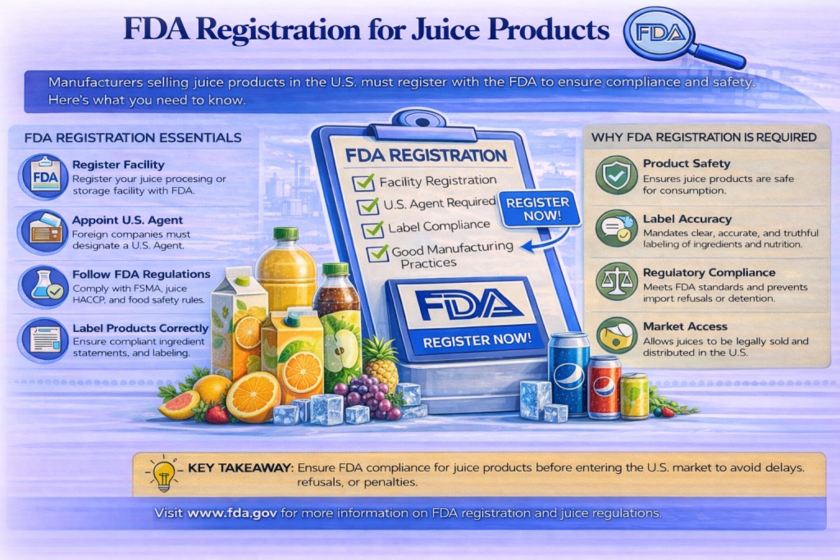
Register the facility
The processor/packer/holder registers; foreign facilities add a U.S. Agent.
Build a Juice HACCP plan
Hazard analysis and critical control points under 21 CFR Part 120.
Achieve the 5-log reduction
A validated control (pasteurization/UV) meeting 120.24 — unless exempt.
Handle warnings & claims
Warning statement if untreated; declare percent juice; substantiate claims.
Handle imports
Follow the Part 120 importer rules (120.14) and file prior notice.
Keep records & renew
Maintain HACCP records, renew every two years, revalidate on change.
Get Your Juice to Market — HACCP and All
FDA Registration Assistance registers juice facilities, serves as U.S. Agent, reviews HACCP documentation and labels (the 5-log control, warning statement, and percent juice), and supports the Part 120 importer requirements and prior notice — so nothing surfaces at the port.
Contact us at info@fdaregistrationassistance.com or call +1 (928) 275-8333. Trusted by companies across 135+ countries, with 15+ years of experience.
Frequently Asked Questions
1. Do juice products need FDA registration?
The facility that processes, packs, or holds juice registers with FDA, and foreign facilities need a U.S. Agent. Juice is a conventional beverage, but with an extra layer — mandatory HACCP. Registration isn't product approval.
2. What is Juice HACCP?
FDA's mandatory food-safety rule for juice, at 21 CFR Part 120. Processors analyze hazards and control them through a written HACCP plan. It covers juice sold as such and juice used as a beverage ingredient — 100% juice, concentrates, and drinks under 100% juice.
3. What is the 5-log pathogen reduction?
Under 21 CFR 120.24, the HACCP plan must include a control that consistently achieves at least a 5-log (100,000-fold) reduction of the "pertinent microorganism." Pasteurization and UV are common methods, and the process must be validated.
4. Does every juice need the 5-log treatment?
Most do, with exemptions: shelf-stable juice made stable by a single thermal step, and juice under the LACF/acidified rules (Parts 113/114). Retail operations selling directly to consumers are exempt from HACCP — but untreated retail juice still needs the warning label.
5. What is the warning statement on untreated juice?
Under 21 CFR 101.17(g), packaged juice not processed to the 5-log reduction (e.g., unpasteurized or fresh) must carry an FDA warning that it may contain harmful bacteria, especially for vulnerable groups. It's the notice on fresh-pressed juices.
6. How does percent-juice labeling work?
Beverages that contain or purport to contain juice must declare percent juice under 21 CFR 101.30. "100% juice" must be accurate; "juice drink/beverage" signals less than 100%. "Fresh," "natural," and "no added sugar" must meet FDA definitions.
7. Do juice importers need FSVP?
Not standard FSVP. Juice under HACCP is exempt; instead, importers follow the Part 120 importer provisions at 21 CFR 120.14 — verifying the juice was processed per Part 120. This mirrors how seafood follows Seafood HACCP rather than FSVP.
8. Is a retail juice bar covered?
A retail establishment that makes juice and sells directly to consumers (not to other businesses) is exempt from Juice HACCP — but untreated juice still needs the warning. Selling or distributing to other businesses generally triggers full HACCP.
9. Does Juice HACCP replace CGMP?
No — HACCP sits on top of current good manufacturing practices, not in place of them. Sanitation, hygiene, and pest control still apply and are the foundation HACCP relies on.
10. What records does Juice HACCP require?
Hazard analysis, HACCP plan, monitoring, corrective actions, and verification records, available to FDA. Retention varies — refrigerated juice records generally at least one year, frozen or shelf-stable at least two years.
11. Do I need prior notice to import juice?
Yes — prior notice before each shipment arrives, on top of facility registration and the Part 120 importer requirements. Missing prior notice is a common cause of port holds.
12. Is "FDA registered" the same as "FDA approved"?
No — registration tells FDA a facility exists and what it does; it isn't approval of the juice. "FDA approved" based on registration is inaccurate.
13. What if my juice isn't HACCP-compliant?
Juice that doesn't comply with Part 120 can be treated as adulterated, leading to detention or refusal at import, seizure, or injunction. HACCP documentation is checked closely, so gaps surface fast.
14. How does FDA Registration Assistance help?
It registers juice facilities, serves as U.S. Agent, reviews HACCP documentation and labels (5-log control, warning statement, percent juice), and supports the Part 120 importer requirements and prior notice, for companies across 135+ countries. Contact info@fdaregistrationassistance.com or +1 (928) 275-8333.