
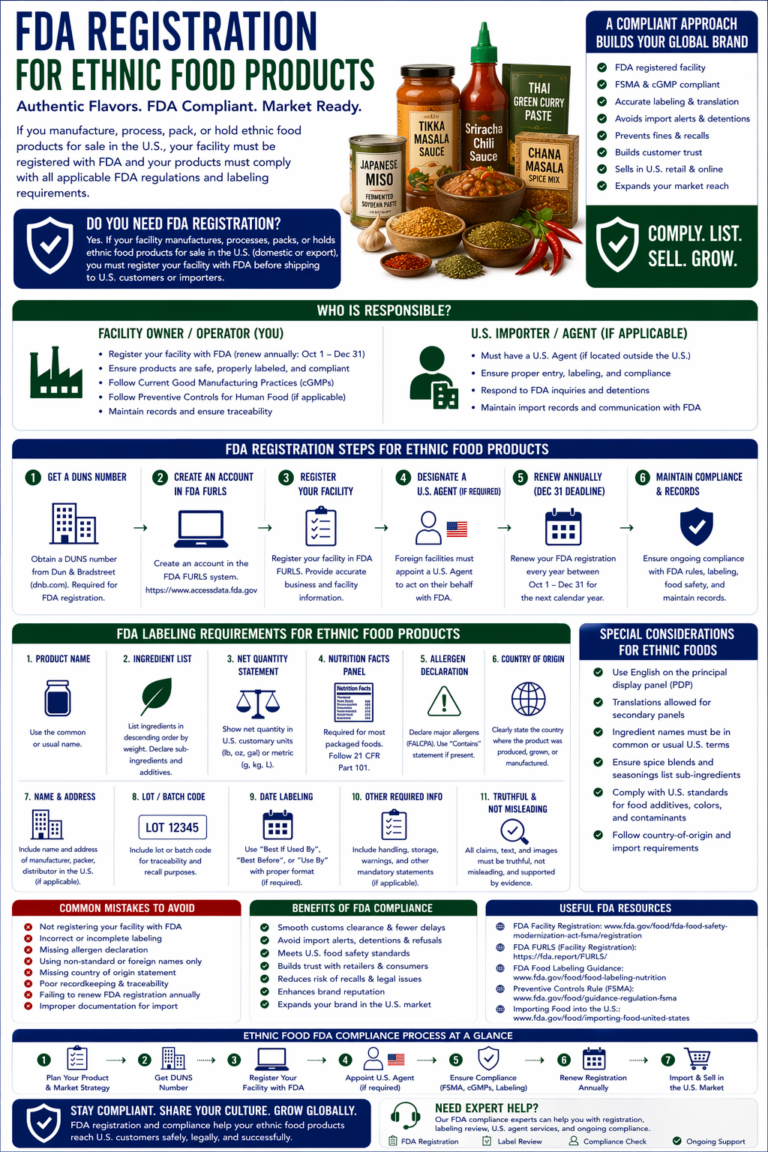
FDA Registration for Ethnic Food Products
The two issues that catch traditional recipes — ingredients and names — and how to clear them.
Key Takeaways
- Same foundation as any food — registration, U.S. Agent, FSVP, label, prior notice.
- Ingredients are the #1 catch — each needs a lawful U.S. basis.
- Traditional use ≠ U.S. lawful — legal at home doesn't mean approved here.
- Names must be translated — into FDA-recognized common names.
- Blends must be broken down — sub-ingredients and hidden allergens declared.
- It may also hit a category — acidified, LACF, or juice; check separately.
The Foundation Is the Same
However traditional the recipe, an ethnic food meets the same FDA foundation as any food entering the U.S. — facility registration (the maker registers, family-owned included), a U.S. Agent for foreign facilities, FSVP held by the U.S. importer, a compliant U.S.-format label, and prior notice before each shipment. Cultural status doesn't lighten any of it.
Are Your Traditional Ingredients Lawful Here?
This is where ethnic products most often run into trouble. In the U.S., every ingredient must have a lawful basis for its use — an approved food additive, GRAS (generally recognized as safe), or an approved color additive. A traditional ingredient used freely for generations elsewhere doesn't automatically meet that bar. The recurring risk areas:
| Ingredient type | What to verify |
|---|---|
| Colors | On the U.S. approved color-additive list; synthetic colors also need batch certification |
| Additives & preservatives | Cleared as a food additive for the specific use, or GRAS for it |
| Botanicals & herbs | A GRAS basis for use in food (some are fine; some aren't established) |
| Sweeteners | Approved for use in the U.S. — not all non-U.S. sweeteners are |
Translating Names — Not Just Language
The second catch is naming. It's not enough to translate a label into English; ingredients have to appear under the names FDA and U.S. consumers recognize:
- Use FDA-recognized common names — a traditional name can stay alongside the recognized one, for authenticity
- Break down compound ingredients — a spice blend, sauce, or paste used as an ingredient must disclose its sub-ingredients
- Surface hidden allergens — an allergen inside a traditional blend still has to be declared (all nine, including sesame)
- Rebuild the label to U.S. format — Nutrition Facts, net quantity, responsible firm, plus Customs origin marking
Common Ethnic-Food Compliance Misses
Get Your Ethnic Product Recipe-Ready
FDA Registration Assistance reviews each ingredient for U.S. lawfulness, maps traditional names to FDA-recognized terms, breaks down compound ingredients and allergens, and rebuilds the label to U.S. format — alongside registration, U.S. Agent, and FSVP. Where the product also falls into a regulated category, we handle that too.
Contact us at info@fdaregistrationassistance.com or call +1 (928) 275-8333. Food Facility Registration is available starting at $858. Trusted by companies across 135+ countries, with 15+ years of experience.
Frequently Asked Questions
1. Do ethnic food products need FDA registration?
Yes. Any facility that manufactures, processes, packs, or holds an ethnic food product for the U.S. must be registered, including small and family-owned producers, and foreign facilities need a U.S. Agent. Traditional or cultural status doesn't change this — the same foundation applies as for any food, plus FSVP for imports and a compliant label.
2. What most often causes problems for ethnic food products?
Two things: ingredients that aren't lawful in the U.S., and ingredient names or labels that haven't been translated into FDA-recognized terms. A traditional recipe can be entirely normal in its home country yet use a color, additive, or botanical that isn't approved here — or list ingredients under names a U.S. consumer and FDA won't recognize. Both are common causes of detention.
3. Are my traditional ingredients lawful in the U.S.?
Not automatically. Every ingredient must have a lawful U.S. basis for its intended use — an approved food additive, generally recognized as safe (GRAS), or an approved color additive. Traditional use in another country doesn't establish U.S. lawfulness. Some traditional colors, additives, preservatives, and botanicals aren't approved here, and a few are prohibited, so each ingredient needs to be checked against U.S. status.
4. What kinds of ingredients tend to be a problem?
The recurring risk areas are colors not on the U.S. approved list (synthetic colors also need batch certification), additives or preservatives that haven't been cleared for the use, botanicals or herbal ingredients without a GRAS basis, and sweeteners that aren't approved in the U.S. None of these is automatically disqualifying, but each needs to be verified rather than assumed lawful because it's traditional.
5. Can I keep traditional ingredient names on the label?
You can keep a traditional or regional name, but it has to be accompanied by the FDA-recognized common or usual name so a U.S. consumer understands the ingredient. It's not either/or — the traditional name can stay for authenticity as long as the recognized name is there too. Listing ingredients only under traditional names is a frequent cause of delays.
6. How are spice blends and compound ingredients handled?
Compound ingredients — spice blends, sauces, pastes used as ingredients — generally have to disclose their sub-ingredients, so a blend can't just be listed as one name. This also matters for allergens: an allergen hidden inside a traditional blend still has to be declared. Fully breaking down compound ingredients is an important step for ethnic recipes.
7. Do allergen rules apply to ethnic foods?
Yes, fully. The nine major allergens — including sesame — must be clearly declared on any food sold in the U.S., and allergens hidden in traditional compound ingredients, sauces, or blends have to be identified. Because many traditional recipes use sesame, tree nuts, soy, or wheat-based ingredients, allergen review deserves particular attention.
8. Do my labels need to be in English?
Yes. Labels must be in English (a second language may also appear), with a compliant Nutrition Facts panel, recognized ingredient names, allergen declarations, and net quantity, plus Customs country-of-origin marking for imports. Most ethnic labels need to be rebuilt to U.S. format rather than simply translated word-for-word.
9. Could my ethnic product fall into a regulated category?
Yes. Many ethnic products are acidified foods (pickles, fermented sauces), low-acid canned foods (jarred staples), or juices — each of which carries extra requirements like process filing or HACCP. This is a separate question from ingredients and labeling, and it's worth checking; there's a dedicated guide on how traditional products fall into U.S. regulated categories.
10. Do ethnic foods need FSVP?
Yes, if imported. The U.S. importer holds FSVP and must verify the foreign supplier produces food meeting U.S. standards, with records available to FDA. Working with a small or family producer doesn't remove the obligation — FSVP applies regardless of the supplier's size, and it's a common gap for smaller ethnic-food supply chains.
11. What are the common compliance issues for ethnic foods?
Ingredients that aren't lawful in the U.S.; incomplete or untranslated ingredient lists; undisclosed sub-ingredients in blends; missing or unclear allergen declarations; labels that don't meet U.S. format; and not realizing the product falls into a regulated category. Most are avoidable by reviewing ingredients and the label before shipping.
12. Does registration mean my ethnic product is FDA approved?
No. FDA doesn't pre-approve foods or facilities — registration just puts the facility on record. It doesn't certify your recipe or confirm your ingredients are lawful; those are separate questions. Your product still has to meet all applicable ingredient, labeling, and category requirements to enter and stay on the U.S. market.
13. How long does it take to get an ethnic product compliant?
There's no single fixed number — registration is quick, but verifying ingredient lawfulness and rebuilding the label take longer and vary by product. If an ingredient turns out to need a GRAS conclusion or isn't approved at all, that becomes the long pole. The practical approach is to review ingredients first, since that's the piece most likely to require a change.
14. How does FDA Registration Assistance help ethnic food brands?
We review each ingredient for U.S. lawfulness, map traditional names to FDA-recognized terms, break down compound ingredients and allergens, and rebuild the label to U.S. format — alongside facility registration, U.S. Agent, and FSVP. Where the product also falls into a regulated category, we handle that too. Starting at $858 for registration, for companies across 135+ countries. Contact info@fdaregistrationassistance.com or +1 (928) 275-8333.