
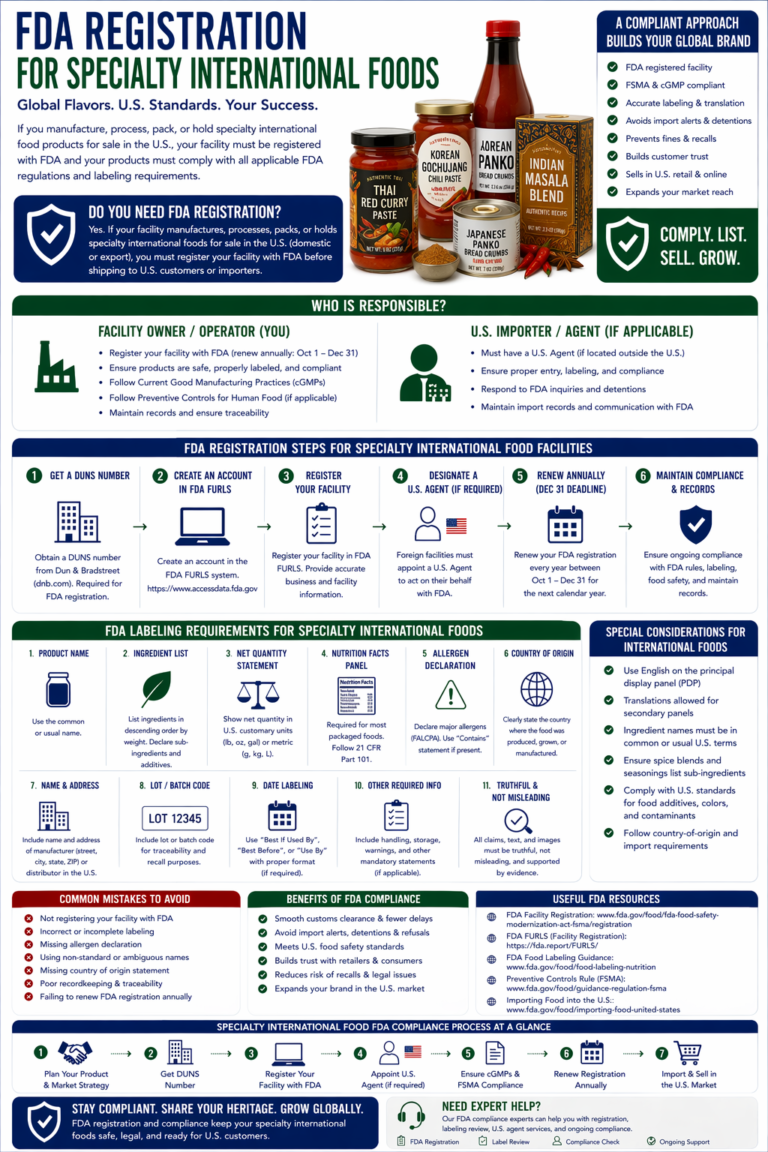
FDA Registration for Specialty & International Foods
The same requirements — plus the hidden categories that catch traditional products.
Key Takeaways
- No "traditional" discount — the same rules apply as for any food.
- Traditional products often hide a category — acidified, LACF, juice, or USDA.
- Classify by what it is — pH, ingredients, and preservation, not the name.
- Some traditional ingredients aren't lawful here — additives and colors vary.
- Labels get rebuilt for the U.S. — English, recognized names, Nutrition Facts.
- Process filing surprises many — pickled and jarred products often need it.
The Same Rules Apply — No Exceptions for Tradition
However unique or small-batch a product is, it meets the same FDA foundation as any food entering the U.S.:
- Facility registration — the maker registers, small or artisanal included
- A U.S. Agent — for the foreign facility
- FSVP — held by the U.S. importer, regardless of the supplier's size
- A compliant label — English, U.S. format, allergens, net quantity
- Prior notice — before each shipment arrives
The Hidden Categories in Traditional Foods
A recipe that's an everyday product at home can land in a regulated U.S. category — often one that needs extra filings the producer never expected:
| Traditional product | Often is… | What it triggers |
|---|---|---|
| Pickles, kimchi, fermented or acidified sauces | Acidified food | FCE + SID (Part 114) |
| Jarred low-acid staples — beans, curries, meats in sauce | Low-acid canned (LACF) | FCE + SID (Part 113) |
| Traditional cured or dried meats, sausages | Meat / poultry | USDA/FSIS, not FDA |
| Fruit juices, nectars, aguas frescas | Juice | Juice HACCP (Part 120) |
| Products with traditional additives or colors | May use non-approved additives | Ingredient lawfulness review |
| Any imported product | Foreign-format label | English + U.S. rebuild + origin marking |
Ingredients & Labels for Traditional Products
Bring Your Specialty Food to the U.S.
FDA Registration Assistance starts by classifying your product to find which U.S. rules it actually triggers, then handles what follows: facility registration and U.S. Agent, ingredient lawfulness review, FSVP, label adaptation to U.S. format, and process filing where the product turns out to be acidified or low-acid canned.
Contact us at info@fdaregistrationassistance.com or call +1 (928) 275-8333. Food Facility Registration is available starting at $858. Trusted by companies across 135+ countries, with 15+ years of experience.
Frequently Asked Questions
1. Do specialty and international foods need FDA registration?
Yes. Any facility that manufactures, processes, packs, or holds a specialty or international food for the U.S. must be registered, including small and artisanal producers, and foreign facilities need a U.S. Agent. Traditional or small-batch status doesn't reduce the requirement — the same foundation applies as for any food: registration, FSVP, labeling, and prior notice.
2. Do traditional foods get lighter FDA requirements?
No. All food sold in the U.S. meets the same FDA requirements, regardless of how traditional or cultural it is. In fact, traditional products often face more scrutiny, not less, because a recipe that's ordinary at home may fall into a regulated U.S. category or use an ingredient that isn't approved here. Authenticity doesn't change the rules.
3. Can my traditional product fall into a regulated category without my realizing it?
Yes — this is the most common surprise. A traditional pickle or fermented sauce is often an acidified food requiring FCE registration and a scheduled process; a jarred low-acid staple can be a low-acid canned food; a traditional cured meat falls under USDA rather than FDA; and a fruit drink can be subject to juice HACCP. The category depends on what the product is, not on its tradition.
4. How do I know which U.S. rules my product triggers?
By classifying the product on its actual characteristics — pH, water activity, ingredients, and how it's preserved — rather than by its name or origin. That determines whether it's acidified, low-acid canned, a juice, a USDA product, or a standard food. Getting the classification right first is essential, because it drives every requirement that follows.
5. Are my traditional ingredients allowed in the U.S.?
Not always. Every ingredient must be lawful for its intended use in the U.S. — an approved food additive, GRAS, or an approved color additive. Some traditional additives, colors, or botanicals used elsewhere aren't approved here, and a few are prohibited. Checking each ingredient's U.S. status is an important early step for a traditional product, since an unlawful ingredient can't be fixed with labeling.
6. Do my labels need to be in English?
Yes. Labels must be in English (a second language can also appear), with ingredients in FDA-recognized common or usual names — not only their traditional names. Most international labels need to be rebuilt to meet U.S. format and content rules, including the Nutrition Facts panel, allergen declarations, and net quantity, plus Customs country-of-origin marking. A traditional name can stay, but a recognized name has to accompany it.
7. How should traditional ingredient names be handled?
A traditional or regional name may be used, but it has to be accompanied by the FDA-recognized common or usual name so a U.S. consumer understands the ingredient. Incorrect or untranslated ingredient names are a frequent cause of delays for specialty products, so mapping each traditional ingredient to its recognized U.S. name matters.
8. Do allergen rules apply to international foods?
Yes. Allergen labeling applies to all foods sold in the U.S., including imported specialty products. The nine major allergens — including sesame — must be clearly declared, and allergens hidden in traditional compound ingredients have to be identified. This is one of the most strictly enforced areas, so it needs careful attention on a traditional recipe.
9. Do specialty foods need FSVP?
Yes. If the product is imported, the U.S. importer must run FSVP — verifying the foreign supplier produces food meeting U.S. standards, with hazard analysis and records. Using a small or traditional producer doesn't remove the obligation; FSVP applies regardless of the supplier's size or reputation, and records must be available for FDA.
10. What if my product needs process filing?
If your traditional product is an acidified or low-acid canned food, the manufacturing facility needs FCE registration and a scheduled process (SID) validated by a process authority, filed by the manufacturer. This is common for traditional preserved, pickled, fermented, or jarred products, and it's a step many specialty producers don't expect — so it's worth confirming early.
11. What are the common compliance issues for specialty foods?
Labels that don't meet U.S. format, incomplete or untranslated ingredient lists, missing or unclear allergen declarations, ingredients that aren't lawful in the U.S., unsubstantiated health claims, and — most importantly — not recognizing that the product falls into a regulated category needing process filing. Most are avoidable by classifying the product and reviewing it before shipping.
12. Does registration mean my specialty product is FDA approved?
No. FDA doesn't pre-approve foods or facilities — registration puts the facility on record. Being registered doesn't certify your traditional product or confirm its ingredients are lawful; those are separate questions. Your product still has to meet all applicable labeling, ingredient, and category requirements to enter and remain on the U.S. market.
13. How long does it take to get a specialty product compliant?
There's no single fixed number — it depends on the product. Registration is relatively quick, but classifying the product, confirming ingredient lawfulness, adapting the label, and (if needed) completing process filing all take time and vary widely. The practical approach is to start with classification and ingredient review, since those determine everything else.
14. How does FDA Registration Assistance help specialty food importers?
We start by classifying your product to find which U.S. rules it actually triggers, then handle the pieces that follow: facility registration and U.S. Agent, ingredient lawfulness review, FSVP, label adaptation to U.S. format, and process filing where the product turns out to be acidified or low-acid canned. Starting at $858 for registration, for companies across 135+ countries. Contact info@fdaregistrationassistance.com or +1 (928) 275-8333.