
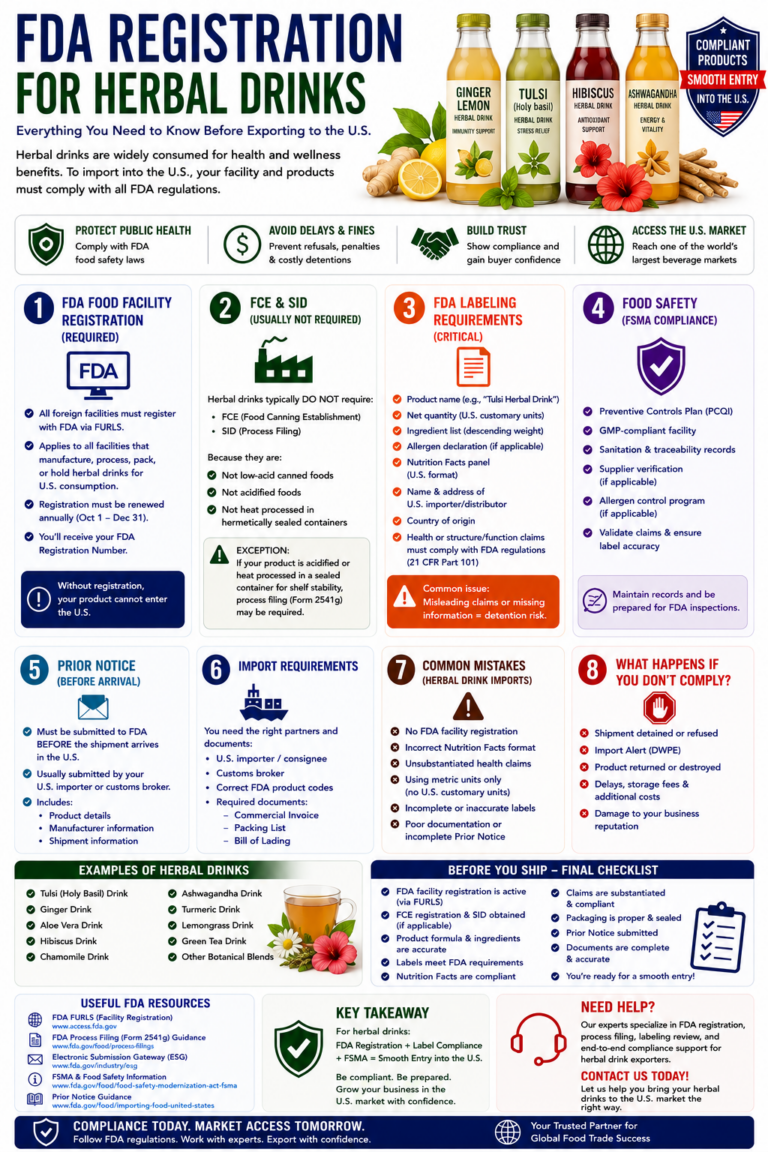
FDA Registration for Herbal Drinks
Supplement-lawful isn't food-lawful — the botanical rule that catches most herbal beverages, plus the claim trap.
Key Takeaways
- A botanical in a beverage must be GRAS or an approved food additive — for food use.
- Supplement-lawful ≠ food-lawful — the DSHEA allowance is supplement-only.
- An unapproved botanical = adulterated — subject to seizure and import refusal.
- You can't relabel a drink as a "supplement" — a beverage is a conventional food.
- Disease/wellness claims risk drug status — "detox," "boosts immunity," etc.
- Low-acid herbal tonics may be LACF — shelf-stable versions can need FCE + SID.
A Botanical in a Beverage Must Be Food-Legal
Here's the point most herbal-drink makers miss. A beverage is a conventional food, and to be lawful in a conventional food, an ingredient must be used per a food-additive regulation, be GRAS for its intended use in food, or qualify for another exception. If a botanical isn't, it's an unapproved food additive — and the drink is adulterated.
Real examples make it concrete:
| Botanical | In a dietary supplement | In a conventional beverage |
|---|---|---|
| Whole-leaf stevia / crude extract | Usable as a dietary ingredient | Not GRAS/approved — unlawful (FDA warning letters; "not allowed in any food, including teas") |
| Purified stevia extract (GRAS) | Usable | Lawful — has accepted GRAS status for food |
| Ginkgo | Dietary ingredient | Must be GRAS/approved; adding it to a drink doesn't make a "ginkgo supplement" |
| Yohimbe bark extract | Dietary ingredient | Unlawful in a soft drink without a food-additive or GRAS basis |
You Can't Relabel the Drink as a "Supplement"
The obvious workaround — call the herbal beverage a "dietary supplement" so the botanical is a "dietary ingredient" — generally doesn't work. FDA treats a product that's represented and consumed as a beverage as a conventional food, no matter the label, and specifically watches for companies selling conventional beverages as supplements to skirt the food-ingredient rules.
Herbal Claims & the Drug Line
Herbal and "wellness" positioning makes claims the other big risk. As a conventional food, an herbal drink can make truthful structure/function claims based on nutritive value — but it cannot claim to treat, cure, or prevent a disease:
Processing, Caffeine & Labeling
- Low-acid tonics can be LACF — many herbal drinks are water + botanicals at pH above 4.6, so a shelf-stable version is a low-acid canned food needing FCE + a scheduled process; citrus/acid may make it acidified instead
- Added caffeine draws scrutiny — natural caffeine (guarana, yerba mate) is part of the botanical, but adding pure/synthetic caffeine is a food-additive question with safety limits
- Name every botanical — the ingredient list must name each herb/extract; vague "herbal blend" labeling isn't enough
- Allergens & the full label — identity, Nutrition Facts, net quantity, responsible firm, and any allergens in blends
- FSVP for imports — verify, first of all, that the botanicals are lawful for food use before the shipment arrives
Get Your Herbal Drinks U.S.-Ready
FDA Registration Assistance starts with the two things that actually sink herbal drinks — confirming each botanical is lawful for use in a conventional food (GRAS or approved food additive) and reviewing claims so they stay out of drug territory — then handles registration and U.S. Agent, classification, FCE/SID for shelf-stable low-acid tonics, labeling, and FSVP for imports.
Contact us at info@fdaregistrationassistance.com or call +1 (928) 275-8333. Food Facility Registration is available starting at $858. Trusted by companies across 135+ countries, with 15+ years of experience.
Frequently Asked Questions
1. Do herbal drinks need FDA registration?
Yes — any facility that manufactures, processes, packs, or holds herbal drinks for the U.S. market registers with FDA, with a U.S. Agent if foreign. But registration is the easy part. The real risk for herbal drinks is whether the botanical ingredients are actually lawful in a conventional food, and whether the marketing claims are compliant — both bigger hurdles than registration itself.
2. Can I put any herb in a beverage?
No — this is the key point. When a botanical goes into a beverage, the beverage is a conventional food, so the botanical must be an approved food additive or GRAS (generally recognized as safe) for that use in food. If it isn't, it's an unapproved food additive and the drink is considered adulterated. Not every herb that's popular in supplements clears this bar for use in a conventional food or beverage.
3. My herb is allowed in supplements — can't I use it in a drink?
Not automatically. DSHEA lets many botanicals be used as "dietary ingredients" in dietary supplements without GRAS or food-additive approval — but that allowance is specific to supplements. It does not extend to conventional foods. So an herb that's perfectly lawful in a supplement capsule can be an unapproved food additive when added to a beverage. Supplement-lawful does not equal food-lawful.
4. Can you give an example of a botanical that's fine in supplements but not in a drink?
Stevia is the classic case. Whole-leaf stevia and crude stevia extract are not GRAS or approved for use in conventional food — FDA has issued warning letters telling companies that stevia leaf "is not allowed for use in any food, including teas," making those teas adulterated. Only certain purified stevia extracts have achieved GRAS status for food use. Ginkgo, yohimbe, and various other botanicals raise the same issue: fine in a supplement, not automatically lawful in a beverage.
5. Can I just label my herbal beverage as a dietary supplement instead?
Generally not. FDA treats a product that's represented and consumed as a beverage as a conventional food, regardless of the label a company would prefer — and it specifically watches for companies selling conventional beverages as "supplements" to skirt the food-additive and GRAS rules. A drink marketed and consumed like a beverage is a conventional food, and its botanicals must meet the food-ingredient standard. Calling it a supplement doesn't change that.
6. What happens if I use a botanical that isn't GRAS or approved for food?
The botanical is treated as an unapproved food additive, and the herbal drink is considered adulterated — which makes it subject to detention, refusal at import, seizure, and warning letters. This is one of the most serious and most common problems in the herbal-beverage space, precisely because companies assume supplement-era comfort with an herb carries over to conventional foods. It doesn't.
7. What claims can an herbal drink make?
As a conventional food, an herbal drink can make truthful structure/function claims based on nutritive value and meet defined nutrient content claims — but it cannot claim to treat, cure, or prevent a disease. "Detox," "boosts immunity," "relieves anxiety," or similar disease/therapeutic claims can make the product an unapproved drug. Herbal and "wellness" positioning makes this a high-risk area, so claims have to be worded carefully and stay out of drug territory.
8. Do herbal drinks need FCE or SID filing?
It depends on the product. A simple herbal tea or infusion often doesn't — but many herbal drinks and tonics are essentially water plus botanicals with a pH above 4.6, which makes a shelf-stable version a low-acid canned food requiring FCE registration and a scheduled process (SID). If acid (like citrus or citric acid) brings the pH to 4.6 or below, it may be an acidified food instead. So "usually no filing" is too simple — the acidity and shelf stability decide it.
9. What about added caffeine in herbal drinks?
Added caffeine gets scrutiny. Caffeine from natural sources (like guarana or yerba mate) is part of the botanical, but adding pure or synthetic caffeine to a conventional beverage is a food-additive question, and FDA has raised safety concerns about highly caffeinated products. If your herbal drink adds caffeine, the amount and source matter, and the total caffeine level should be considered for safety and labeling.
10. What labeling and allergens apply to herbal drinks?
The standard requirements: statement of identity, ingredient list (all botanicals and extracts named), Nutrition Facts, net quantity, and responsible firm. Pure herbal infusions often have few allergens, but blends can include allergenic ingredients, which must be declared. And every botanical has to be named accurately in the ingredient list — vague "herbal blend" labeling without the actual ingredients is a problem.
11. Do imported herbal drinks need FSVP?
Yes. The U.S. importer holds FSVP and must verify the foreign supplier meets U.S. standards, with prior notice before each shipment. For herbal drinks, that verification should specifically confirm the botanicals are lawful for use in conventional food (GRAS or approved) — because an imported herbal beverage with a non-approved botanical will be treated as adulterated at the port. Ingredient lawfulness is the thing to verify first.
12. Does registration mean FDA approved my herbal drink?
No. FDA doesn't pre-approve food — registration just puts the facility on record. It doesn't certify your botanicals, claims, or classification; those remain your responsibility. An herbal drink can be registered and still be adulterated if it contains a botanical that isn't lawful for food use, or misbranded if its claims cross into drug territory. FDA enforces at import and in the marketplace.
13. What are the most common compliance mistakes for herbal drinks?
By far the biggest is using a botanical that's lawful in supplements but not GRAS/approved for conventional food. Others include trying to label a beverage as a supplement to avoid the food-ingredient rules, making disease/therapeutic claims that turn the product into a drug, missing LACF process filing on a shelf-stable low-acid tonic, and vague botanical labeling. Ingredient lawfulness and claims are where herbal drinks most often fail.
14. How does FDA Registration Assistance help with herbal drinks?
We start with the two things that actually sink herbal drinks: confirming each botanical is lawful for use in a conventional food (GRAS or approved food additive) and reviewing claims so they stay out of drug territory. Then we handle facility registration and U.S. Agent, product classification (food vs supplement), FCE/SID filing for shelf-stable low-acid tonics, labeling, and FSVP for imports. Starting at $858 for registration, for companies across 135+ countries. Contact info@fdaregistrationassistance.com or +1 (928) 275-8333.