
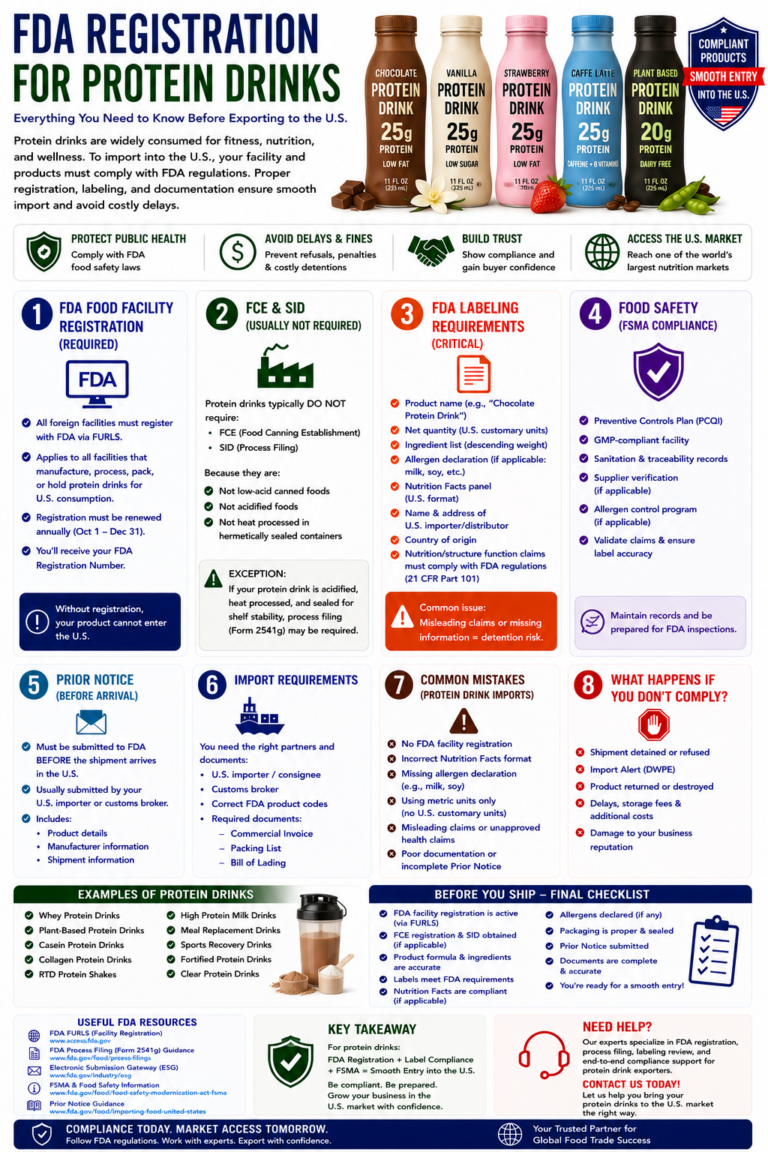
FDA Registration for Protein Drinks
Why a protein beverage is (usually) a conventional food, when it's a low-acid canned food, and how protein claims really work.
Key Takeaways
- A protein drink is usually a conventional food — Nutrition Facts, not Supplement Facts.
- You can't just elect "supplement" — a beverage is a beverage to FDA.
- Shelf-stable low-acid RTD = LACF — FCE + a scheduled process (often aseptic).
- Protein claims use a PDCAAS-corrected %DV — quality, not just grams.
- Plant proteins score lower — so they need more grams for the same claim.
- Nitrogen spiking is fraud — inflated protein numbers are misbranding.
Is a Protein Drink a Food or a Supplement?
Many brands assume they can label a protein drink as a "dietary supplement" for claim flexibility. Usually they can't. FDA's guidance on distinguishing liquid dietary supplements from beverages makes clear that a product represented and consumed as a beverage is a conventional food — using a Nutrition Facts panel — regardless of the label a company would prefer. FDA weighs several factors:
- Representation & claims — is it promoted as a beverage (to refresh, replace a meal, wash down food) or as a supplement source of nutrients?
- Product & brand name — "shake," "drink," "beverage" point toward conventional food
- Packaging & serving size — a bottle/carton consumed like a drink points toward a beverage
- Composition & marketing — how it's formulated and positioned overall
Shelf-Stable Protein Drinks Are Often Low-Acid Canned Foods
Once you know it's a conventional beverage, the next question is acidity and shelf stability. Milk-based and many plant-protein RTDs sit at a pH above 4.6 — they're low-acid — so:
- Shelf-stable = low-acid canned food — a shelf-stable RTD is a low-acid canned food (21 CFR Part 113) needing FCE registration and a scheduled process (SID)
- Aseptic is common — those shelf-stable cartons and bottles are usually aseptically processed; still an LACF, with an aseptic scheduled process
- Refrigerated RTDs are different — a protein drink kept cold (not shelf-stable canned) follows a different path with its own controls
Protein Claims Run on PDCAAS, Not Just Grams
Here's the wrinkle unique to protein products. If you make any protein content claim, the percent Daily Value for protein must be the corrected value using PDCAAS (Protein Digestibility-Corrected Amino Acid Score), under 21 CFR 101.9(c)(7). It's protein quality, not just quantity:
| Protein claim | Corrected %DV needed (per serving) |
|---|---|
| "Good source of protein" / "contains protein" | 10% of the Daily Value |
| "High in protein" / "excellent source" | 20% of the Daily Value |
Allergens, Claims & Imports
- Milk is the key allergen — whey and casein are milk-derived and declared as milk; soy protein and tree nuts (in blends) are also major allergens
- Structure/function vs disease — a conventional food can make truthful nutritive structure/function claims, but not disease (drug) claims
- Performance claims — "builds muscle" and similar must be truthful and substantiated
- Added sugars & sweeteners — declared accurately in the Nutrition Facts
- FSVP for imports — the importer verifies the supplier; for shelf-stable low-acid RTDs, the FCE and scheduled process are core evidence
Get Your Protein Drinks U.S.-Ready
FDA Registration Assistance starts by classifying your product — conventional food (the usual answer for a beverage), dietary supplement, or medical food — then handles registration and U.S. Agent, FCE and scheduled process (SID) filing for shelf-stable low-acid RTDs, protein-claim and PDCAAS review, allergen and claim labeling, and FSVP for imports.
Contact us at info@fdaregistrationassistance.com or call +1 (928) 275-8333. Food Facility Registration is available starting at $858. Trusted by companies across 135+ countries, with 15+ years of experience.
Frequently Asked Questions
1. Do protein drinks need FDA registration?
Yes — any facility that manufactures, processes, packs, or holds protein drinks for the U.S. market registers with FDA, with a U.S. Agent if foreign. But the first real question is classification: a protein drink is usually a conventional food, and whether it's shelf-stable and low-acid then determines if it also needs process filing. Registration is the baseline; classification drives the rest.
2. Is a protein drink a food or a dietary supplement?
Usually a conventional food. FDA's guidance on distinguishing liquid dietary supplements from beverages makes clear that a product represented and consumed as a beverage is a conventional food — using a Nutrition Facts panel — not a dietary supplement. So most ready-to-drink protein shakes are conventional foods, even if a brand would prefer supplement status. You generally can't simply elect to call a drink a supplement.
3. Why can't I just label my protein drink as a supplement?
Because FDA looks at how the product is represented and used, not just what you call it. Factors include the product and brand name, packaging, serving size, recommended conditions of use, composition, and marketing. If it's presented and consumed like a beverage — something you drink to refresh, replace a meal, or wash down food — FDA treats it as a conventional food. Calling a beverage a "supplement" to gain claim flexibility is a common misstep that can lead to misbranding.
4. When would a protein product actually be a supplement or medical food?
A protein product in a non-beverage form (like a powder to mix, or capsules) that's represented as a dietary supplement can be one, using a Supplement Facts panel. And a protein product formulated for the dietary management of a specific disease under physician supervision could be a medical food — a separate, narrow category. But a standard ready-to-drink protein beverage is generally a conventional food, not either of those.
5. Do shelf-stable protein drinks need FCE and SID filing?
Often yes. Milk-based and many plant-protein RTDs are low-acid (pH above 4.6), so a shelf-stable version is a low-acid canned food (21 CFR Part 113) requiring FCE registration and a scheduled process (SID). Many are aseptically processed, which is still an LACF requiring an aseptic scheduled process. Refrigerated protein drinks that aren't shelf-stable canned follow a different path. Acidity and shelf stability decide it.
6. How are protein content claims calculated?
This is where protein products trip up. If you make any protein content claim ("good source of protein," "high protein"), the percent Daily Value for protein must be based on the corrected protein amount using PDCAAS (Protein Digestibility-Corrected Amino Acid Score) under 21 CFR 101.9(c)(7). It's protein quality, not just quantity: a lower-quality protein produces a lower corrected %DV, so the claim has to reflect that.
7. Why does PDCAAS matter for plant proteins?
Because plant proteins generally have a lower PDCAAS than dairy or egg protein. Whey and other dairy proteins score near the top (around 1.0), while a plant protein like pea might be around 0.8 — so the same grams of protein yield a lower corrected %DV for the plant product. That means a plant-protein drink may need more grams to make the same "high protein" claim a whey drink can make. It's a real, and often surprising, difference.
8. What are the protein claim thresholds?
Based on the corrected (PDCAAS) percent Daily Value: a "good source of protein" claim generally requires 10% of the DV per serving, and a "high in protein" or "excellent source" claim generally requires 20% of the DV. With protein's Daily Reference Value of 50 grams, those thresholds translate to corrected protein amounts — which is why both quantity and quality matter for the claim you want to make.
9. Is nitrogen or protein spiking a compliance risk?
Yes — it's a serious one. "Nitrogen spiking" or "protein spiking" means adding cheap non-protein nitrogen compounds (like certain free amino acids) to inflate the apparent protein content when measured by nitrogen testing. It overstates the true protein and is treated as economic fraud and misbranding. Protein claims have to reflect genuine, complete protein, verified appropriately — not inflated nitrogen numbers.
10. What allergens matter for protein drinks?
Milk is the big one — whey and casein are milk-derived and must be declared as milk. Soy protein is a major allergen too, and plant-protein blends can include tree nuts. All major allergens present must be declared. Because protein drinks are built around their protein source, getting the allergen declaration right for that source is essential, and cross-contact from shared equipment should be considered.
11. What claims can a protein drink make?
As a conventional food, a protein drink can make truthful nutrient content claims (meeting their definitions) and structure/function claims based on nutritive value, but it cannot make disease claims — claiming to treat, cure, or prevent a disease would make it an unapproved drug. Performance and "builds muscle" type claims must be truthful and substantiated. The line between a lawful structure/function claim and an unlawful disease claim is where many protein brands get into trouble.
12. Do imported protein drinks need FSVP?
Yes. The U.S. importer holds FSVP and must verify the foreign supplier meets U.S. standards, with prior notice before each shipment. For shelf-stable low-acid protein drinks, the supplier's FCE registration and scheduled process are core verification evidence, and the importer should also confirm the protein claims and PDCAAS basis hold up. FSVP ties the whole compliance picture together for imports.
13. Does registration mean FDA approved my protein drink?
No. FDA doesn't pre-approve food — registration, and any FCE/SID filings, are compliance steps rather than an approval. They don't certify your classification, claims, or protein calculations; those remain your responsibility. Your protein drink still has to meet all applicable requirements, and FDA enforces at import and in the marketplace, including on protein claims and classification.
14. How does FDA Registration Assistance help with protein drinks?
We start by classifying the product — conventional food (the usual answer for a beverage), dietary supplement, or medical food — then handle facility registration and U.S. Agent, FCE and scheduled process (SID) filing for shelf-stable low-acid RTDs, protein-claim and PDCAAS review, allergen and claim labeling, and FSVP for imports. Starting at $858 for registration, for companies across 135+ countries. Contact info@fdaregistrationassistance.com or +1 (928) 275-8333.