
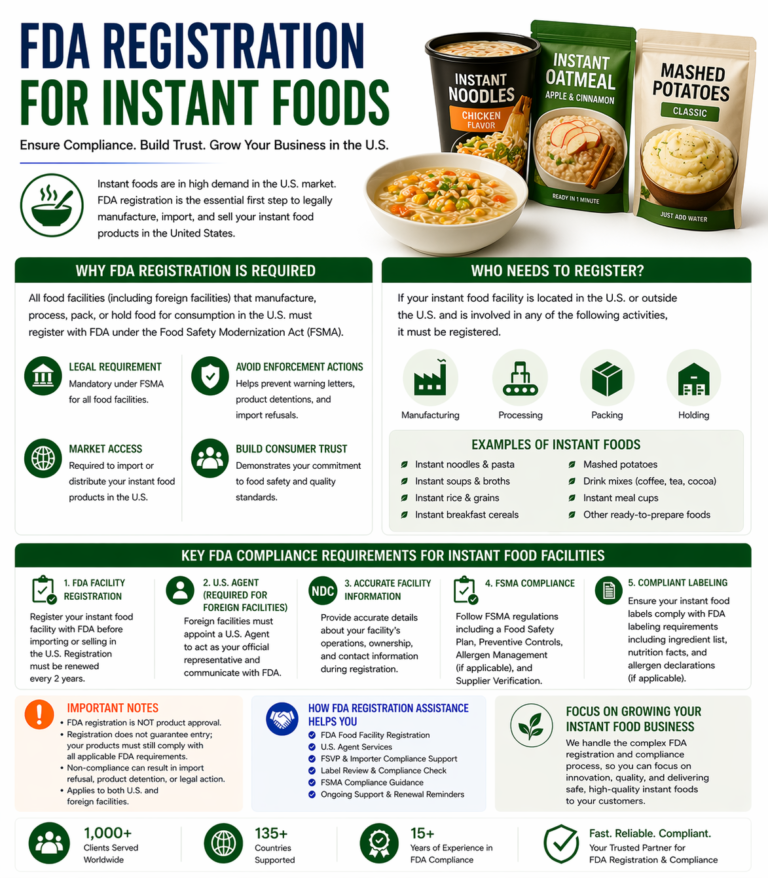
FDA Registration for Instant Foods
Why dehydration usually means fewer canned-food filings — and why low-moisture Salmonella is the risk that replaces them.
Key Takeaways
- "Instant" = dehydrated — a format, not an FDA category; classify the underlying food.
- Shelf-stable by low water activity (aw ≤ 0.85) — not by thermal canning.
- Generally no FCE / scheduled process — the canned-foods regime is for wet low-acid goods.
- Salmonella survives, doesn't grow — the signature low-moisture hazard, and it's heat-resistant when dry.
- Control it with preventive controls + sanitation — environmental monitoring, not a cook step.
- Watch wet components — a shelf-stable low-acid or acidified sachet can still need a scheduled process.
"Instant" Is a Format, Not a Category
There's no "instant foods" box in FDA's framework. "Instant" describes how a product is prepared by the consumer — just add hot water — and that convenience comes from dehydration. So to know your obligations, you classify the underlying food and, above all, recognize that it's a low-moisture food.
FDA treats foods with a water activity (aw) of 0.85 or below as low-moisture foods that are generally shelf-stable without refrigeration, because most pathogens can't grow at that dryness. Water activity is a recognized control parameter under FSMA preventive controls (21 CFR Part 117): if dryness keeps your product safe, you validate that target, monitor it, and verify it.
Do You Need an FCE & Scheduled Process?
For a genuinely dry product, no. The question only arises when part of the product isn't shelf-stable by low moisture:
| Instant / dehydrated product | Process filing (FCE + scheduled process)? |
|---|---|
| Dehydrated / powdered — noodles, soup mix, oatmeal, drink mix (aw ≤ 0.85) | Generally none — shelf-stable by low moisture |
| Wet, low-acid shelf-stable component (aw > 0.85, pH > 4.6) in a sealed container | Can be a low-acid canned food → FCE + scheduled process |
| Acidified wet component (acid added to pH ≤ 4.6) | Acidified food → FCE + scheduled process |
| Retort-pouch component | Thermal-processing / pouch rules apply |
Salmonella in Low-Moisture Foods
If pathogens can't grow in a dry product, what's the risk? Survival, not growth. Salmonella is the defining hazard of low-moisture foods, and it behaves in ways that catch dry-food makers off guard:
- It survives, for months to years — it can't multiply at instant-food dryness, but it persists
- It gets harder to kill as it dries — Salmonella becomes more heat-resistant at low water activity, so drying doesn't reliably eliminate it
- Contamination is environmental — it usually enters via dust, airflow, equipment niches, personnel, or a contaminated dry ingredient, not the finished batch
- The control is sanitation, not a cook step — dry-cleaning, hygienic zoning, and environmental monitoring for Salmonella under a Part 117 plan
Assemblies, Allergens & the Supplement Line
- Multi-component products — a noodle cup (dried block + seasoning + dehydrated veg + oil/paste sachet) is assessed component by component; the sachet is often the non-dry part
- The container — if it's meant to be microwaved, packaging must be food-contact-cleared for that heat (see microwaveable foods)
- Allergens — instant foods lean on wheat, soy, milk, and egg across sub-components; declare every major allergen (sesame is now the 9th)
- Supplement line — powdered meal replacements / fortified drink mixes can cross into dietary-supplement classification, which changes the rules
Get Your Instant Foods Compliant
FDA Registration Assistance classifies your product first — confirming it's low-moisture (and so generally outside the FCE/scheduled-process regime), and flagging any wet low-acid or acidified component that isn't. From there we handle facility registration, U.S. Agent, labeling (allergens and rehydration/serving), and FSVP for imports — and point you to the low-moisture preventive-controls and sanitation expectations that actually govern dry-food safety.
Contact us at info@fdaregistrationassistance.com or call +1 (928) 275-8333. Food Facility Registration is available starting at $858. Trusted by companies across 135+ countries, with 15+ years of experience.
Frequently Asked Questions
1. Do instant foods require FDA registration?
Yes — if you manufacture, process, pack, or hold instant foods for the U.S. market, your facility registers with FDA (and a foreign facility also needs a U.S. Agent). But "instant" isn't a special FDA category. It's a convenience format created by dehydration, so the more useful question is what the dehydration means for your other filings — and there, instant/dehydrated foods usually have fewer, not more, requirements than canned goods.
2. Do instant foods need an FCE and a scheduled process like canned foods?
Usually not. Instant foods are made shelf-stable by removing water — they're low-moisture foods (water activity at or below 0.85), so they're preserved by dryness rather than by the thermal "commercial sterilization" that defines low-acid canned foods. Because they're not low-acid canned foods or acidified foods, dehydrated/powdered instant products generally don't need a Food Canning Establishment (FCE) registration or a filed scheduled process. That regime is for canned goods, not dry ones.
3. What makes instant foods shelf-stable?
Low water activity. FDA treats foods with a water activity (aw) of 0.85 or below as low-moisture foods that are generally shelf-stable without refrigeration, because most pathogens can't grow at that dryness. Water activity is a recognized FDA control parameter under FSMA preventive controls (21 CFR Part 117) — if dryness is what keeps your product safe, you validate that target, monitor it, and verify the finished product.
4. If pathogens can't grow, what's the actual hazard in dry foods?
Survival, not growth. Salmonella is the signature hazard for low-moisture foods: it can't multiply at the dryness of instant products, but it can survive for months to years, and it actually becomes more heat-resistant as it dries out — so drying doesn't reliably kill it. Worse, contamination usually enters from the environment (dust, airflow, equipment niches, personnel, or a contaminated dry ingredient) rather than the finished batch. That's why the control is sanitation and environmental monitoring, not a cook step.
5. How do I control Salmonella in a low-moisture instant food?
Through a preventive-controls food-safety plan under 21 CFR Part 117 built around the dry environment: rigorous dry-cleaning and hygienic zoning, environmental monitoring for Salmonella, control of incoming dry ingredients, and (where a kill step exists) a validated lethality treatment — remembering that Salmonella is desiccation- and heat-resistant when dry. FDA's January 2025 draft guidance on low-moisture ready-to-eat foods reflects exactly this focus. It's a different discipline from the thermal scheduled process used for canned foods.
6. When would an "instant" product still need a scheduled process?
When part of it isn't actually dry and shelf-stable by low moisture. If an instant product includes a wet, low-acid component that's shelf-stable in a sealed container with a water activity above 0.85, that component can be a low-acid canned food needing an FCE and scheduled process. An acidified wet component (acid added to reach pH 4.6 or below) follows the acidified-foods rules. And a retort-pouch component follows thermal-processing/pouch rules. The dry powder isn't the issue — a wet shelf-stable element is.
7. How are multi-component instant products (like a noodle cup) handled?
Component by component. An instant noodle cup can contain a dried noodle block, a seasoning powder, dehydrated vegetables, and an oil or paste sachet — each has its own considerations, and the sachet is often the one that isn't simply low-moisture. The container matters too: if it's designed to be microwaved, the packaging must be food-contact-cleared for that heat; if a component is in a retort pouch, pouch rules apply. Assess the whole assembly, not just "it's instant."
8. What are the main allergen concerns for instant foods?
Instant foods lean heavily on common allergens — wheat (noodles), soy and milk (creamers, seasonings, meal replacements), and egg — often across several sub-components. Every major allergen present anywhere in the product (including in a seasoning sachet) must be declared, and sesame is now the 9th major allergen. Because instant products combine many ingredients from different suppliers, allergen mapping across the whole assembly is essential.
9. Are powdered meal replacements and drink mixes regulated as food?
Sometimes they cross the line into dietary supplements. A powdered meal replacement or fortified drink mix marketed and formulated as a conventional food follows food rules; but if it's presented as a supplement (supplement-style claims, a Supplement Facts panel, dosage form), it's regulated as a dietary supplement with additional requirements. The classification drives labeling and other obligations, so it's worth settling early.
10. Do instant foods need Nutrition Facts and rehydration instructions?
Yes. Packaged instant foods need a compliant Nutrition Facts panel, a full ingredient list, and allergen declarations. For dehydrated products, serving size and preparation (as-packaged vs prepared) need to be handled correctly so the nutrition information is accurate, and clear rehydration/preparation instructions matter — especially if any step is needed for safety or quality.
11. Does importing instant foods require anything extra?
Yes. The foreign facility registers with FDA and maintains a U.S. Agent, and the U.S. importer must have an FSVP (Foreign Supplier Verification Program) plus file prior notice for each shipment. Given the low-moisture Salmonella risk, supplier verification for dry ingredients and finished instant products is a meaningful part of FSVP, not a formality.
12. Does FDA approve instant foods?
No. FDA doesn't pre-approve food products, including instant foods. You register your facility, comply with the applicable rules (preventive controls, labeling, and — for any low-acid or acidified wet component — the canned-foods rules), and FDA enforces compliance at the facility and, for imports, at the border. There's no FDA "approval" certificate for an instant food.
13. Is it true dry products face fewer requirements?
Partly — and it's a common trap. Dry, low-moisture instant foods do skip the FCE/scheduled-process regime that canned low-acid foods carry, so in that sense there's less to file. But they are not lower-risk overall: the low-moisture Salmonella problem means real preventive-controls and sanitation obligations. "Fewer canned-food filings" is not the same as "fewer food-safety duties."
14. How does FDA Registration Assistance help with instant foods?
We classify your product correctly first — confirming it's low-moisture (and so generally outside the FCE/scheduled-process regime), and flagging any wet low-acid or acidified component that isn't. From there we handle facility registration, U.S. Agent, labeling (including allergens and rehydration/serving), and FSVP for imports, and we point you to the low-moisture preventive-controls and sanitation expectations that actually govern dry-food safety. Registration is available starting at $858, for companies across 135+ countries. Contact info@fdaregistrationassistance.com or +1 (928) 275-8333.