
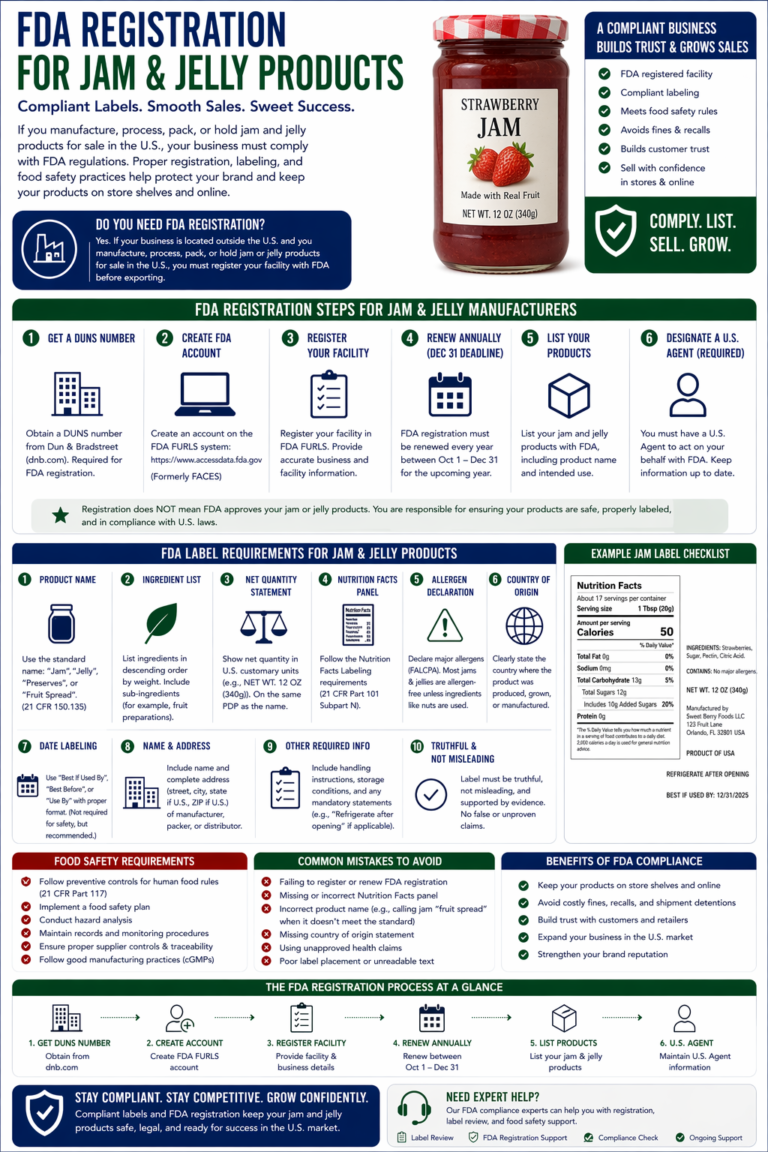
FDA Registration for Jam & Jelly Products
The naming standard behind "jam" and "jelly," when you must say "fruit spread," and the pepper-jelly acidified-food trap.
Key Takeaways
- "Jam," "jelly," "preserves" are standardized — Part 150 sets the rules.
- Fruit-to-sugar ratio + 65% Brix — required to use those names.
- Low-sugar → "fruit spread" — or "reduced sugar" before the name.
- Standard fruit jam skips FCE/SID — exempt from the acidified-foods rule.
- Peppers, rhubarb, tomato, figs, nuts flip it — into an acidified food (FCE + SID).
- Pepper jelly is the classic trap — not a simple fruit jelly.
"Jam" and "Jelly" Have Legal Definitions
The names aren't marketing — they're standards of identity in 21 CFR Part 150. To use "jam," "jelly," or "preserves," the product must hit both a fruit-to-sugar ratio and a minimum Brix:
| Product | Fruit-to-sugar (by weight) | Soluble solids |
|---|---|---|
| Fruit jelly (§150.140) | ≥ 45 parts fruit juice : 55 sweetener | ≥ 65% Brix |
| Jam / preserves — Group I fruits (strawberry, raspberry, boysenberry, grape) | 47 parts fruit : 55 sweetener | ≥ 65% Brix |
| Jam / preserves — other fruits (§150.160) | 45 parts fruit : 55 sweetener | ≥ 65% Brix |
| Doesn't meet the standard | Must be a "fruit spread" — not "jam" or "jelly" | |
Standard Jam Skips FCE/SID — Until You Add Low-Acid Ingredients
Here's the reassurance, and the trap. A standard fruit jam or jelly is generally exempt from the acidified-foods regulation (21 CFR Part 114): its high sugar and low water activity control safety, so it doesn't need FCE registration or a scheduled process.
Ingredients, Labeling & Imports
- Optional ingredients (Part 150) — pectin (gelling), acid, buffers, preservatives, and spices are permitted within the standard; each must be lawful and declared
- Added sugars — jams/jellies are high in sugar; declare Total and Added Sugars accurately (see added sugars)
- Claims — "no sugar added"/"reduced sugar"/"low calorie" must meet FDA definitions; "organic" needs USDA certification; "natural" must be truthful
- Allergens — usually light, but nut-containing preserves and shared equipment need assessment
- FSVP for imports — verify the supplier and, for pepper jellies/low-acid recipes, confirm the acidified-food process filing is in place
Get Your Jam & Jelly U.S.-Ready
FDA Registration Assistance reviews your recipe against the Part 150 standards to confirm the correct name (jam, jelly, preserve, or fruit spread), determines whether it's an acidified food (especially for pepper jellies and low-acid recipes) and coordinates FCE/SID if so, and reviews labeling, added sugars, and claims — plus registration, U.S. Agent, and FSVP for imports.
Contact us at info@fdaregistrationassistance.com or call +1 (928) 275-8333. Food Facility Registration is available starting at $858. Trusted by companies across 135+ countries, with 15+ years of experience.
Frequently Asked Questions
1. Do jam and jelly products need FDA registration?
Yes. Any facility that manufactures, processes, packs, or holds jam or jelly for the U.S. market must be registered with FDA, and foreign facilities need a U.S. Agent, with prior notice for each imported shipment. Jam and jelly are relatively low-risk, but the two things that actually take work are the naming rules (standards of identity) and, for some recipes, whether the product is an acidified food.
2. Can I call any fruit spread "jam" or "jelly"?
No — "jam," "jelly," and "preserves" are standardized names under 21 CFR Part 150. To use them, the product must meet a set fruit-to-sugar ratio and reach at least 65% soluble solids (Brix). A product that uses less sugar, comes in below 65% Brix, or uses a fruit outside the standard can't be labeled "jam" or "jelly" — it has to be called a "fruit spread" or similar. The names have legal requirements behind them.
3. What is the fruit-to-sugar ratio for jam and jelly?
For fruit jelly (21 CFR 150.140), the mixture must be at least 45 parts fruit juice to 55 parts sweetener. For fruit preserves and jams (21 CFR 150.160), it's 45 parts fruit to 55 parts sweetener for most fruits, or 47 parts fruit to 55 parts sweetener for "Group I" fruits (like strawberries, raspberries, boysenberries, and grapes). In both cases, the finished product must contain at least 65% soluble solids.
4. What do I call a low-sugar or reduced-sugar product?
If it doesn't meet the standard, it's a "fruit spread" — many reduced-sugar and low-Brix products are labeled that way. Alternatively, the term "Reduced Sugar" can precede "Jam" or "Jelly" as a nutrient content claim if the product meets the reduced-sugar definition. No-sugar-added and low-calorie fruit spreads use nutrient content claims rather than the old "artificially sweetened" standardized names. The point is you can't call a non-standard product plain "jam" or "jelly."
5. Are jams and jellies acidified foods that need FCE/SID filing?
Usually not. A standard fruit jam or jelly is generally exempt from the acidified-foods regulation (21 CFR Part 114) — its high sugar content and low water activity control safety, so it typically doesn't need FCE registration or a scheduled process. This is the big reassurance for most fruit jam makers: no process filing for a standard, high-sugar fruit jam.
6. When does a jam or jelly become an acidified food?
When it contains significant amounts of low-acid ingredients. Jams and jellies that add things like peppers, rhubarb, tomatoes, raisins, figs, nuts, or certain spices and herbs can fall under the acidified-foods regulation — which means FCE registration and a scheduled process (SID) validated by a process authority. Pepper jelly is the classic example: it's not a simple fruit jelly, and the added peppers can make it an acidified food. If your recipe adds low-acid ingredients, get the classification checked.
7. What optional ingredients can standardized jam and jelly contain?
Part 150 allows specific optional ingredients, including pectin (for gelling), acid ingredients (for tartness and to help set), buffering agents, preservatives, and spices or flavorings, within the standard. Each must be a lawful ingredient and declared in the ingredient list. Pectin and added acid are common; if you rely on added acid to control safety, though, you may be moving toward the acidified-food classification.
8. Do jam and jelly products need a Nutrition Facts label?
Yes, most packaged jams and jellies need a Nutrition Facts panel in the required format, including Total Sugars and Added Sugars (jams and jellies are high in sugar, so the added-sugars line matters). Small-package exemptions are limited and usually not practical for commercial products. The ingredient list, allergen declarations (where applicable), net quantity, and responsible firm are also required.
9. What claims are regulated on jam and jelly?
"No sugar added," "reduced sugar," and "low calorie" are nutrient content claims with specific FDA definitions the product must meet. "Organic" requires USDA organic certification, and "natural" and "homemade-style" must be truthful. And the product identity itself — jam, jelly, preserve, or fruit spread — has to match the standard, since using a standardized name incorrectly is itself a labeling violation.
10. What allergens matter for jam and jelly?
Plain fruit jams and jellies often have few allergens, but some contain tree nuts (nut-studded preserves) or are made on shared equipment, and pectin or other additives rarely introduce allergens. Any major allergen present must be declared, and cross-contact should be considered where relevant. It's a lighter allergen profile than, say, a chocolate spread, but it still has to be assessed for each recipe.
11. Do imported jams and jellies need FSVP?
Yes. If the jam or jelly is imported, the U.S. importer holds FSVP and must verify the foreign supplier meets U.S. standards, with prior notice before each shipment. For a standard fruit jam, verification is usually straightforward; for a pepper jelly or a low-acid-ingredient product, the importer should confirm the acidified-food process filing is in place. Imported products must also meet the same Part 150 naming rules.
12. Does FDA approve jam and jelly before sale?
No. FDA doesn't pre-approve food or facilities — registration just puts the facility on record. Your product still has to meet the standard-of-identity naming rules, the labeling requirements, and (if it's an acidified food) the process-filing requirements. There's no "FDA approved" jam; there's compliant jam, correctly named and, where required, properly filed.
13. What are the most common compliance mistakes for jam and jelly?
Calling a low-sugar or non-standard product "jam" or "jelly" when it should be a "fruit spread"; missing that a pepper jelly or low-acid-ingredient jam is an acidified food needing FCE/SID; inaccurate added-sugars declarations; unsupported "no sugar added" or "organic" claims; and undeclared ingredients like pectin or preservatives. Naming and the acidified-food question are the two that most often catch producers.
14. How does FDA Registration Assistance help with jam and jelly?
We review your recipe against the Part 150 standards to confirm the correct name (jam, jelly, preserve, or fruit spread), determine whether it's an acidified food (especially for pepper jellies and low-acid-ingredient recipes) and coordinate FCE/SID if so, and review labeling, added sugars, and claims — plus facility registration, U.S. Agent, and FSVP for imports. Starting at $858 for registration, for companies across 135+ countries. Contact info@fdaregistrationassistance.com or +1 (928) 275-8333.
