
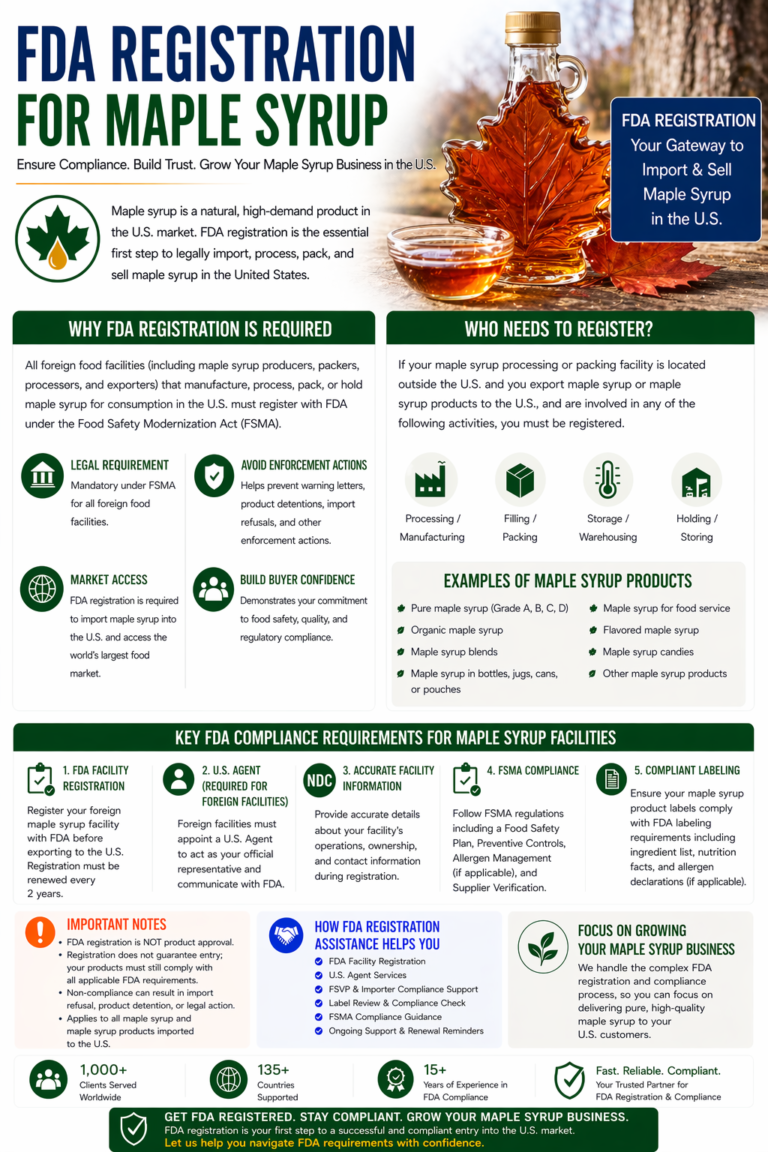
FDA Registration for Maple Syrup
What makes real maple syrup "maple syrup," the four color grades, the added-sugars footnote, and the lead concern most sellers overlook.
Key Takeaways
- "Maple syrup" is standardized — ≥66% soluble solids from maple sap (21 CFR 168.140).
- Blends are "table syrup" — not "maple syrup"; overstating "100% maple" is adulteration.
- All retail maple is "Grade A" — in four color-flavor classes.
- Grading is USDA/state, not FDA — voluntary federally, but many states require it.
- Pure maple gets an added-sugars footnote — the "†" symbol option.
- Lead is the maple-specific safety issue — from old equipment; no FCE/SID needed.
What Makes It "Maple Syrup"
Maple syrup is a high-value product, so authenticity is the first compliance question. Under its standard of identity (21 CFR 168.140), maple syrup is made by concentrating and heat-treating maple tree sap and must contain at least 66% soluble solids derived solely from that sap.
The Four Color Grades
Since 2015, all retail maple syrup is "Grade A," separated into four color-and-flavor classes by light transmittance. The grade describes color and flavor — not quality — among the Grade A classes:
| Grade A class | Color / light transmittance | Taste |
|---|---|---|
| Golden Color | Lightest (≥ 75% Tc) | Delicate |
| Amber Color | 50–74.9% Tc | Rich (classic maple) |
| Dark Color | 25–49.9% Tc | Robust |
| Very Dark Color | < 25% Tc | Strong |
| Processing Grade | Doesn't meet Grade A — ingredient/bulk use, not retail | |
The Added-Sugars Footnote & Lead
Process Filing, Claims & Imports
- No FCE/SID — at ≥66% Brix and low water activity, maple syrup is shelf-stable without being a low-acid canned or acidified food; no process filing
- "Organic" — requires USDA organic certification; "pure," "100% maple," and "natural" must be genuinely true
- Country of origin — imported syrup must be accurately marked (e.g., "Product of Canada")
- FSVP for imports — verify authenticity, lead/food-safety, grade, and labeling; most maple is imported, so FSVP is the central obligation
Get Your Maple Syrup U.S.-Ready
FDA Registration Assistance confirms your product qualifies as pure maple syrup under the standard of identity (or names it correctly if it's a blend), reviews your labeling — grade, the added-sugars footnote, organic and purity claims, and country of origin — and addresses lead/food-safety and authenticity in supplier verification, plus registration, U.S. Agent, and FSVP for imports.
Contact us at info@fdaregistrationassistance.com or call +1 (928) 275-8333. Food Facility Registration is available starting at $858. Trusted by companies across 135+ countries, with 15+ years of experience.
Frequently Asked Questions
1. Do maple syrup products need FDA registration?
Yes. Any facility that manufactures, processes, packs, or holds maple syrup for the U.S. market must be registered with FDA, and foreign facilities need a U.S. Agent, with prior notice for each shipment. Since most maple syrup sold in the U.S. is imported (largely from Canada), FSVP is a central requirement. Maple syrup is low-risk to process, so the real compliance work is the standard of identity, labeling, grade, and lead/food-safety.
2. Is "maple syrup" a standardized name?
Yes. Under 21 CFR 168.140, maple sirup is made by concentrating and heat-treating maple tree sap (or dissolving maple sugar made from that sap), and must contain at least 66% soluble solids derived solely from that sap. So only genuine maple — at that Brix — can be labeled "maple syrup." A product that adds cane or corn syrup, or is maple-flavored, isn't "maple syrup" and has to be named differently.
3. What's the difference between maple syrup and table or pancake syrup?
Pure maple syrup meets the 21 CFR 168.140 standard — it's concentrated maple sap. A "table syrup" or "pancake syrup" is typically a blend built on corn syrup or other sweeteners with little or no real maple, and it's standardized separately (as table sirup, 21 CFR 168.180) or named as a maple-flavored product. Calling a blend "maple syrup," or implying "100% maple" when it's not, is economic adulteration and misbranding — a major enforcement area for this high-value product.
4. What are the maple syrup grades?
Under the 2015 standards, all retail maple syrup is "Grade A," divided into four color-and-flavor classes by light transmittance: Grade A Golden Color/Delicate Taste (lightest, early season), Amber Color/Rich Taste (the classic flavor), Dark Color/Robust Taste (stronger, good for cooking), and Very Dark Color/Strong Taste (strongest). Syrup that doesn't meet Grade A is "Processing Grade," used as an ingredient rather than sold at retail. The grade describes color and flavor, not quality among the Grade A classes.
5. Is maple grading an FDA requirement?
Not exactly — and this is an important distinction. The grade standards are a USDA program (and an international standard harmonized between the U.S. and Canada), and at the federal level they're voluntary. However, many states require maple syrup sold there to be graded and labeled accordingly. FDA's role is the standard of identity, labeling, and safety; the color grade is a separate USDA/state matter. Both can apply to the same bottle, so it's worth getting both right.
6. How is maple syrup shown on the Nutrition Facts panel?
Maple syrup is high in sugar, so the panel addresses Total and Added Sugars. For a single-ingredient package of pure maple syrup, FDA allows a symbol (a "dagger") next to the Added Sugars percent Daily Value leading to a truthful footnote — because a gram amount of "added" sugars on pure maple syrup could mislead consumers into thinking sugar was added. The percent Daily Value still appears. This footnote option is specific to pure single-ingredient products like maple syrup and honey.
7. Is lead a concern for maple syrup?
Yes — it's the maple-specific safety issue to watch. Lead can leach into maple syrup from old lead-soldered evaporators, tanks, fittings, or other equipment that contacts the sap or syrup. Modern production uses lead-free, food-grade equipment, and producers should avoid any lead-containing contact surfaces and test where there's any doubt. For imported syrup, lead is a reasonable point to include in supplier verification.
8. Do maple syrup products need FCE or SID filing?
No. Maple syrup is high in soluble solids (at least 66% Brix) and low in water activity, so it's shelf-stable on that basis — it's neither a low-acid canned food nor an acidified food, and doesn't require Food Canning Establishment (FCE) registration or a scheduled process (SID). The compliance effort is on identity, labeling, grade, lead/food-safety, and (for imports) FSVP — not process filing.
9. Can I label my maple syrup as "organic"?
Only if it's certified. "Organic" requires USDA organic certification — you can't use the term without it. Other claims like "pure," "100% maple," and "natural" must be truthful and not misleading, and for pure maple syrup the "100%" claim has to genuinely mean the product is only maple. Overstated purity or origin claims are among the most common maple-label problems.
10. Does country-of-origin labeling matter for maple syrup?
Yes. Imported maple syrup must be accurately marked with its country of origin (for example, "Product of Canada"), and origin claims on the label have to be truthful. Because so much maple syrup is imported, incorrect or missing country-of-origin marking is a common cause of import problems, alongside the identity and grade questions.
11. Do imported maple syrup products need FSVP?
Yes. The U.S. importer holds FSVP and must verify the foreign supplier meets U.S. standards, with prior notice before each shipment. For maple syrup — most of which is imported — verification should confirm authenticity (genuine maple meeting the standard, not an adulterated blend), lead and food-safety controls, correct grade, and compliant labeling including country of origin. FSVP is the central obligation for maple importers.
12. Does registration mean FDA approved my maple syrup?
No. FDA doesn't pre-approve food or facilities — registration just puts the facility on record. It doesn't certify that your product meets the standard of identity, that your grade is correct, or that your labeling and safety controls are adequate; those remain your responsibility. Maple syrup can be registered and still be misbranded (a blend called "maple syrup") or adulterated (lead, or economic dilution). FDA enforces at import and in the marketplace.
13. What are the most common compliance mistakes for maple syrup?
Calling a blend or maple-flavored product "maple syrup" (or overstating "100% maple"); missing or incorrect grade labeling where a state requires it; incorrect or missing country-of-origin marking; mishandling the added-sugars declaration; unsupported "organic" claims; and overlooking lead from old equipment. Authenticity/identity and grade are the two that most often catch maple products.
14. How does FDA Registration Assistance help with maple syrup?
We confirm your product qualifies as pure maple syrup under the standard of identity (or name it correctly if it's a blend), review your labeling — grade, added-sugars footnote, organic and purity claims, and country of origin — and address lead/food-safety and authenticity as part of supplier verification, plus facility registration, U.S. Agent, and FSVP for imports. Starting at $858 for registration, for companies across 135+ countries. Contact info@fdaregistrationassistance.com or +1 (928) 275-8333.
