FDA Registration for Flour & Grain Products
Wheat, corn, rice, oats, barley, rye, quinoa, buckwheat, sorghum, millet — milled or whole, the mycotoxin question comes first.
Key Takeaways
- Mills, processors, packers & warehouses register — holding grain counts, not just milling.
- Aflatoxin = action level (20 ppb); DON = advisory level (1 ppm, finished wheat products).
- Fumonisins = guidance levels (commonly 2–4 ppm on corn products).
- Import Alert 23-14 covers DWPE for mycotoxins.
- "Enriched" flour is a standard — added B vitamins, iron, folic acid (Part 137).
- Wheat is a major allergen; raw flour carries Salmonella/E. coli.
Mycotoxins — Three Toxins, Three Tools
Grains are the classic mycotoxin substrate, and a common mistake is assuming FDA regulates them all the same way. It doesn't — the tool differs by toxin:
| Toxin | Mold / main grain | FDA level | Tool |
|---|---|---|---|
| Aflatoxin | Aspergillus — corn, others | 20 ppb total aflatoxins | Action level |
| Deoxynivalenol (DON / vomitoxin) | Fusarium — wheat | 1 ppm on finished wheat products | Advisory level |
| Fumonisins | Fusarium — corn | 2–4 ppm (by corn product) | Guidance levels |
"Enriched," Wheat, Gluten-Free & Whole Grain
"Enriched" is a standard Part 137
"Enriched flour" must carry added thiamin, riboflavin, niacin, iron, and folic acid. You can't label a product "enriched" unless it meets those levels — and FDA also permits folic acid fortification of corn masa flour.
Wheat is a major allergen
Declare wheat under FALCPA — in the ingredient list or a "Contains: Wheat" statement. Watch blended flours, seasoned mixes, and shared-equipment cross-contact. See allergen labeling.
Gluten-free = under 20 ppm
A "gluten-free" claim must meet FDA's rule (101.91): less than 20 ppm gluten — including naturally gluten-free grains (oats, rice, corn) processed near wheat, barley, or rye.
Whole grain claims
"Whole grain" or "100% whole grain" must reflect the actual grain composition, and any related health claim must meet FDA's authorized health-claim rules. This connects to the bread standards on our bakery page.
Registration, FSVP & Prior Notice
| Requirement | Who | What it covers |
|---|---|---|
| Facility registration | Mill / processor / packer / warehouse | 21 CFR 1.225; DUNS/UFI; biennial renewal (even years, Oct–Dec) |
| U.S. Agent | Foreign facilities | Real U.S. address, reachable by FDA (no P.O. box) |
| FSVP | U.S. importer | Hazard analysis — mycotoxins, pathogens, pesticide residues, foreign material (Part 1, Subpart L) |
| Prior notice | Every import shipment | Filed before arrival; must match label, invoice, and entry |
| 60-day updates | Registered facilities | Report changes within 60 days (1.234) |
Getting Flour & Grain to Market
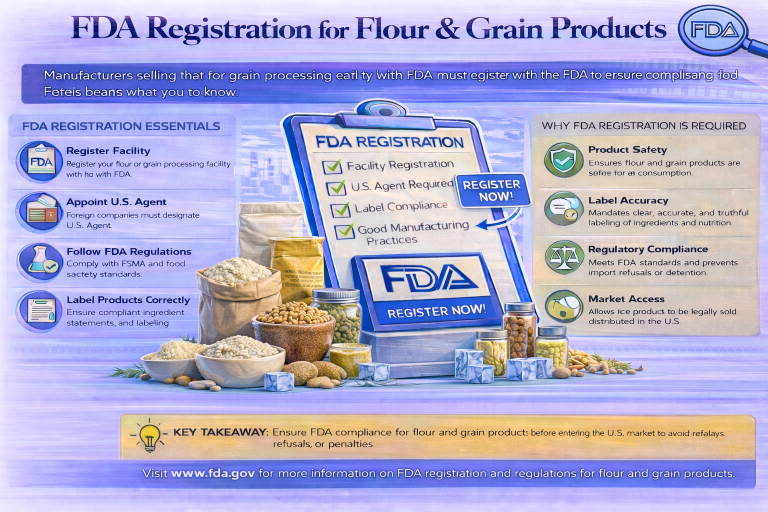
Register the facility
Mill/processor/packer/warehouse registers with a DUNS; foreign facilities add a U.S. Agent.
Manage mycotoxins
Control aflatoxin, DON, and fumonisins against FDA's action/advisory/guidance levels.
Meet enrichment & identity standards
Label "enriched" only if it meets Part 137 fortification (folic acid); name products accurately.
Get labeling right
Declare wheat; complete Nutrition Facts; substantiate gluten-free/whole-grain claims.
Handle imports
Prior notice + FSVP with grain-specific hazard analysis.
Keep it current
Renew every two years; report changes within 60 days; keep testing records.
Get Your Flour & Grain Products to Market
FDA Registration Assistance registers mills and grain facilities, serves as U.S. Agent, builds FSVP programs with grain-specific hazard analysis (mycotoxins included), reviews labeling and enrichment, and coordinates prior notice — plus import-alert resolution if needed. Food Facility Registration is available as a service starting at $858.
Contact us at info@fdaregistrationassistance.com or call +1 (928) 275-8333. Trusted by companies across 135+ countries, with 15+ years of experience.
Frequently Asked Questions
1. Do flour and grain products need FDA registration?
Yes — any facility that mills, processes, packs, or holds them for U.S. consumption registers, including warehouses and grain elevators unless an exemption applies. Foreign facilities also need a U.S. Agent. Registration identifies the facility; it isn't approval.
2. What's the defining hazard for grain products?
Mycotoxins — toxins from molds that infect grains in the field or storage. FDA monitors imports closely, and there's a dedicated import alert (23-14) for detention without physical examination due to mycotoxins. Milling reduces levels but doesn't eliminate them.
3. How does FDA regulate aflatoxin, DON, and fumonisins?
With three different tools. Aflatoxin (Aspergillus, notably corn) has an action level of 20 ppb. DON/vomitoxin (Fusarium, wheat) has an advisory level of 1 ppm on finished wheat products. Fumonisins (Fusarium, corn) have guidance levels, commonly 2–4 ppm by product. Only aflatoxin uses an action level.
4. Does milling remove mycotoxins?
It reduces but doesn't remove them — which is why FDA's DON advisory applies to finished wheat products, not raw wheat headed to milling. Sourcing, cleaning, milling practices, and testing together keep products within FDA levels.
5. What does "enriched" flour require?
"Enriched flour" is a standard of identity (21 CFR Part 137) requiring added thiamin, riboflavin, niacin, iron, and folic acid. A product can't be labeled "enriched" unless it meets those levels. FDA also permits folic acid fortification of corn masa flour.
6. Is wheat a major allergen?
Yes — one of the nine major U.S. allergens under FALCPA, declared in the ingredient list or a "Contains: Wheat" statement. It matters especially for blended grain products, seasoned flour mixes, and shared-equipment products.
7. Is raw flour a food-safety hazard?
Yes — raw flour is a raw agricultural product linked to Salmonella and E. coli, so FDA advises against eating raw dough or batter. For products not cooked by the end user, a validated kill step such as heat-treated flour matters.
8. What about gluten-free grain products?
A "gluten-free" claim must meet FDA's rule (21 CFR 101.91) — under 20 ppm gluten. This applies to naturally gluten-free grains too (oats, rice, corn), especially when processed in shared facilities where cross-contact with wheat, barley, or rye can occur.
9. Are whole grain claims regulated?
A "whole grain" or "100% whole grain" claim must reflect the actual grain composition, and any related health claim must meet FDA's authorized health-claim rules. A product that doesn't match the implied standard risks a misbranding issue.
10. Does organic certification replace FDA registration?
No — USDA organic certification is separate. Facility registration, U.S. Agent, FSVP, prior notice, and FDA labeling all still apply to organic grain products; the two frameworks operate independently.
11. Do importers need FSVP and prior notice?
Yes — prior notice per shipment and an importer FSVP. For grains, the hazard analysis should address mycotoxins, pathogens, pesticide residues, heavy metals, and foreign material. The importer of record owns the FSVP.
12. Do warehouses and grain elevators need to register?
Generally yes — a facility that holds flour or grain products for U.S. consumption, including warehouses, grain elevators, and storage, registers unless a specific exemption applies. Holding, not just manufacturing, can trigger registration.
13. Is "FDA registered" the same as "FDA approved"?
No — registration tells FDA a facility exists and what it does; it isn't approval of the product. "FDA approved" based on registration is inaccurate.
14. How does FDA Registration Assistance help?
It registers mills and grain facilities, serves as U.S. Agent, builds FSVP programs with grain-specific hazard analysis (mycotoxins included), reviews labeling and enrichment, and coordinates prior notice — plus import-alert resolution. Registration is available starting at $858, for companies across 135+ countries. Contact info@fdaregistrationassistance.com or +1 (928) 275-8333.