FDA Registration for Soft Drinks & Sodas
The soda-specific rules cut both ways: one big exemption that saves you paperwork, and a few ingredient limits that quietly trip people up.
Key Takeaways
- Sodas are conventional beverages — food facility framework applies (registration, labeling).
- Carbonated = exempt from acidified-food rules (21 CFR 114.3(b)) despite low pH.
- Cola caffeine is GRAS to 0.02% — 200 ppm (21 CFR 182.1180).
- Sweeteners, colors, preservatives must be approved additives or GRAS, and declared.
- Carbonated/seltzer/tonic water aren't "bottled water" (21 CFR 165.110).
- Not a supplement, not TTB — and registration ≠ approval.
Acidic, But Not "Acidified"
Canned low-acid and acidified foods carry a heavy process-filing burden — Food Canning Establishment registration, scheduled processes, a process authority. A soda's pH is usually below 4.6, so you might expect the same. It doesn't apply:
What Goes In — and the Limits
| Ingredient type | Rule | Note |
|---|---|---|
| Caffeine (cola-type) | GRAS to 0.02% (200 ppm) | 21 CFR 182.1180 |
| Sweeteners | Approved additive or GRAS | Aspartame, sucralose, ace-K, steviol glycosides, etc. |
| Colors | Approved color additive | Includes caramel color and certified colors |
| Preservatives | Permitted for the use | e.g. sodium/potassium benzoate |
| Acidulants | Permitted for the use | e.g. citric, phosphoric acid |
What a Soda Label Needs
Core elements
- Nutrition Facts panel — with the added sugars line
- Full ingredient list
- Firm name & address
- Net quantity & product identity
If it applies
- Percent juice declaration if the drink contains juice
- Correct declaration of sweeteners, colors, preservatives
- Caffeine disclosed in the ingredient list
- No false or misleading claims
Bringing a Soft Drink to Market
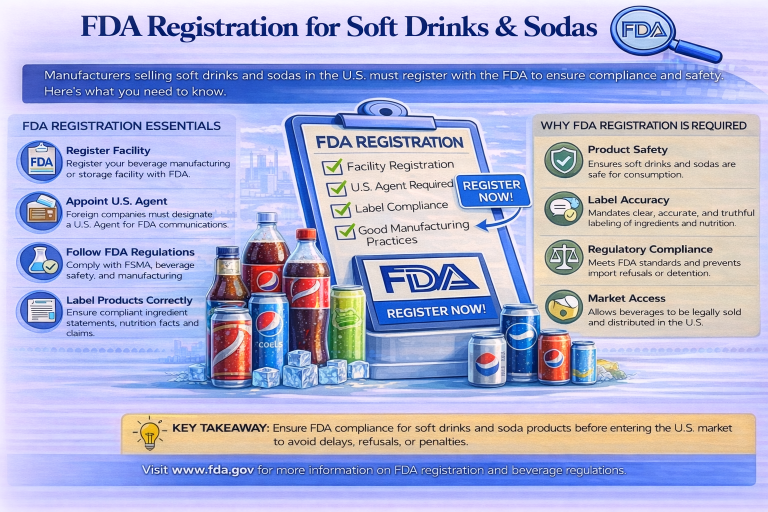
Register the facility
The maker/bottler/holder registers; foreign facilities add a U.S. Agent.
Confirm ingredients are lawful
Sweeteners, colors, preservatives, acidulants, caffeine — approved or GRAS at compliant levels.
Confirm your acidified status
Carbonated soft drinks are exempt from Part 114 — but check any non-carbonated line.
Build a compliant label
Nutrition Facts with added sugars, ingredients, percent juice if applicable, firm info.
Handle imports
Registration, U.S. Agent, FSVP, and prior notice before shipping.
Keep it current
Renew every two years and revisit labels and formulas as products change.
Launch Your Soft Drink Without Border Surprises
FDA Registration Assistance registers beverage facilities, serves as U.S. Agent, reviews additives and labels against FDA rules, and supports FSVP and prior notice — so ingredient and labeling issues surface before shipping, not at the port.
Contact us at info@fdaregistrationassistance.com or call +1 (928) 275-8333. Trusted by companies across 135+ countries, with 15+ years of experience.
Frequently Asked Questions
1. Do soft drinks and sodas need FDA registration?
The facility that makes, bottles, or holds them registers with FDA, and foreign facilities need a U.S. Agent. Sodas are conventional beverages (a category of food), so the food facility framework applies. Registration isn't product approval.
2. Are sodas "acidified foods" because they're acidic?
No — carbonated beverages are specifically excluded from the acidified foods rule (21 CFR 114.3(b)), even with a pH below 4.6. So a standard carbonated soft drink generally doesn't file an FCE or scheduled process, unlike a canned acidified food. A non-carbonated line can differ.
3. Is there a caffeine limit for sodas?
For cola-type beverages, caffeine is GRAS up to 0.02% (200 ppm) under 21 CFR 182.1180, used per good manufacturing practice. Products well beyond that, like many energy drinks, sit in a more scrutinized space and shouldn't assume the cola GRAS level covers them.
4. What ingredients can I use?
Only lawful ones — sweeteners that are approved additives or GRAS (aspartame, sucralose, ace-K, certain steviol glycosides), approved color additives, and permitted preservatives and acidulants. Each must be declared correctly on the label.
5. Are artificial sweeteners allowed?
Yes — but only FDA-approved high-intensity sweeteners or GRAS options, used within their conditions and properly declared. An unapproved sweetener, or one outside its approved use, makes the product non-compliant.
6. How is carbonated water different from bottled water?
FDA's bottled water standard (21 CFR 165.110) specifically excludes carbonated water, seltzer, soda water, sparkling water, and tonic water. So a carbonated or sparkling drink is a conventional beverage, not "bottled water," and is labeled accordingly.
7. What labeling does a soda need?
A Nutrition Facts panel (with added sugars), a full ingredient list, firm name/address, and — if it contains juice — a percent-juice declaration. Caffeine, sweeteners, colors, and preservatives must be declared. Nothing false or misleading.
8. Do soft drinks fall under preventive controls?
Facilities generally evaluate the preventive controls rule (21 CFR Part 117), though a shelf-stable acidic carbonated beverage may have few significant hazards. The facility still registers and does the analysis; the outcome depends on the product and process.
9. Do I need FSVP and prior notice to import?
Yes — imported sodas need a registered foreign facility with a U.S. Agent, prior notice per shipment, and an importer FSVP. Missing any of these can cause a hold or refusal.
10. Is a soda the same as a dietary supplement?
No — a conventional soft drink is a food/beverage. Adding supplement-style ingredients or making structure/function or disease claims can change how FDA views it, and a beverage marketed as a supplement follows different rules. Keep the positioning clear.
11. Do sodas involve TTB or alcohol rules?
Non-alcoholic soft drinks are FDA's domain, not TTB's. TTB comes in only once alcohol is involved (or a product crosses 0.5% ABV). See do non-alcoholic beverages need TTB approval.
12. Is "FDA registered" the same as "FDA approved"?
No — registration tells FDA a facility exists and what it does; it isn't approval of the drink. "FDA approved" based on registration is inaccurate.
13. Who's responsible if I import?
The importer carries the U.S.-side responsibility — FSVP, prior notice, and confirming registration. Assuming the foreign bottler handles everything is a costly mistake. See our food importer guide.
14. How does FDA Registration Assistance help?
It registers beverage facilities, serves as U.S. Agent, reviews additives and labels, and supports FSVP and prior notice for imports, for companies across 135+ countries. Contact info@fdaregistrationassistance.com or +1 (928) 275-8333.