
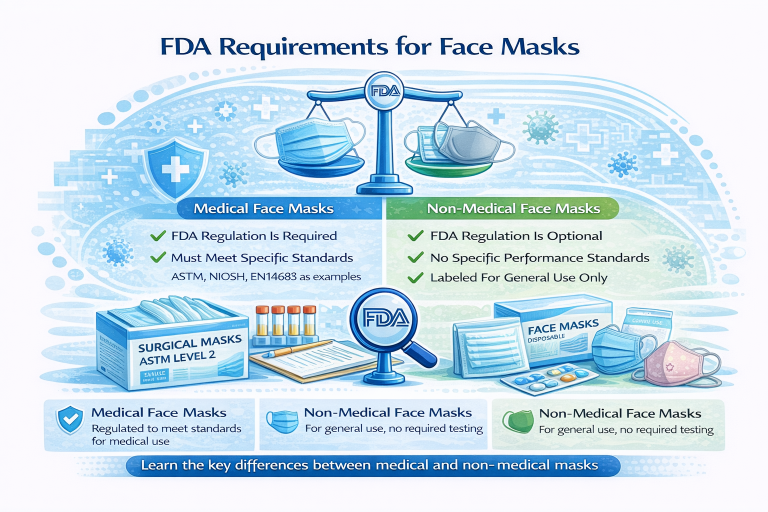
FDA Requirements for Face Masks
Which masks are FDA devices, which are NIOSH's, and which are neither — plus the claims that change everything.
Key Takeaways
- Surgical mask = Class II FDA device — 21 CFR 878.4040 (FXX), 510(k), ASTM F2100.
- N95 = NIOSH (42 CFR 84); a surgical N95 is also an FDA device (MSH).
- Standard N95 = NIOSH only — not an FDA device.
- Non-medical face covering, no claims = not an FDA device.
- Disease/medical claims make any mask a device.
- COVID EUAs ended; KN95 isn't FDA-authorized; "cleared" ≠ "approved."
Which Mask Is Regulated by Whom
| Mask type | Regulated by | Requirement |
|---|---|---|
| Surgical / medical mask | FDA (Class II device) | 510(k); FXX; ASTM F2100 |
| Surgical N95 respirator | FDA + NIOSH | Class II (MSH) + NIOSH; 510(k)-exempt unless disease/surgical-smoke claims |
| Standard N95 respirator | NIOSH | NIOSH approval (42 CFR 84); not an FDA device |
| Non-medical face covering / cloth mask (no claims) | Neither (generally) | Not an FDA device (may follow ASTM F3502) |
| Any mask with disease/medical claims | FDA (device) | Device pathway applies |
Surgical Masks Are Class II Devices
A surgical/medical mask — a fluid barrier that filters microorganisms and particulates for a medical purpose — is a Class II device (21 CFR 878.4040, product code FXX) and requires a 510(k):
- ASTM F2100 — the primary performance standard, with Levels 1/2/3 for bacterial filtration efficiency (BFE), particle filtration (PFE), fluid resistance, breathability, and flammability
- Supporting standards — ASTM F2101 (BFE test) and ASTM F1862 (synthetic-blood/fluid resistance)
- Related product codes — OUK (antimicrobial/antiviral-coated masks) and OXZ (pediatric masks)
- Then the device pathway — establishment registration, listing, quality system (QMSR), labeling/UDI, MDR, and a U.S. Agent if foreign
N95 Respirators: NIOSH — and FDA for Surgical N95
Standard N95. An N95 respirator is approved by NIOSH under 42 CFR Part 84 (filters ≥95% of particles). A standard N95 is NIOSH-approved but is not an FDA medical device. (OSHA separately governs respirator use in workplaces — fit testing, respiratory-protection programs.)
Surgical N95. A respirator used in healthcare — worn by personnel to protect both patient and wearer — is dual-regulated: NIOSH-approved and an FDA Class II device (21 CFR 878.4040, product code MSH). Under the FDA/CDC MOU, MSH surgical N95s are generally 510(k)-exempt — unless the respirator is intended to prevent specific diseases/infections or is represented as filtering surgical smoke, which removes the exemption.
Non-Medical Face Coverings — Until You Make a Claim
A general-purpose, non-medical face covering or cloth mask that makes no medical claims — not marketed for a medical purpose, not claiming to prevent disease or infection, not claiming medical-grade filtration — is generally not an FDA-regulated device. (Such products may follow the consensus standard for barrier face coverings, ASTM F3502.)
The COVID EUAs Have Ended
During COVID-19, FDA issued Emergency Use Authorizations and enforcement-discretion policies that temporarily relaxed the rules for masks and respirators. Those have wound down — FDA removed many products (including KN95s) from EUA lists in 2021, and the public health emergency ended in 2023.
- Standard rules apply now — surgical masks need a 510(k); surgical N95s follow the MSH/NIOSH framework
- No pandemic shortcuts — don't rely on expired EUAs or enforcement-discretion policies
- KN95s — generally not FDA-authorized (and not NIOSH-approved)
Common Face Mask Mistakes
- Selling a surgical mask without a 510(k)
- Disease-prevention claims on a non-medical covering — makes it an unauthorized device
- Calling a mask "FDA approved" — surgical masks are cleared; N95s are NIOSH-approved
- Representing a KN95 as an N95 or as NIOSH-approved
- Relying on expired COVID EUAs; skipping ASTM F2100 testing
- Missing the U.S. Agent (foreign device-mask makers)
Get Your Face Mask Compliant
FDA Registration Assistance starts by classifying the product — surgical/medical mask (Class II device), surgical N95 (FDA + NIOSH), standard N95 (NIOSH), or non-medical face covering (generally not a device) — and reviewing the claims. For FDA-device masks we handle establishment registration and device listing, support the 510(k) and ASTM testing strategy, provide U.S. Agent service for foreign makers, and help with labeling/UDI and quality-system requirements.
Contact us at info@fdaregistrationassistance.com or call +1 (928) 275-8333 for a quote. An independent compliance firm serving 1,000+ companies across 135+ countries, with 15+ years of experience.
Frequently Asked Questions — Face Masks
1. Are face masks regulated by the FDA?
It depends on the type and intended use. A surgical/medical mask is an FDA-regulated medical device (Class II). An N95 respirator is regulated by CDC/NIOSH, and a surgical N95 used in healthcare is also an FDA device. But a non-medical face covering or cloth mask that makes no medical claims is generally not an FDA-regulated medical device. The key questions are what the mask is for and what it claims - medical purpose or disease/infection claims pull a mask into FDA device regulation.
2. Is a surgical mask a medical device?
Yes. A surgical (or medical) mask - designed as a fluid barrier and to filter particles/microorganisms for a medical purpose - is a Class II medical device under 21 CFR 878.4040 (product code FXX), and it requires a 510(k). Surgical masks are expected to meet recognized standards, principally ASTM F2100 (which covers bacterial filtration efficiency, particle filtration, fluid resistance, and flammability, at Levels 1, 2, and 3). Antimicrobial-coated masks (product code OUK) and pediatric masks (OXZ) are related device categories.
3. What is ASTM F2100 and do I need it?
ASTM F2100 is the primary performance standard for medical face masks, defining three barrier levels (1, 2, 3) based on bacterial filtration efficiency (BFE), sub-micron particulate filtration (PFE), fluid resistance, differential pressure (breathability), and flammability. FDA recognizes it (along with ASTM F2101 for BFE testing and ASTM F1862 for synthetic-blood/fluid resistance). A surgical mask 510(k) typically demonstrates conformance to F2100 at the claimed level, so yes - if you're marketing a surgical mask, testing to F2100 is central.
4. How are N95 respirators regulated?
N95 respirators are regulated by CDC's National Institute for Occupational Safety and Health (NIOSH) under 42 CFR Part 84, which certifies that the respirator filters at least 95% of particles (42 CFR 84.181). A standard N95 is NIOSH-approved but is not an FDA medical device. The exception is the surgical N95 (see below). OSHA separately regulates respirator use in workplaces (fit testing, respiratory protection programs).
5. What is a surgical N95, and who regulates it?
A surgical N95 is a respirator used in healthcare settings, worn by personnel to protect both the patient and the wearer from transfer of microorganisms, body fluids, and particulates. It's dual-regulated: NIOSH-approved (42 CFR Part 84) AND an FDA Class II device (21 CFR 878.4040, product code MSH). Under the FDA/CDC MOU, surgical N95s in product code MSH are generally exempt from 510(k) - unless the respirator is intended to prevent specific diseases or infections, or is labeled/represented as filtering surgical smoke or plumes, in which case it's not exempt.
6. When is a face mask NOT an FDA device?
A general-purpose, non-medical face covering or cloth mask that makes no medical claims - not marketed for a medical purpose, not claiming to prevent disease or infection, not claiming medical-grade filtration - is generally not an FDA-regulated medical device. (There's a consensus standard for barrier face coverings, ASTM F3502, that such products may follow.) The line is intended use and claims: add a medical purpose or a disease/infection-prevention claim and the same physical mask becomes an FDA device.
7. Do disease-prevention claims change the classification?
Yes - decisively. Claiming a mask prevents specific diseases or infections (for example "prevents COVID-19" or "protects against the flu") gives it a medical intended use and makes it an FDA device, and can remove exemptions that would otherwise apply. This is the single most common way a mask brand ends up non-compliant: marketing an otherwise-general face covering with medical/disease claims. Keep non-medical coverings to non-medical language, or take the device pathway.
8. Are the COVID-19 mask EUAs still in effect?
No. The COVID-era Emergency Use Authorizations and enforcement-discretion policies for masks and respirators have wound down - FDA removed many products (including KN95s) from EUA lists in 2021, and the public health emergency ended in 2023. So the temporary shortcuts are gone and standard rules apply: surgical masks need a 510(k), surgical N95s follow the MSH/NIOSH framework, and imported KN95s (which are a foreign standard, not NIOSH-approved) are generally not FDA-authorized. Don't rely on pandemic-era authorizations.
9. Can I sell KN95 masks in the U.S.?
KN95 is a Chinese standard, not a NIOSH approval, so a KN95 is not a NIOSH-approved respirator and (outside the expired COVID EUAs) is generally not FDA-authorized as a surgical mask or surgical N95. You can't market a KN95 as an N95, as NIOSH-approved, or with medical/surgical claims. To sell a respirator in the U.S. as an N95 you need NIOSH approval; to sell a medical mask you need the FDA device pathway. Misrepresenting a KN95 is a common enforcement and counterfeit issue.
10. What registration does a surgical mask maker need?
The device pathway: FDA establishment registration and device listing (21 CFR Part 807), a 510(k) clearance for the surgical mask (product code FXX), a compliant quality system (QMSR), device labeling and UDI where applicable, Medical Device Reporting, and a U.S. Agent if the establishment is foreign. It's the standard Class II device process - classification and the 510(k) are the front-end work, then registration/listing and ongoing compliance.
11. Is a surgical mask "FDA approved"?
No - it's "FDA cleared," not "approved." Surgical masks are Class II devices that go through 510(k) clearance (substantial equivalence), not premarket approval (PMA). Only high-risk Class III PMA devices are "FDA approved." And a NIOSH-approved N95 is "NIOSH-approved," not "FDA approved." Calling a mask "FDA approved" is inaccurate; describe it as FDA-cleared (surgical mask), NIOSH-approved (N95), or registered/listed, as applicable.
12. Do foreign mask manufacturers need to register?
Yes, for masks that are FDA devices. A foreign maker of surgical masks or surgical N95s must have FDA establishment registration and listing, the required 510(k) (for surgical masks), and a U.S. Agent. For a NIOSH-only N95, the relevant approval is NIOSH's. For a non-medical face covering with no claims, there's generally no FDA device registration - but adding medical claims changes that. Imported masks are scrutinized closely for correct classification and for counterfeit/misrepresented approvals.
13. What about children's / pediatric face masks?
A pediatric surgical/medical face mask is an FDA device with its own product code (OXZ) and follows the surgical-mask device framework (510(k), ASTM standards adapted for the product). As with adult masks, a non-medical children's face covering with no medical claims is generally not an FDA device - but sizing/fit and safety (e.g., choking hazards from small parts) and truthful, non-medical claims still matter. If it's marketed for a medical purpose, it's a device.
14. What are the most common face mask compliance mistakes?
Selling a surgical mask without a 510(k); marketing a non-medical face covering with disease-prevention claims (making it an unauthorized device); calling a mask "FDA approved"; representing a KN95 as an N95 or as NIOSH-approved; relying on expired COVID EUAs; skipping ASTM F2100 testing for a surgical mask; and (for foreign makers) missing the U.S. Agent. Almost all trace back to not matching the mask type, intended use, and claims to the correct framework - FDA, NIOSH, or neither.
15. Is a face shield the same as a face mask?
No - a face shield is a different product. A face shield intended for a medical purpose (protecting against splashes/sprays in healthcare) is its own Class II device type with its own product code, separate from surgical masks. A non-medical face shield with no medical claims, like a non-medical face covering, is generally not an FDA device. Either way, classify a shield on its own - don't assume it follows the mask rules just because it's worn on the face.
16. How does FDA Registration Assistance help mask companies?
We start by classifying the product - surgical/medical mask (Class II device), surgical N95 (FDA + NIOSH), standard N95 (NIOSH), or non-medical face covering (generally not a device) - and reviewing the claims. For FDA-device masks we handle establishment registration and device listing, support the 510(k) and ASTM testing strategy, provide U.S. Agent service for foreign makers, and help with labeling/UDI and quality-system requirements. We're an independent compliance firm serving 1,000+ companies across 135+ countries with 15+ years of experience. Contact info@fdaregistrationassistance.com or +1 (928) 275-8333.
