Importing Canned Foods: Verifying FCE & SID
What to verify, the red flags to watch for, and how it all feeds your FSVP.
Key Takeaways
- You verify, you don't file — only the manufacturer or its FDA agent files FCE/SID.
- Confirm a SID for each product — and each container and formulation.
- Check the label matches the filed process — mismatches cause holds.
- The exposure is yours at the port — even though the filing isn't.
- Verification is part of FSVP — the documents are your evidence.
- Do it before goods ship — gaps can't be fixed at the port.
Verify, Don't File
This is the point that trips up importers most: an importer, distributor, or broker cannot file an FCE or a scheduled process. Those filings belong to the manufacturer or its authorized FDA agent. So if a supplier tells you to "handle the FCE" on your end, that's not how it works — and it's a warning sign.
What you do own is verification: confirming the filings exist, are valid, and cover the exact products you're importing — and holding that evidence for your FSVP. The filing is the manufacturer's job; the checking is yours.
What to Verify With Your Supplier
Before canned-food goods ship, collect and confirm each of these from your supplier:
- A valid FCE number — for the physical plant producing the food (Form 2541, one per plant)
- A scheduled process (SID) per product — covering each product, container, and formulation you're importing
- Process-authority validation — the documentation each SID rests on
- Confirmed classification — that the product is correctly identified as low-acid or acidified
- A label that matches the filed process — ingredients and identity consistent with the SID
- Active Food Facility Registration — the facility on record with FDA
- A designated U.S. Agent — required for the foreign facility
Red Flags in a Supplier's Filings
Any of these suggests the process-filing side isn't properly handled — and it becomes your problem at import:
How This Feeds Your FSVP
Verifying FCE and SID isn't a separate errand — it's part of your Foreign Supplier Verification Program. FSVP requires you, the U.S. importer, to verify that your foreign supplier produces food meeting U.S. standards, and for canned foods the supplier's FCE, SID, and process-authority documentation are core evidence for that.
Verify Your Supplier With Confidence
FDA Registration Assistance helps importers confirm a supplier's FCE and scheduled process (SID) are valid and cover the products being imported, check that labels align with the filed process, and organize the documentation into FSVP records — and where a supplier's filings are missing, we coordinate with the manufacturer and process authority.
Contact us at info@fdaregistrationassistance.com or call +1 (928) 275-8333. Food Facility Registration is available separately, starting at $858. Trusted by companies across 135+ countries, with 15+ years of experience.
Frequently Asked Questions
1. As the importer, do I file FCE and SID?
No. Only the manufacturer, or an authorized FDA agent acting for it, can file an FCE or a scheduled process (SID) — an importer, distributor, or broker can't. Your role is to verify that your supplier has these filings in place and valid, and to keep the documentation as part of your FSVP. You verify; the manufacturer files.
2. What should I verify before importing canned foods?
That your supplier has a valid FCE number for the producing plant; a scheduled process (SID) on file for each product and container you're importing; process-authority validation behind each SID; a label that matches the filed process; confirmed classification (low-acid or acidified); active Food Facility Registration; and a designated U.S. Agent. Collecting and checking these is your due diligence as the importer.
3. Which canned foods require FCE and SID?
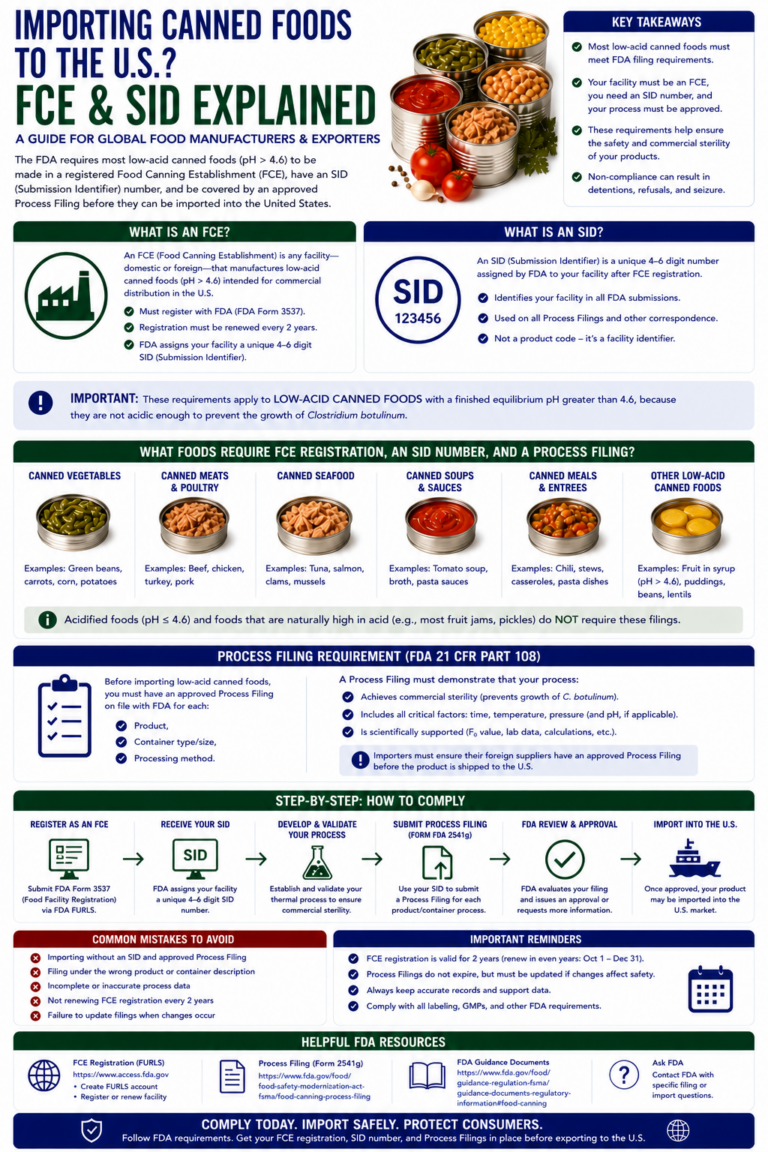
Low-acid canned foods (finished pH above 4.6) such as canned vegetables, meats, seafood, and soups, and acidified foods (a low-acid base brought to pH 4.6 or below with added acid) such as pickles and hot sauces. Naturally acidic foods generally don't require them. Confirming which category your product is in is the first thing to verify, since it decides whether the filings apply.
4. Can I import canned foods without the supplier's FCE and SID?
If the product requires them and they aren't in place, the shipment can be detained or refused — and as the importer you carry the exposure at the port even though the filing is the manufacturer's job. That's why verifying the filings exist and are valid before the goods ship is essential, not optional.
5. What are the red flags that a supplier isn't compliant?
A supplier who can't produce an FCE number, uses one SID across many different products, tells you to "handle the FCE" on your end, has a label that doesn't match the filed formulation, or calls a naturally acidic product "acidified" without validation. Any of these suggests the process-filing side isn't properly handled, and it becomes your problem at import.
6. How does verifying FCE and SID connect to FSVP?
FSVP requires the U.S. importer to verify that a foreign supplier produces food meeting U.S. standards. For canned foods, the supplier's FCE, SID, and process-authority documentation are core evidence for that verification. So checking these isn't a separate task — it's part of building and maintaining your FSVP records, which FDA can inspect.
7. Does each product need its own SID?
Yes — and often each container size and formulation too. When you verify a supplier, confirm there's a scheduled process covering each specific product and package you're importing, not just one filing they point to for everything. A single SID stretched across products that behave differently is a common gap.
8. What if the SID is incorrect or doesn't match the product?
A shipment can be delayed or refused if the filing doesn't match the product, and corrections can't be made at the port. If your verification turns up a mismatch between the SID, the label, and the actual product, that has to be resolved with the manufacturer and process authority before the goods ship, not after.
9. Do I need prior notice as well?
Yes. Prior notice must be filed with FDA before the shipment arrives, identifying the product, shipper, and importer. It's usually filed by your customs broker through the customs system. It's separate from FCE and SID, but it's part of the same pre-arrival picture you need in order before importing.
10. Does the label matter for an imported canned food?
Yes. The label has to meet FDA requirements and be consistent with the filed process. When you verify a supplier, check that the label matches the SID — a label that contradicts the filed formulation can hold a shipment even when the FCE and SID themselves are valid. Label and filing have to line up.
11. Can I fix compliance issues after the goods ship?
In most cases, no. FCE, SID, prior notice, and labeling have to be right before export, and they can't be back-dated once goods are in transit or at the port. Verification is valuable precisely because it happens early — while there's still time to fix a gap with the manufacturer rather than lose a shipment.
12. Does the supplier's FCE registration mean FDA approved the product?
No. FCE registration and SID filings are compliance steps, not an FDA approval or endorsement. FDA doesn't pre-approve foods; the filings put the facility and validated process on record. Verifying them confirms the process-filing requirements are met — it doesn't certify the product, which still has to meet all applicable requirements at import.
13. How long does verification take?
There's no single fixed number — it depends on how quickly your supplier provides documentation and whether any gaps turn up. Requesting the FCE number, SIDs, and process-authority documentation early gives you time to resolve issues before shipping. The point of verifying up front is to avoid a rushed problem at the port.
14. How does FDA Registration Assistance help importers verify FCE and SID?
We help importers confirm their supplier's FCE and scheduled process (SID) are valid and cover the products being imported, check that labels align with the filed process, and organize the documentation into FSVP records. Where a supplier's filings are missing, we can coordinate with the manufacturer and process authority. Starting at $858 for registration, for companies across 135+ countries. Contact info@fdaregistrationassistance.com or +1 (928) 275-8333.