FDA Consulting Services in Miami, Florida
Trusted by 1,000+ companies across 135+ countries, with 15+ years of FDA regulatory experience. Headquartered in Miami-Dade, we help Miami importers, distributors, food and produce companies, cosmetic and beauty brands, supplement makers, and drug and device firms register correctly, prepare shipments before they reach PortMiami or Miami International Airport, and respond when FDA holds a shipment.
Have a shipment on hold, or one about to arrive? Tell us what you import or make, whether food, produce, seafood, cosmetics, supplements, drugs, or devices, and your role in the supply chain. We can review the FDA notice or the planned shipment and identify the registration, FSVP, Prior Notice, labeling, and Florida permit points to address.
Request My Miami FDA AssessmentFDA Services for Miami Businesses
Food, Produce & Supplements
Latin and Caribbean foods, fresh produce, seafood, coffee, and a large supplement sector. FDA food facility registration, FSMA, FSVP, and labeling.
Cosmetics & Beauty
Miami is a beauty and personal-care hub for the Americas. MoCRA cosmetic registration, product listing by the Responsible Person, safety substantiation, and Florida manufacturer permits.
Drugs & Pharma
A pharma logistics point for Latin America. FDA drug establishment registration, listing, NDC labeler codes, and drug import alert support, separate from product approvals.
Medical Devices
A distribution gateway for devices bound for the region. Medical device registration, listing, U.S. Agent, 510(k) context, and device detention support.
Two Roles, Two Rule Sets
In a gateway city like Miami, most businesses import — but many also produce here. The obligations differ sharply, and a lot of Miami companies do both.
| Requirement | If You Produce in Miami | If You Import into Miami |
|---|---|---|
| FDA facility registration | Your facility registers: food every two years, drugs and devices every year, plus any Florida permit | Your foreign supplier's facility registers |
| U.S. Agent | Not required (you're domestic) | Required for foreign food, drug, and device facilities |
| FSVP | Not applicable | Required — you verify the foreign supplier |
| Prior Notice | Not for domestic shipments | Required before each food import arrives, including food for a foreign trade zone |
| Labeling | FDA-compliant labeling | English labeling; a Spanish label must repeat all required information |
Because so much Miami trade is imported, the FSVP and U.S. Agent columns carry the most weight here, and they're where shipments most often get held. Missing FSVP is a common refusal reason; see what to do after an FSVP refusal.
The Gateway to the Americas — and Our Home Base
No U.S. city is more central to FDA-regulated trade with Latin America and the Caribbean. PortMiami and Miami International Airport move food, fresh produce, cosmetics, supplements, pharmaceuticals, and devices into the U.S. every day. MIA ranked first in the U.S. for international freight in 2025 and receives 67% of the perishables imported into the country, including 67% of imported fruits and vegetables and 50% of imported fish, and it is North America's first IATA-designated pharma hub airport (Miami International Airport). That makes the importer's obligations (FSVP, foreign-supplier registration with a U.S. Agent, and Prior Notice) the heart of FDA compliance here.
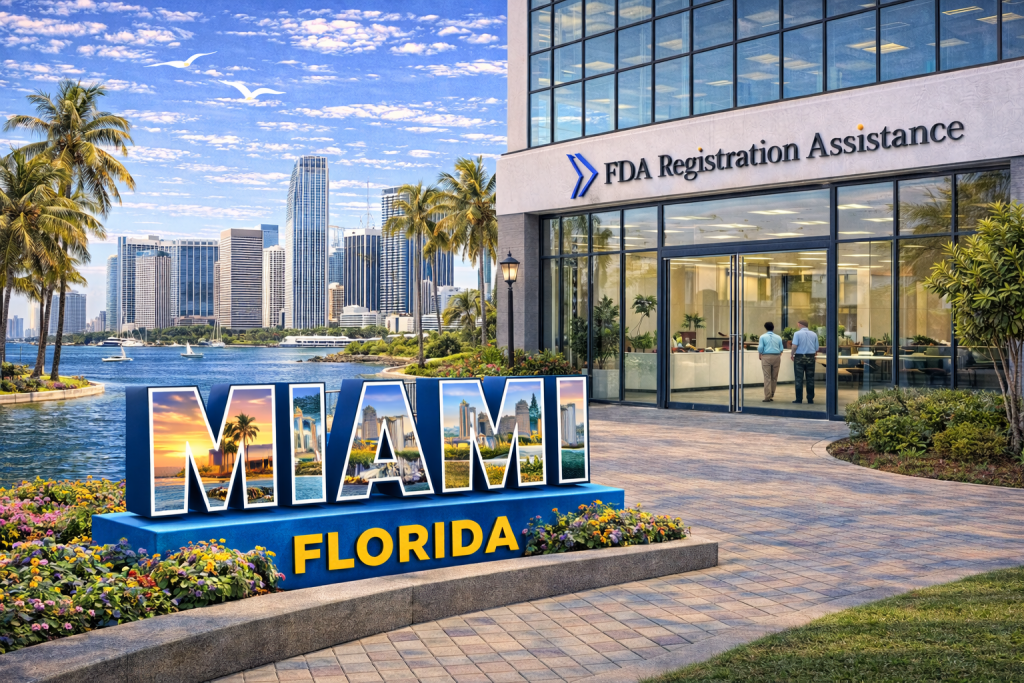
It's also our home market: FDA Registration Assistance is headquartered in Miami-Dade, at 18117 Biscayne Blvd in Aventura. We work hands-on with the importers, distributors, beauty brands, supplement companies, and food producers that make this one of the most FDA-active cities in the country — where a single shipment of perishables can't afford a hold. For national guidance, see FDA registration services in the United States.
FDA Holds, Import Alerts, and Florida Permits
Three issues come up most often for Miami importers and producers: what to do when FDA detains a shipment, how a firm gets off an import alert, and which free trade zone and Florida rules apply.
If FDA Detains Your Shipment
FDA issues a Notice of FDA Action with a respond-by date. The rules allow 10 business days from detention for the owner, consignee, or importer of record to submit testimony, and a representative can respond with written authorization (FDA). The importer of record can also ask to relabel or recondition the goods on Form FDA 766 (FDA).
Getting Off an Import Alert
Products on an import alert can be detained without physical examination at every entry. Many import alerts say at least five consecutive non-violative commercial shipments should be entered before FDA considers removing a firm and product from the Red List (FDA import alert). A removal request also needs evidence that the root cause was corrected. Read more about import alert removal.
Free Trade Zones and Florida Permits
Food for use in a foreign trade zone still needs Prior Notice unless an exemption applies (FDA); Miami-Dade is served by Foreign-Trade Zone No. 32 (International Trade Administration). Florida requires a permit to manufacture a drug, device, or cosmetic in Florida or distribute prescription drugs in or into the state (Florida DBPR), and FDACS permits food manufacturers and warehouses (FDACS).
Other Florida service areas: Fort Lauderdale, West Palm Beach, Orlando, Tampa, and Jacksonville.
A Cross-Category Checklist
FDA Registration for Every Product Type
Whatever you make or import through Miami, we handle the full FDA pathway by category: FDA food facility registration, seafood importer registration, coffee products, dietary supplements, FDA drug establishment registration, OTC drugs, medical device registration, and MoCRA cosmetic registration. Tell us your category and we'll map the exact steps.
FDA Compliance for Your Miami Business
Tell us your products and your role in the supply chain, whether importer, distributor, producer, or brand owner, and we'll confirm which FDA registrations, listings, and programs apply, then handle the filings, U.S. Agent and FSVP work, label review, and the documentation FDA asks for when a shipment is held.
- Identify which FDA programs apply to each product, supplier, and facility.
- Review a Notice of FDA Action or import alert listing and outline the evidence to gather.
- Agree the scope, required documents, and pricing before any paid work begins.
Contact our specialists, email info@fdaregistrationassistance.com, or call +1 (928) 275-8333. Import alert help · Registration pricing · All service areas.
Request My Miami FDA AssessmentFDA Registration Assistance is a private regulatory consulting firm, not a law firm, FDA, or any government agency. Professional assistance is not legal advice, government approval, or a guarantee of a regulatory outcome.
Frequently Asked Questions — FDA Consulting in Miami, Florida
Do businesses in Miami need FDA registration?
Many do. Facilities that manufacture, process, pack, or hold food, establishments that make drugs or devices, initial device importers, and cosmetic manufacturers generally register with the FDA. A Miami importer that only buys and resells usually doesn't register itself but needs registered foreign suppliers and FSVP; domestic device distributors that do not import also do not register (FDA). What you file depends on whether you produce or import.
Why is Miami such an important city for FDA compliance?
Because Miami is the primary U.S. gateway for trade with Latin America and the Caribbean. Miami International Airport ranked first in the U.S. for international freight in 2025 and handles 67% of perishables imported into the country (Miami International Airport), and PortMiami adds ocean cargo, so import compliance is central here.
Are you actually based in Miami?
Yes. FDA Registration Assistance is headquartered in Miami-Dade at 18117 Biscayne Blvd, Suite 1288, in Aventura, so this is our home market. We are a private consulting firm, not an FDA office. We work with Miami importers, manufacturers, distributors, and brand owners, as well as clients across the U.S. and 135+ countries.
I import products into Miami — what do I need?
Then FSVP applies: you verify each foreign supplier, the foreign facility registers and appoints a U.S. Agent, and Prior Notice is filed before each shipment. This is the most common situation we handle in Miami.
Does a Miami-based (domestic) producer need a U.S. Agent?
No. A U.S. Agent is only required for foreign facilities. As a domestic Miami producer you register your own facility, but you don't need a U.S. Agent — that requirement falls on your foreign suppliers if you import.
How are food and produce imports through Miami regulated?
Imported food needs the foreign facility registered, FSVP by the U.S. importer, and Prior Notice per shipment. Farms are exempt from food facility registration, but packinghouses that are not farms register, and the importer verifies that the foreign farm meets the FSMA Produce Safety Rule. Perishables move fast, so compliance must be in place before arrival.
What about Latin American and Caribbean food brands?
They're treated as foreign suppliers: the producing facility registers with the FDA and appoints a U.S. Agent, the Miami importer runs FSVP, and labeling must meet U.S. requirements in English; if the label also uses Spanish, all required information must appear in both languages (21 CFR 101.15). We coordinate both sides of that relationship.
Miami is a beauty hub — do cosmetics companies need to register?
Under MoCRA, cosmetic manufacturers register their facility, and the Responsible Person, usually the brand owner, lists products and substantiates safety. Some small businesses, generally those with under $1 million in average annual U.S. cosmetic sales, are exempt from registration and listing (FDA). Manufacturing cosmetics in Florida also requires a state permit (Florida DBPR). Miami's large beauty sector, much of it serving Latin America, is squarely covered.
Do dietary supplement companies in Miami register?
Yes. Supplements are regulated as foods, so manufacturing facilities register as food facilities and follow the CGMP rule in 21 CFR Part 111, with a Supplement Facts label; there is no FDA product approval or registration for the supplement itself. Miami has a substantial supplement and nutraceutical industry, both domestic and import-driven.
How are pharmaceutical imports and distribution handled?
Drug establishments register and list with the FDA, with NDC labeler codes, and imported drugs face additional controls. Prescription drug wholesale distributors don't register as drug establishments; they need a state license, including a Florida permit to distribute in or into Florida (Florida DBPR), and report licensure to FDA every year under DSCSA (FDA). Miami's role as a pharma logistics point for Latin America makes correct registration and documentation important.
Do medical device companies in Miami need to register?
Yes. Device makers and initial importers complete FDA establishment registration, with device listing for manufacturers and a U.S. Agent for foreign establishments, and pay the annual establishment fee, $13,785 for FY 2027 (Federal Register). Manufacturers follow the Quality Management System Regulation (FDA), and many devices need a 510(k). Miami is a key device-distribution point for Latin America.
What is FSVP and why does it matter so much in Miami?
The Foreign Supplier Verification Program is the U.S. importer's duty to verify that foreign suppliers meet U.S. food-safety standards. Because Miami imports so much food, FSVP is one of the most frequent — and most frequently missed — requirements here.
Can FDA Registration Assistance act as our U.S. Agent or FSVP Agent?
Yes. We serve as the U.S. Agent for foreign food, drug, and device facilities, and we support FSVP programs for importers, including acting as the designated FSVP agent when no U.S. owner or consignee is available. We manage the related filings for Miami importers and their suppliers.
What happens if an import isn't compliant when it reaches Miami?
The shipment can be detained or refused, and perishables can spoil during the hold. The Notice of FDA Action sets a respond-by date, generally based on 10 business days from detention (FDA), and we help prepare the testimony, a reconditioning request, or import alert removal evidence. We are regulatory consultants, not attorneys; if a matter needs legal counsel, we will tell you. Getting registration, FSVP, and Prior Notice right before arrival is what keeps goods moving.
Is a DUNS Number required?
Yes. For food facility registration the DUNS Number is the required Unique Facility Identifier, and drug establishments use a DUNS Number as well. We help you or your foreign supplier obtain one if it isn't already in place.
Does registration need to be renewed?
Yes. Food facility registrations renew every two years, between October 1 and December 31 of even-numbered years, so the current window runs to December 31, 2026, and an unrenewed registration is treated as expired (FDA). Cosmetic facility registrations renew every two years, and drug and device registrations renew annually. We track and manage the renewals so nothing lapses.
Does FDA registration mean FDA approval?
No. Registration and listing are mandatory regulatory steps; they are not FDA approval or endorsement. Some products, such as new drugs and many devices, need separate FDA approval or clearance, and claiming “FDA approved” when you are only registered is misleading and can misbrand the product.
How long does FDA registration take?
Many registrations and listings are completed within a few business days once your information and any identifiers, like a DUNS Number, are ready. FSVP setup, labeling, and premarket submissions take additional time.
We re-export through a Miami free trade zone — do FDA rules apply?
Partly. Food imported for future export or for use in a foreign trade zone still needs Prior Notice unless an exemption applies, such as food exported without leaving the port of arrival (FDA). Products later entered into U.S. commerce need full compliance, while true re-exports may differ. We help determine which rules apply to your specific flow.
We sell imported foods on Amazon from Miami — do FDA rules still apply?
Yes. Online sales don't change FDA requirements, and the import obligations — foreign facility registration, FSVP, and Prior Notice — still apply. Marketplaces often request proof of compliance, and FSVP for Amazon sellers explains the importer side.
Do labeling requirements apply to imported products?
Yes. Imported food, supplements, cosmetics, drugs, and devices must meet U.S. labeling rules — Nutrition, Supplement, or Drug Facts, ingredients, allergens, net quantity, and English. We review and fix labels before goods ship.
Do you work with companies outside Miami?
Yes. While we are based in Miami, we serve clients across Florida, the U.S., and 135+ countries, with the same process whether you're local or overseas.
What's the first step for a Miami business?
A quick review of your products and your role — producer, importer, brand owner, or distributor — to map exactly which FDA registrations and programs apply. From there we handle the filings.
Can you handle multiple product categories for one company?
Yes. Many Miami importers and brands span food, cosmetics, supplements, and devices; we coordinate registration, listing, U.S. Agent, and FSVP across each category under a single engagement.
How do I get started?
Send us your company and product details and your role in the supply chain using the form at the bottom of this page, or contact our team, and we'll confirm which FDA requirements apply to your Miami business and handle the registrations and filings. Email info@fdaregistrationassistance.com or call +1 (928) 275-8333.
Request FDA Support for Your Miami Business
Tell us what your company makes, sells, or distributes, where each product is manufactured or packed, your U.S. importer or buyer arrangement, label readiness, and target shipment date.
Submitting this inquiry does not purchase a service or authorize paid work. Our team can discuss the scope and required materials before you commission assistance. Fields marked with an asterisk are required.