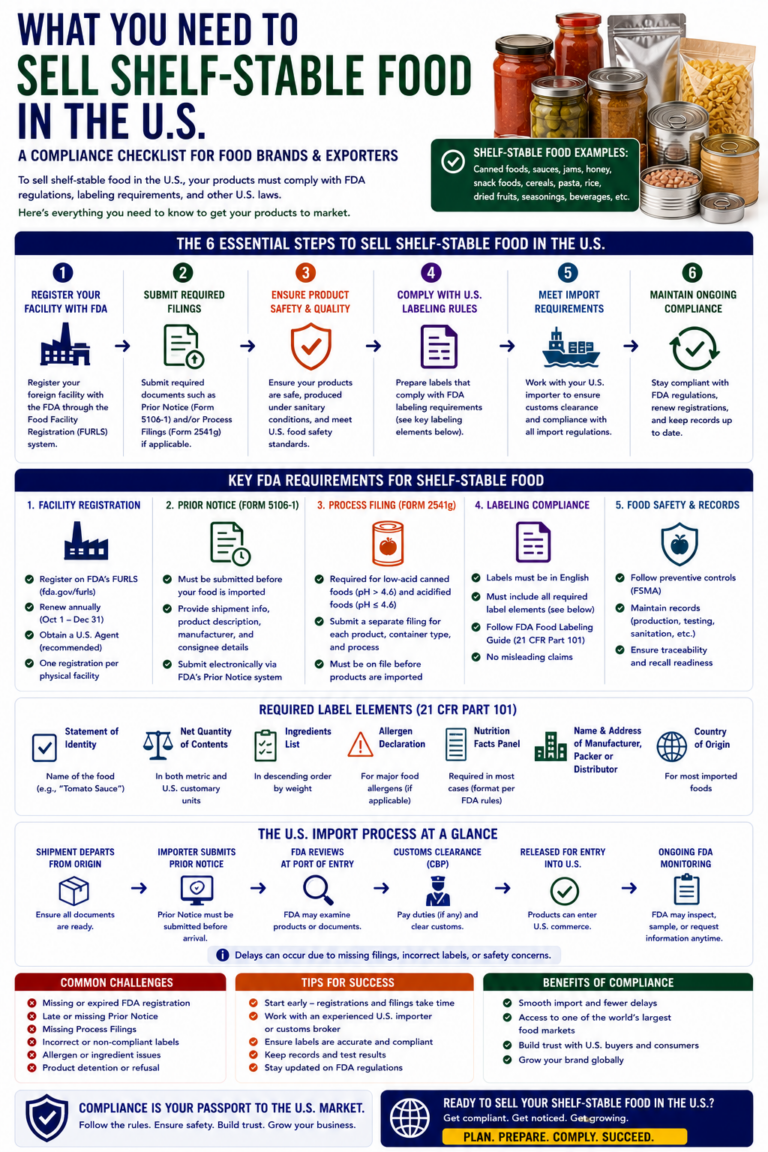
What You Need to Sell Shelf-Stable Food in the U.S.
The one decision that changes your requirements — plus the full checklist of what it takes to sell shelf-stable food in the U.S.
Key Takeaways
- The standard set always applies — registration, labeling, FSVP, prior notice.
- FCE/SID depends on classification — low-acid and acidified foods need it; others usually don't.
- "Shelf-stable" ≠ "needs a filing" — and it doesn't mean "no filing" either.
- Not canned can still need a filing — a low-acid food controlled by water activity or formulation files too.
- Naturally acid & dry foods generally skip FCE/SID — but still register and label.
- A process authority confirms classification — it's not a guess to make on your own.
How a Food Becomes Shelf-Stable
Shelf stability means the product is safe at room temperature. There are a few ways to get there — and the method is exactly what determines your FDA requirements:
Thermal processing
Heat to commercial sterility (canning/retort)
Acidity
Low pH stops bacterial growth
Low water activity
Drying or formulation removes available water
Hurdles combined
Sugar, salt, preservatives, fermentation
Does Your Shelf-Stable Food Need FCE/SID?
This is the question that changes your requirements. Here's how the categories break down:
| Your product | FCE / scheduled process? | Notes |
|---|---|---|
| Low-acid, thermally processed (LACF) | Required | pH > 4.6, aw > 0.85 — canned soups, vegetables, meats Part 113 |
| Low-acid, water-activity / formulation control | Required | Low-acid but shelf-stable without canning — still files (Form 2541f) |
| Acidified (acid added to pH ≤ 4.6) | Required | Pickles, some sauces, salsas Part 114 |
| Naturally acid (pH ≤ 4.6, no acid added) | Usually not | Many fruit products — still register & label |
| Dry / low-aw / high-sugar (not low-acid) | Usually not | Grains, snacks, powders — still register & label |
The Rest of What You Need
Whatever your classification, every shelf-stable food needs these to be sold in the U.S.:
Facility registration + U.S. Agent
An active FDA Food Facility Registration; foreign facilities designate a U.S. Agent.
Compliant labeling
Identity, Nutrition Facts, ingredients, allergens, net quantity, responsible party — matching your formulation and any filing.
FSVP importer + documentation
A U.S. importer running FSVP, and consistent shipment documents.
Prior notice
Filed to FDA before each shipment arrives — usually by your customs broker or importer.
Selling Isn't the Same as Importing
Clearing FDA gets your product into the country. Selling through a marketplace or retailer can add its own layer: they generally require FDA-compliant labeling and may request compliance documentation before or after listing — and can remove non-compliant products. So aim for a label and documentation set that satisfies both FDA and your sales channel from the start.
Getting Sell-Ready
Determine how your product stays stable
Thermal, acidity, water activity, or formulation — this decides FCE/SID.
Register the facility
Food Facility Registration; foreign facilities add a U.S. Agent.
Add FCE & a scheduled process if required
For low-acid or acidified foods, validated by a process authority.
Make the label compliant
Matching your formulation and any filing.
Set up FSVP & documentation
A compliant importer and consistent paperwork.
File prior notice & confirm channel needs
Before arrival — and ready for marketplace/retailer requirements.
Sell Shelf-Stable Food the Compliant Way
FDA Registration Assistance starts by confirming how your product achieves shelf stability and whether FCE/SID applies — then handles the FDA side end to end: registration and U.S. Agent, FCE and scheduled process filings where required with process-authority coordination, and label and documentation review with FSVP support.
Contact us at info@fdaregistrationassistance.com or call +1 (928) 275-8333. Food Facility Registration is available starting at $858. Trusted by companies across 135+ countries, with 15+ years of experience.
Frequently Asked Questions
1. What do I need to sell shelf-stable food in the U.S.?
The standard requirements — FDA Food Facility Registration (with a U.S. Agent for foreign facilities), a compliant label, an FSVP importer, documentation, and prior notice — plus, for some shelf-stable foods, FCE registration and a scheduled process filing. Whether that last part applies depends on how your product achieves shelf stability, which is the key question to answer first.
2. Do all shelf-stable foods need FCE and SID filings?
No — and this is the most misunderstood point. FCE and a scheduled process are required for low-acid and acidified foods. Naturally acid foods, dry foods, and other products that aren't low-acid generally don't need them. The determining factor is whether your product is a low-acid or acidified food, not simply whether it sits on a shelf.
3. My product is shelf-stable but not canned — do I still need a filing?
Possibly yes. If it's a low-acid food made shelf-stable by controlling water activity or formulation rather than by canning, it can still require a scheduled process filing (Form 2541f) — because botulinum control in a low-acid food has to be established regardless of method. "Not canned" doesn't automatically mean "no filing."
4. How do I know if my product is low-acid or acidified?
A low-acid food has a finished equilibrium pH above 4.6; an acidified food is a low-acid food brought to a finished pH of 4.6 or below by adding acid. A food that is naturally at or below 4.6 without added acid is neither. Because the classification drives your filing requirement, a process authority typically confirms it rather than leaving it to a rough estimate.
5. Which shelf-stable foods usually don't need FCE/SID?
Generally, naturally acid foods (many fruit products), dry foods (grains, snacks, powders), high-sugar products, and other items that aren't low-acid and don't rely on a controlled low-acid process. They still need registration, labeling, FSVP, and prior notice — just not the FCE and scheduled process filing.
6. Does FDA approve my shelf-stable food before I sell it?
No. FDA doesn't approve food or labels. It requires registration and, for low-acid and acidified foods, the FCE and scheduled process filings — and it reviews shipments at import. There's no approval to obtain, but there are mandatory requirements to meet before you sell.
7. Do I need a process authority?
If your product is a low-acid or acidified food, yes — a process authority establishes and validates the scheduled process behind your filing. For products that aren't low-acid or acidified, a process authority generally isn't required, though confirming your classification is still worthwhile.
8. Is registration alone enough to sell shelf-stable food?
No. Registration is the foundation, but selling also requires compliant labeling, an FSVP importer, prior notice, and any FCE/SID filings your product needs. Registration lets your facility be listed; the other pieces let the product actually enter and be sold.
9. Do labeling rules apply to all shelf-stable foods?
Yes. Every food needs a compliant U.S. label — identity, Nutrition Facts, ingredients in descending order, allergens, net quantity, and responsible party — and for products with a filing, the label must also match the formulation and process on file. Labeling is one of the most common causes of holds.
10. Does selling online or in retail add requirements?
The FDA requirements are the same, but marketplaces and retailers add their own layer: they generally require FDA-compliant labeling and may request compliance documentation before or after listing, and can remove non-compliant products. Being import-compliant is necessary but, for those channels, not always the whole picture.
11. Who submits prior notice?
Prior notice must reach FDA before the shipment arrives and is usually filed by the customs broker or importer. It needs to be accurate and consistent with your registration and any filings; errors can cause refusal at entry.
12. Can I fix compliance issues after shipping?
In most cases, no. Missing registration, filings, or a compliant label can't be resolved at the border, and the shipment can be held, detained, or refused. Compliance for shelf-stable foods has to be complete before you ship and sell.
13. What are the most common mistakes?
Assuming a shelf-stable product doesn't need a filing when it's actually low-acid, misclassifying the product, non-compliant labeling, no FSVP importer, incomplete documentation, and prior notice errors. The classification mistakes are the ones most specific to shelf-stable foods.
14. How does FDA Registration Assistance help?
We start by confirming how your product achieves shelf stability and whether FCE/SID applies, then handle the FDA side end to end: Food Facility Registration and U.S. Agent, FCE and scheduled process filings where required, process-authority coordination, and label and documentation review with FSVP support — all before you ship. Starting at $858 for registration, for companies across 135+ countries. Contact info@fdaregistrationassistance.com or +1 (928) 275-8333.