
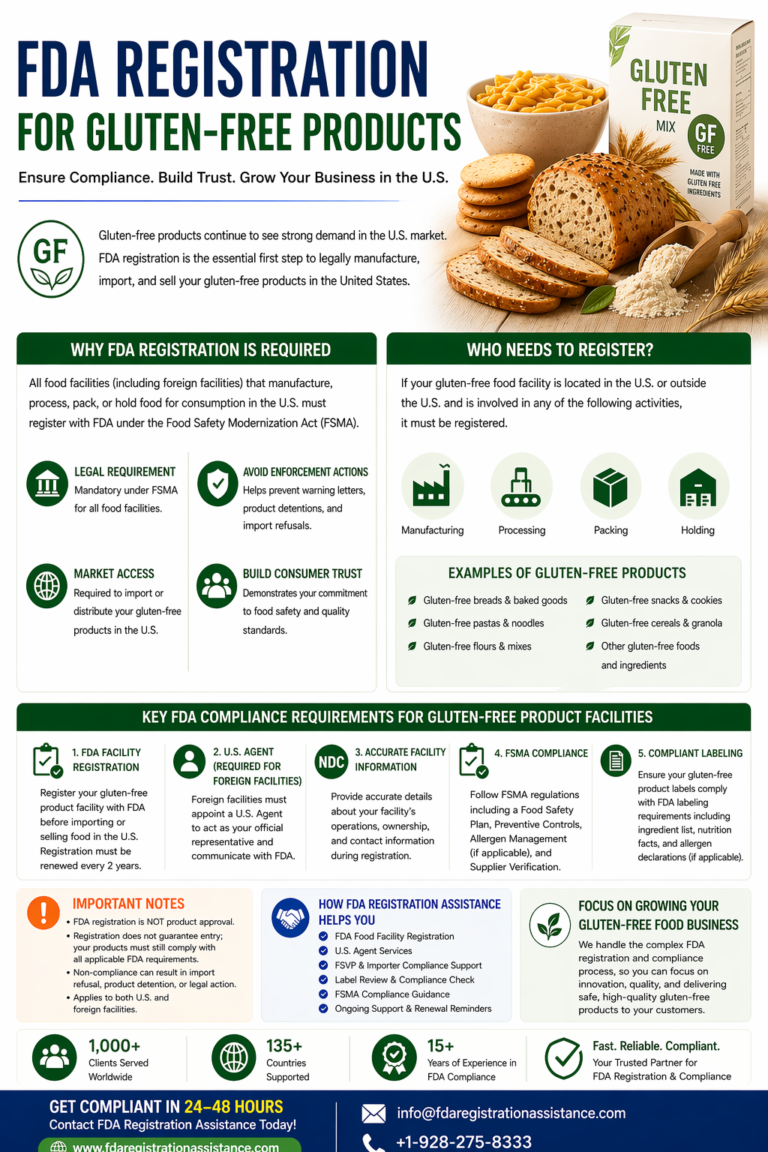
FDA Registration for Gluten-Free Products
The under-20-ppm standard, the fermented/hydrolyzed recordkeeping rule, and why wheat-free doesn't mean gluten-free.
Key Takeaways
- Gluten-free IS FDA-defined — unlike keto or halal, there's an enforceable standard.
- Under 20 ppm gluten — the threshold under 21 CFR 101.91 (2013 rule).
- Wheat, rye, barley + crossbreeds — the gluten-containing grains to keep out.
- Fermented/hydrolyzed foods need records — proving gluten-free before fermentation.
- "Wheat-free" ≠ "gluten-free" — barley and rye still contain gluten.
- Wheat is still a major allergen — gluten-free doesn't remove allergen labeling.
The One Diet Claim FDA Actually Defines
Most diet-marketing terms — "keto," "paleo," "clean," even "low carb" — have no FDA definition, so they're judged only by the general "truthful and not misleading" standard. Gluten-free is the exception. FDA issued a specific rule in 2013 (codified at 21 CFR 101.91) precisely because the claim matters medically: it exists to protect people with celiac disease, who must avoid gluten entirely.
That means gluten-free isn't a marketing flourish you can define yourself — it's a regulated claim with a number attached. If your label says gluten-free and the product doesn't meet the standard, it's misbranded, and false gluten-free claims are a frequent trigger for FDA warning letters and import refusals.
What "Gluten-Free" Requires
| Element | Requirement |
|---|---|
| The claim terms | "Gluten-free," "no gluten," "free of gluten," "without gluten" (21 CFR 101.91) |
| Gluten limit | Less than 20 ppm gluten — including any unavoidable presence |
| Grains kept out | Wheat, rye, barley + crossbreeds (e.g. triticale; spelt is wheat) |
| Ingredients from those grains | Only if processed to remove gluten AND the food stays under 20 ppm |
| Fermented / hydrolyzed foods | Records proving gluten-free before fermentation (can't be reliably tested) |
| "Wheat-free" | Not the same — barley and rye still contain gluten |
Fermented, Hydrolyzed & Distilled Foods
Here's where gluten-free gets genuinely technical. In fermented and hydrolyzed foods, gluten proteins are broken apart, and current test methods can't reliably detect or quantify the gluten. So FDA's 2020 rule (compliance 2021) built a records-based path instead of finished-product testing:
- Prove it before fermentation — records showing the food was gluten-free (under 21 CFR 101.91) before fermentation or hydrolysis
- Evaluate cross-contact — assess the process for gluten cross-contact and control any risk
- Keep the records ≥ 2 years — available to FDA on inspection
- Distilled foods (e.g. distilled vinegar) — FDA verifies the absence of protein/gluten in the distillate; malt beverages (not distilled) fall under the recordkeeping path
Wheat-Free ≠ Gluten-Free (and the Allergen)
- "Wheat-free" is not "gluten-free" — a wheat-free product can still contain gluten from barley (malt, malt vinegar) or rye; don't use the terms interchangeably
- Wheat is still a major allergen — under FALCPA, and gluten-free doesn't remove that duty
- You can be both gluten-free and "Contains: Wheat" — e.g. specially processed wheat starch tested under 20 ppm: labeled gluten-free, but still needs the wheat allergen declaration
- Imported labels rarely map cleanly — a foreign "gluten-free" claim doesn't automatically meet the U.S. definition
Get Your Gluten-Free Products Compliant
FDA Registration Assistance handles registration and the compliance around the claim: confirming your product can meet the under-20-ppm definition, setting up the fermented/hydrolyzed recordkeeping where it applies, reviewing your label so the gluten-free claim and the wheat allergen declaration are both correct, and handling U.S. Agent and FSVP for imports.
Contact us at info@fdaregistrationassistance.com or call +1 (928) 275-8333. Food Facility Registration is available starting at $858. Trusted by companies across 135+ countries, with 15+ years of experience.
Frequently Asked Questions
1. Do gluten-free products require FDA registration?
Yes — gluten-free foods are regulated as ordinary food, so a facility that manufactures, processes, packs, or holds them for the U.S. registers with FDA (foreign facilities also need a U.S. Agent). What makes gluten-free different from claims like "keto" or "halal" is that FDA actually defines it — so on top of the normal food rules, there's a specific, enforceable gluten-free standard your product must meet if it bears the claim.
2. What is the FDA definition of "gluten-free"?
Under FDA's 2013 rule (21 CFR 101.91), "gluten-free" — along with "no gluten," "free of gluten," and "without gluten" — means the food contains less than 20 parts per million (ppm) of gluten. The food must either be inherently gluten-free, or not contain a gluten-containing grain, an ingredient derived from one that hasn't been processed to remove gluten, or such an ingredient processed to remove gluten if it still leaves 20 ppm or more. Any unavoidable gluten must stay under 20 ppm. It's a voluntary claim — but once you make it, you must meet the standard.
3. Which grains count as gluten-containing?
Wheat, rye, barley, and their crossbred hybrids (such as triticale) — and note that spelt is a type of wheat. Ingredients derived from these (wheat flour, barley malt) generally disqualify a gluten-free claim unless they've been processed to remove gluten and the finished food still tests under 20 ppm. This is why the exact source of every ingredient matters, not just the headline recipe.
4. Is "wheat-free" the same as "gluten-free"?
No — and conflating them is a serious error. A product can be wheat-free and still contain gluten from barley or rye (barley malt, malt vinegar, rye flour). "Gluten-free" covers all gluten-containing grains and carries the under-20-ppm standard; "wheat-free" only tells you wheat isn't present. Don't use them interchangeably on a label, and don't assume a wheat-free formulation qualifies as gluten-free.
5. Do I still declare wheat as an allergen on a gluten-free product?
Yes, if any wheat-derived ingredient is present. Wheat is one of the major food allergens under FALCPA, and the gluten-free rule doesn't remove allergen-labeling duties. A product can, for example, use specially processed wheat starch, test under 20 ppm gluten, be labeled "gluten-free," and still need a "Contains: Wheat" allergen declaration. Gluten-free and allergen labeling are separate obligations that both apply.
6. How do fermented and hydrolyzed foods prove they're gluten-free?
Through records, not just testing. Because current test methods can't reliably detect and quantify intact gluten in fermented or hydrolyzed foods (yogurt, sauerkraut, pickles, cheese, vinegar, beer, hydrolyzed plant protein), FDA's 2020 rule requires the manufacturer to make and keep records demonstrating the food was gluten-free (under 21 CFR 101.91) before fermentation or hydrolysis, that cross-contact was evaluated, and that any risk was controlled. These records must be kept at least two years and shown to FDA on request.
7. What about distilled foods like vinegar?
Distillation removes gluten proteins, so for distilled foods (such as distilled vinegar) FDA evaluates compliance by verifying the absence of protein — and therefore gluten — in the distillate using scientifically valid methods. Note a related point: malt beverages don't undergo distillation, so if they bear a gluten-free claim they fall under the fermented/hydrolyzed recordkeeping approach instead.
8. Am I required to test my product for gluten?
The rule doesn't mandate testing — you're responsible for ensuring the food meets the under-20-ppm standard, and testing with a scientifically valid method is the most effective way to do that. For most non-fermented foods, periodic testing plus ingredient and supplier controls is the practical route. For fermented/hydrolyzed foods, the recordkeeping approach substitutes for finished-product testing. Either way, the burden of proof is on you.
9. Can oats be gluten-free?
Yes. Oats are inherently gluten-free but are frequently cross-contacted with wheat, barley, or rye during growing and handling. Oats and oat products can bear a gluten-free claim if the finished food is under 20 ppm gluten, which in practice means sourcing gluten-free oats and controlling cross-contact throughout your process.
10. Does FDA approve gluten-free products?
No. FDA doesn't pre-approve foods or labels. You register your facility, ensure the product genuinely meets the gluten-free definition, keep the required records (especially for fermented/hydrolyzed foods), and label correctly; FDA enforces afterward. Because "gluten-free" is a defined claim aimed at protecting people with celiac disease, a false or unsubstantiated gluten-free claim is a common trigger for warning letters and import problems.
11. Does importing gluten-free food require anything extra?
Yes — the standard import steps: the foreign facility registers with FDA and keeps a U.S. Agent, and the U.S. importer runs FSVP with prior notice per shipment. Beyond that, imported products must meet the U.S. gluten-free standard and (for fermented/hydrolyzed items) the recordkeeping rule — foreign gluten-free labels don't automatically satisfy the U.S. definition, so this is a frequent point of failure at the border.
12. Are gluten-free supplements handled the same way?
The 21 CFR 101.91 gluten-free definition applies to dietary supplements as well as conventional foods, so a supplement bearing a gluten-free claim must meet the same under-20-ppm standard (and the fermented/hydrolyzed recordkeeping rule if relevant). Supplements also carry their own Supplement Facts labeling and framework on top of the gluten-free requirement.
13. What are the most common gluten-free mistakes?
Treating "wheat-free" as "gluten-free"; forgetting the wheat allergen declaration on a gluten-free product that uses wheat starch; missing the fermented/hydrolyzed recordkeeping requirement; assuming a supplier's claim is enough without documentation; and not controlling cross-contact (especially with oats). The theme is that gluten-free is a real, enforceable standard — so it has to be built into sourcing, process, and records, not just printed on the package.
14. How does FDA Registration Assistance help with gluten-free products?
We handle registration and the compliance around the claim: confirming your product can meet the under-20-ppm definition, setting up the fermented/hydrolyzed recordkeeping where it applies, reviewing your label so the gluten-free claim and the wheat allergen declaration are both correct, and handling U.S. Agent and FSVP for imports. Registration is available starting at $858, for companies across 135+ countries. Contact info@fdaregistrationassistance.com or +1 (928) 275-8333.