
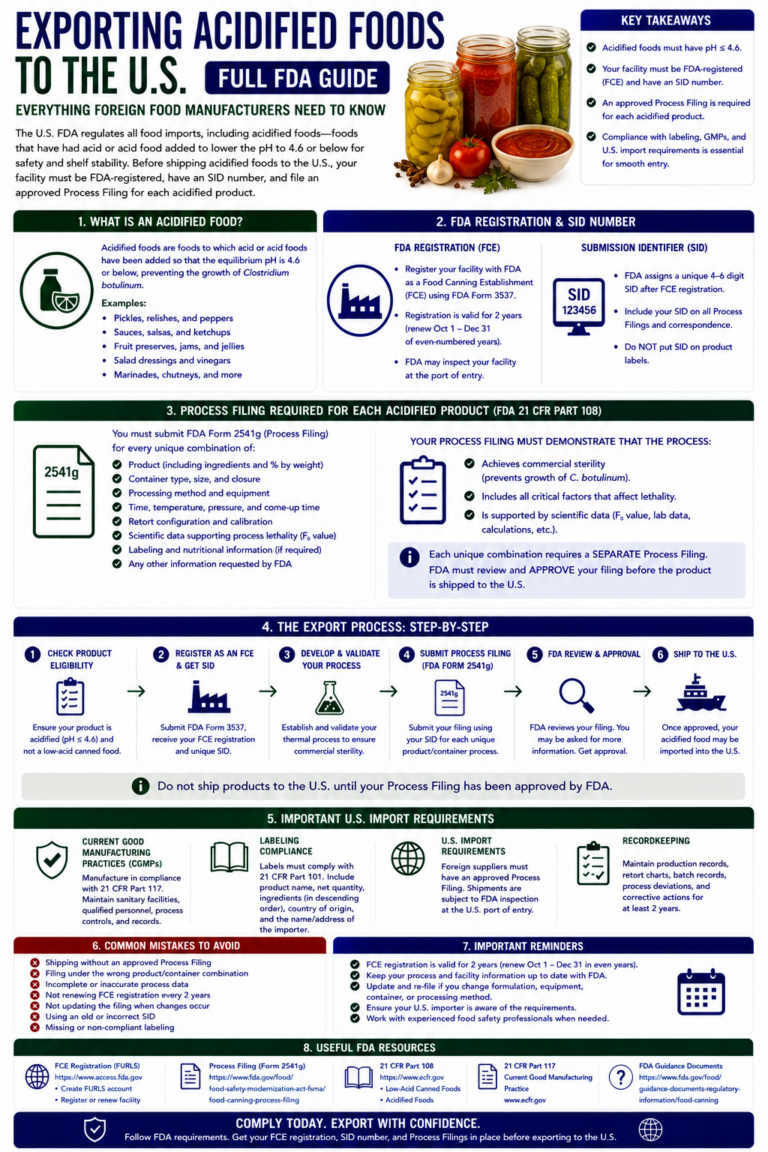
Exporting Acidified Foods to the U.S.
What's distinct about acidified foods, the export requirements, and the guide for your product type.
Key Takeaways
- Acidified foods fall under Part 114 — not Part 113 (that's low-acid canned).
- The acid is the control — pH 4.6 or below, reached and held uniformly.
- Filed via the acidified-method form (2541e) — against your FCE.
- A process authority validates the pH control — not just heat.
- Cold-filled products often need challenge studies — validation isn't one-size-fits-all.
- Everything before export — filings can't be fixed at the border.
Why Acidified Foods Are Handled Differently
Acidified and low-acid canned foods are often mentioned together, but their safety basis — and therefore their filing — differs at the core:
Low-acid canned (LACF)
- Natural pH above 4.6
- Safety from thermal sterilization
- Filed under Part 113
- Validation centers on the heat process
Acidified
- Low-acid base + added acid → pH ≤ 4.6
- Safety from acidification
- Filed under Part 114, Form 2541e
- Validation centers on pH control
What Exporting Acidified Foods Involves
Beyond the acidification itself, exporting acidified foods runs through the same compliance chain as any regulated canned food:
- Confirm classification — that it's a true acidified food, ideally verified by a process authority
- FCE registration + a scheduled process (SID) under Part 114, per product and container
- Process-authority validation of your acidification and pH control
- A compliant label that matches your formulation and the process on file
- The import chain — FSVP held by your U.S. importer, prior notice filed before arrival
Guides for Your Acidified Product
Each acidified category has its own nuances — go straight to yours:
Common Acidified Export Mistakes
Export Your Acidified Foods Compliantly
FDA Registration Assistance handles the acidified-food side end to end: confirming classification, Food Facility Registration and U.S. Agent, FCE and scheduled process (SID) filing under Part 114, process-authority coordination for pH validation, and label review — so your product is compliant before export.
Contact us at info@fdaregistrationassistance.com or call +1 (928) 275-8333. Food Facility Registration is available starting at $858. Trusted by companies across 135+ countries, with 15+ years of experience.
Frequently Asked Questions
1. What does it take to export acidified foods to the U.S.?
FCE registration and a scheduled process (SID) filed under 21 CFR Part 114 for each product, validated by a process authority, plus the standard export requirements: Food Facility Registration, a U.S. Agent for foreign facilities, a compliant label, FSVP held by your U.S. importer, and prior notice. Because acidified foods rely on acidity for safety, validation centers on your product reliably reaching and holding pH 4.6 or below.
2. What makes acidified foods different from other canned foods?
In a low-acid canned food, thermal sterilization is the safety control; in an acidified food, the acidification is. An acidified food starts as a low-acid product and has acid added to bring it to pH 4.6 or below, which prevents Clostridium botulinum from growing. So they fall under Part 114 rather than Part 113, and their scheduled process is about validated pH control, not just heat.
3. Which scheduled process form applies to acidified foods?
Acidified foods are filed using the acidified-method scheduled process form (Form 2541e), against your FCE. It captures how the product is acidified and processed — pH, acidification method, time, temperature, and container. Each product and container generally needs its own scheduled process, validated by a process authority.
4. Why is pH so important for acidified foods?
Because pH is the safety mechanism. The product has to reach and hold an equilibrium pH of 4.6 or below, uniformly throughout, to keep Clostridium botulinum from growing. If acidification isn't uniform or the pH drifts above 4.6, the safety basis fails — which is why a process authority validates the pH control specifically.
5. Do cold-filled acidified products need extra validation?
Often, yes. Many acidified foods are hot-filled, but products that are cold-filled or rely on formulation rather than heat typically need challenge studies to prove the process reliably controls pathogens. A process authority determines what validation your specific product and process require — it isn't one-size-fits-all.
6. Do I need both FCE and SID?
Yes, if your product is a true acidified food. FCE registers the facility as a canning establishment; the scheduled process (SID) is then filed per product under Part 114. FCE has to be in place first, and a SID can't exist without it. Both must be complete before you export.
7. How do I confirm my product is actually acidified?
It has to be a low-acid base with acid added to reach pH 4.6 or below, shelf-stable in a sealed container. Naturally acidic foods and several excluded categories aren't acidified foods and follow different rules. Because the boundary is technical, a process authority should confirm the classification before you file.
8. Does each product variation need its own filing?
Generally yes. A different formulation, container type, or size can change the validated process, so each typically needs its own scheduled process. A hot sauce in a 5 oz bottle and the same sauce in a gallon jug usually need separate filings, since the process that ensures safety can differ.
9. Does labeling matter for acidified foods?
Yes. The label must meet FDA requirements and match your formulation and the scheduled process on file. A label that doesn't align with the filed process is a common cause of holds even when the FCE and SID are valid, so labeling and the filing have to be consistent.
10. Who holds FSVP for an acidified food import?
The U.S. importer — the owner or consignee at entry — holds FSVP, not the foreign manufacturer. As the exporter you support it by providing your registration, FCE, SID, and process documentation, but the FSVP obligation itself sits with the U.S. importer bringing the product in.
11. What happens if I ship without the filings?
Your shipment can be placed on hold while FDA requests documentation, delayed while it's resolved, or refused. A missing FCE, scheduled process, or prior notice can't be fixed once the goods are at the port. Shipping before the acidified-food filings are complete is one of the most common and avoidable mistakes.
12. Does registration or filing mean FDA approved my product?
No. FCE registration and the scheduled process filing are compliance steps, not an FDA approval or endorsement. FDA doesn't pre-approve foods or labels; the filings establish that your facility is registered and your acidification process is validated and on record. The product still has to meet all applicable requirements at import.
13. Is the process the same for acidified beverages and sauces?
The core Part 114 framework is the same, but each product type has nuances. Acidified beverages follow the same rules unless they're carbonated or juice, which are handled differently; acid-predominant dressings and condiment sauces can be acid foods rather than acidified foods. There are dedicated guides for beverages, sauces, and hot sauce for the specifics.
14. How does FDA Registration Assistance help acidified food exporters?
We handle the acidified-food side end to end: confirming classification, Food Facility Registration and U.S. Agent, FCE and scheduled process (SID) filing under Part 114, process-authority coordination for pH validation, and label review — so your product is compliant before export. Starting at $858 for registration, for companies across 135+ countries. Contact info@fdaregistrationassistance.com or +1 (928) 275-8333.