
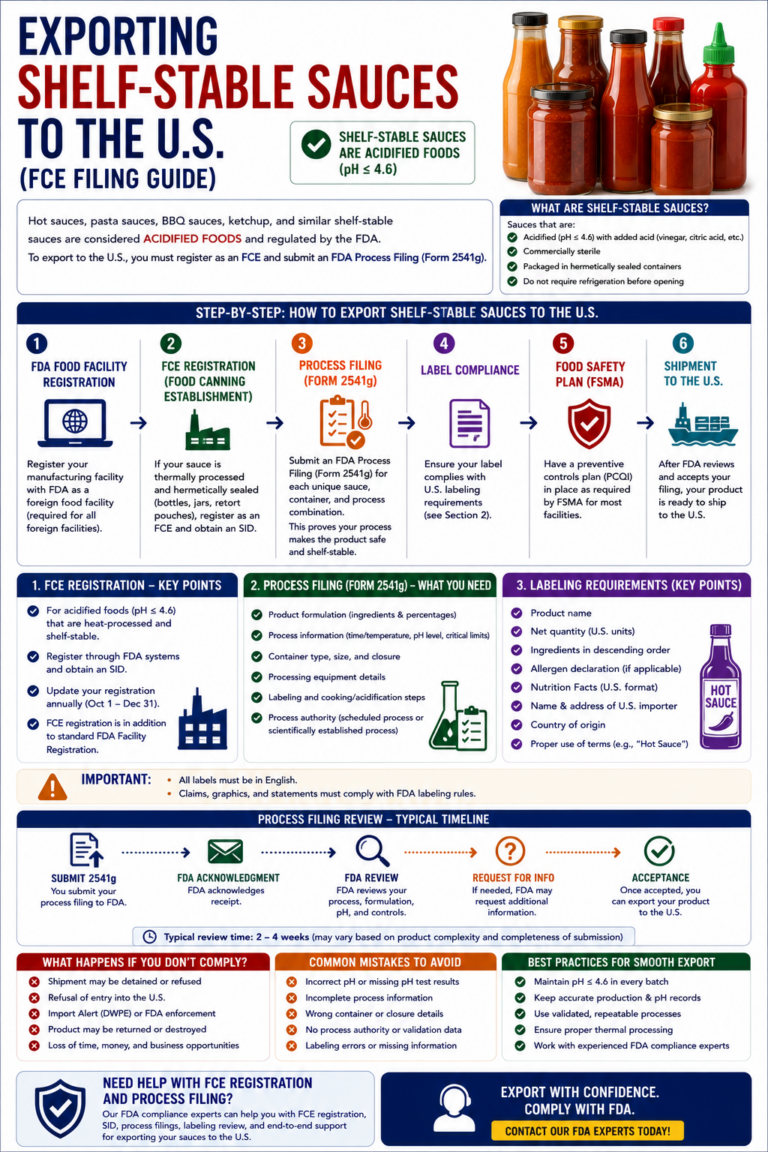
Exporting Shelf-Stable Sauces to the U.S.
The classification that decides your rules — and the requirements once you know your sauce's category.
Key Takeaways
- "Sauce" isn't one category — it can be acidified, acid, or low-acid.
- Acidified sauce (added acid → pH ≤ 4.6): Part 114, FCE/SID required.
- Low-acid sauce (pH > 4.6, shelf-stable): Part 113, FCE/SID required.
- Acid-predominant dressings/condiment sauces can be acid foods — often excluded.
- Naturally acidic sauce (no added acid): acid food, usually no FCE/SID.
- A process authority confirms it — the acidified-vs-acid line is subtle.
One Word, Several Regulatory Paths
Most food types sit in a single lane. Sauces don't — the same shelf on a supermarket aisle holds products from three or four different FDA categories:
Acidified
Low-acid base + added acid to pH ≤ 4.6 — many ketchups, barbecue sauces, marinades, hot sauces.
Acid
Naturally acidic, or acid-predominant dressings and condiment sauces with small low-acid amounts.
Low-acid
pH above 4.6 — cream, cheese, alfredo, and gravy-style sauces, where safety stakes are highest.
Which Rule Applies to Your Sauce?
Find your sauce — this is what sets every requirement downstream:
| Your sauce | FCE / scheduled process? | What governs it |
|---|---|---|
| Acidified (low-acid base + added acid → pH ≤ 4.6) | Yes | Acidified food Part 114 |
| Low-acid (pH > 4.6), shelf-stable | Yes | Low-acid canned food Part 113 (or aw/formulation control) |
| Acid-predominant dressing / condiment sauce (small low-acid amounts) | Usually no | Acid food, excluded 114.3(b) |
| Naturally acidic (pH ≤ 4.6, no acid added) | Usually no | Acid food 114.3(a) |
| Refrigerated (not shelf-stable) | Different path | Excluded from acidified — refrigerated |
What the Filing Involves
If your sauce lands in the Part 114 (acidified) or Part 113 (low-acid) category, here's the added layer beyond standard registration and labeling:
FCE + scheduled process
Register the canning establishment, then file a scheduled process for each formulation and container.
Process-authority validation
An expert validates that your acidification or thermal process reliably keeps the sauce safe — the basis your filing rests on.
Standards of Identity & the Standard Requirements
Two more things every sauce exporter should check:
Standard of identity
Some sauces are standardized — mayonnaise, for example, has a federal standard. If your sauce matches a standardized name, the formulation and label must meet it. See sauces & condiments.
The standard set
Registration and U.S. Agent, compliant labeling, an FSVP importer, and prior notice apply to every sauce, whatever its class.
Export Your Sauce the Compliant Way
FDA Registration Assistance starts by classifying your sauce correctly — acidified, acid, or low-acid — so you meet the right requirements, not the wrong ones. Then we handle the FDA side end to end: registration and U.S. Agent, FCE and scheduled process filings where they apply with process-authority coordination, and label and documentation review including any standard of identity.
Contact us at info@fdaregistrationassistance.com or call +1 (928) 275-8333. Food Facility Registration is available starting at $858. Trusted by companies across 135+ countries, with 15+ years of experience.
Frequently Asked Questions
1. Do all shelf-stable sauces need FCE and SID filings?
No. It depends on the sauce's acidity and how it's made shelf-stable. An acidified sauce (a low-acid base brought to pH 4.6 or below with added acid) or a shelf-stable low-acid sauce needs FCE and a scheduled process. But an acid-predominant dressing or condiment sauce, or a naturally acidic sauce, is generally an acid food and usually doesn't. The classification decides it, not the word "sauce."
2. Why are sauces harder to classify than other foods?
Because sauces span the entire spectrum. Hot sauces and ketchups are often acidified; vinaigrettes and many condiment sauces are acid-predominant; cream, cheese, and gravy-style sauces are low-acid. A single "sauces" label hides three or four different regulatory paths, so each sauce has to be classified on its own.
3. What makes a sauce an "acidified food"?
Under 21 CFR Part 114, an acidified food is a low-acid food to which acid is added to reach a finished equilibrium pH of 4.6 or below, with a water activity above 0.85. A sauce built on a low-acid base and acidified to that pH — many ketchups, barbecue sauces, marinades, and hot sauces — fits, and needs the acidified-food process filing.
4. Are dressings and condiment sauces acidified foods?
Not always. 21 CFR 114.3(b) specifically excludes acid foods — including certain standardized and non-standardized dressings and condiment sauces — that contain only small amounts of low-acid ingredients and whose finished pH doesn't significantly differ from the predominant acid. Those are treated as acid foods, not acidified foods, so they generally fall outside FCE/SID. This is one of the most misunderstood points for sauces.
5. What about a naturally acidic sauce?
A sauce with a natural pH of 4.6 or below, where acid wasn't added to a low-acid base to get there, is an acid food under 21 CFR 114.3(a) and is generally outside the acidified-food FCE/SID requirements. It still needs facility registration and compliant labeling — just not the process filing.
6. What if my sauce is low-acid?
A low-acid sauce — finished pH above 4.6, like many cream, cheese, alfredo, or gravy-style sauces — that's shelf-stable is a low-acid canned food under 21 CFR Part 113 and needs FCE and a scheduled process. If it's made shelf-stable by controlling water activity or formulation rather than a retort, it can still require a filing. Low-acid sauces are where the safety stakes are highest.
7. How do I know which category my sauce is in?
It turns on the finished equilibrium pH, whether acid was added to a low-acid base, how much low-acid ingredient is present, and how the sauce is stabilized. Because the acidified-versus-acid-food line for sauces is genuinely subtle, a process authority should confirm the classification rather than leaving it to an estimate.
8. Do sauces have standards of identity?
Some do. Mayonnaise, for instance, has a federal standard of identity, and certain dressings are standardized (while others, like the former French dressing standard, have been revoked). If your sauce matches a standardized name, the label and formulation have to meet that standard. This is separate from the acidified/low-acid classification.
9. Is registration alone enough to export a sauce?
No. Facility registration is the base requirement, but a sauce that's acidified or low-acid also needs FCE, a scheduled process, and process-authority validation, plus compliant labeling, an FSVP importer, and prior notice. Registration lists your facility; the rest lets the product actually enter.
10. How long does compliance take for a sauce?
It varies by product and readiness. Registration and FCE can be relatively quick, but process-authority validation and the scheduled process filing take longer — especially confirming the classification and pH control for a sauce. It shouldn't be assumed to be a matter of days, so start well ahead of your ship date.
11. Does labeling matter for sauces?
Yes. Beyond identity, Nutrition Facts, ingredients, allergens, net quantity, and responsible party, the label must match the formulation and any filing — and any applicable standard of identity. Labeling errors are among the most common causes of holds, so the label and the classification have to line up.
12. What are the most common sauce mistakes?
Misclassifying the sauce — assuming a low-acid or acidified sauce doesn't need a filing, or filing for an acid-predominant dressing that doesn't — plus skipping process-authority validation, labels that don't match the filing or a standard of identity, no FSVP importer, and prior notice errors. The classification mistakes are the ones specific to sauces.
13. Where do I find the filing details?
If your sauce is acidified or low-acid, the process filing works the same way as for other acidified and low-acid canned foods. See the process filing explainer, the hot sauce and salsa guide for acidified specifics, and the low-acid canned foods guide — and the FCE/SID checklist to confirm you're ready.
14. How does FDA Registration Assistance help?
We start by classifying your sauce correctly — acidified, acid, or low-acid — so you meet the right requirements, then handle the FDA side end to end: Food Facility Registration and U.S. Agent, FCE and scheduled process filings where they apply, process-authority coordination, and label and documentation review including any standard of identity. Starting at $858 for registration, for companies across 135+ countries. Contact info@fdaregistrationassistance.com or +1 (928) 275-8333.