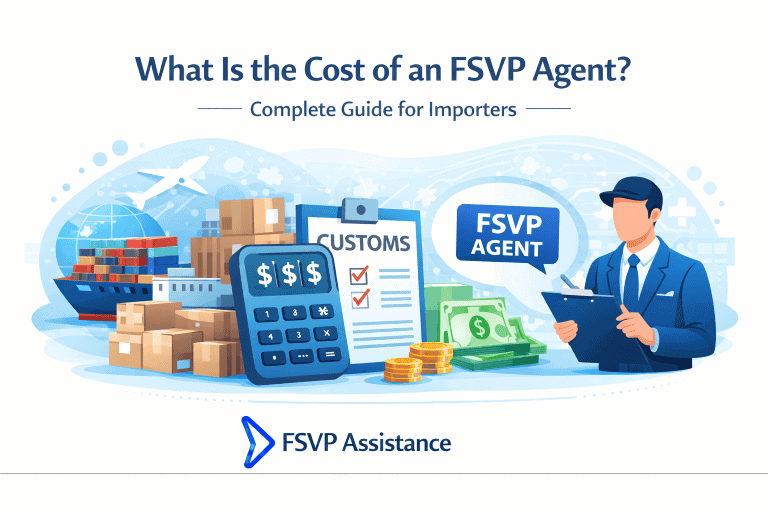
Cost of an FSVP Agent (Foreign Supplier Verification)
What actually drives FSVP cost — and why there's no government fee and no honest flat price.
Key Takeaways
- No FDA/government fee for FSVP — it's a program you run, not a filing. Cost = service only.
- No honest flat price — FSVP cost scales with your import profile.
- Cost drivers — number of suppliers & foods, risk level, supplier audits/certifications, build vs maintain.
- It's "FSVP importer," not "agent" — the U.S.-based responsible party.
- One-time build + ongoing maintenance (plus reanalysis at least every 3 years).
- A deficient FSVP costs more — refusals/import alerts dwarf the price of doing it right.
"FSVP Agent" vs. "FSVP Importer"
The term "FSVP agent" is common but not quite the legal one. Getting it straight helps you know what you're actually paying for:
- FSVP importer — the correct term: the U.S.-based party legally responsible for the FSVP program
- "FSVP agent" (common usage) — the firm that builds and runs your FSVP for you (a service role)
- U.S. agent as FSVP importer — when the owner/consignee of the food at entry is a foreign person, a U.S. agent must be designated as the FSVP importer
What You're Actually Paying For
Unlike device registration (which carries a government MDUFA fee), FSVP has no FDA or government fee. It's a compliance program the U.S. importer develops and maintains, with records FDA can inspect — there's nothing you "file and pay for." So the cost is entirely the service to do the work:
- Determine applicability & the FSVP importer — does FSVP apply, and who's responsible
- Hazard analysis for each food
- Supplier evaluation & approval
- Verification activities — audits, testing, or records review, matched to the risk
- Records — building and keeping the required documentation
- Maintenance & reanalysis — ongoing, plus at least every 3 years
What Drives FSVP Cost
| Factor | Effect on cost |
|---|---|
| Number of foreign suppliers | Each supplier needs evaluation & verification — more suppliers, more work |
| Number of foods/products | Verification is per food per supplier — more supplier-food combinations, more cost |
| Hazard / risk level | Higher-risk foods often need on-site audits (more involved) vs. records review for lower-risk |
| Supplier certifications | Recognized third-party audits (e.g., GFSI) can reduce your verification burden |
| Build vs. maintain | Initial setup is larger; ongoing maintenance is a smaller recurring component |
Build vs. Maintain — and DIY vs. Hire
- Initial build — hazard analysis, supplier approval, verification procedures, records setup (the larger, up-front cost)
- Ongoing maintenance — performing verification, monitoring, records, new suppliers, and reanalysis at least every 3 years (the recurring cost)
- DIY can work for a very simple import (one low-risk food, one well-audited supplier) if you have a qualified individual
- Hiring pays off with multiple suppliers/foods, higher-risk products, no in-house expertise, or to avoid the cost of getting it wrong
Get a Scoped FSVP Quote
Tell us your import profile — number of suppliers and foods, the products and their risk, your suppliers' audit status, and whether you're building or maintaining — and we'll give you a scoped FSVP quote. We don't publish a flat price because an honest number depends on those factors. We can build the program, perform the verification, maintain it, and act as or support the FSVP importer (including for foreign-owned entries) — with our fee kept separate from any government costs (FSVP itself has none).
Contact us at info@fdaregistrationassistance.com or call +1 (928) 275-8333. An independent compliance firm serving 1,000+ companies across 135+ countries, with 15+ years of experience.
Frequently Asked Questions — FSVP Cost
1. How much does an FSVP agent cost?
There's no single flat price, because FSVP cost is a service fee that scales with your situation - and, importantly, FSVP itself has no FDA or government fee (it's a program you run, not a filing). So what you're paying for is the work to build and maintain your FSVP program. The cost is driven by how many foreign suppliers and foods you import, the risk level, whether your suppliers already hold recognized audits/certifications, and whether you're building a new program or maintaining an existing one. We quote based on your specifics.
2. Is there an FDA fee for FSVP?
No - FSVP has no FDA or government fee. Unlike device registration (which carries a MDUFA fee), FSVP is a compliance program the U.S. importer develops and maintains with records FDA can inspect; there's nothing you "file and pay for" with FDA. So any cost is the service/consulting fee to do the work, not a government charge. Be cautious of anyone implying there's an "FDA FSVP fee" - there isn't.
3. Is it an "FSVP agent" or an "FSVP importer"?
The correct legal term is FSVP importer - the U.S.-based party responsible for the FSVP program. "FSVP agent" is a common informal term for the firm that builds and runs your FSVP for you. There's also a narrow technical use: when the owner or consignee of the food at entry is a foreign person, a U.S. agent or representative must be designated as the FSVP importer. So "FSVP agent" can mean your service provider, or the U.S. party acting as the FSVP importer - we can be either, depending on your setup.
4. What drives the cost of FSVP?
The main factors: the number of foreign suppliers you use; the number of different foods/products; the hazard and risk level (higher-risk foods need more verification, often on-site audits); whether your suppliers already have recognized third-party audits/certifications (which reduce your verification burden); and whether you're building a new program from scratch or maintaining an existing one. A single supplier of one low-risk food costs far less to cover than many suppliers of higher-risk foods. We size the work to these factors.
5. Why does the number of suppliers matter so much?
Because FSVP requires you to evaluate and verify each foreign supplier for each food - approving the supplier, determining appropriate verification activities, and performing them. More suppliers (and more foods per supplier) means more evaluations, more verification, and more records. So a brand importing from one factory is a much smaller FSVP job than a distributor sourcing many products from many suppliers in multiple countries. Cost tracks the number of supplier-food combinations you need to cover.
6. How does supplier risk affect the cost?
Higher-risk foods (those where a hazard requires control, like certain ready-to-eat or pathogen-prone products) generally require stronger verification - often an annual on-site audit of the supplier - which is more involved and costly than, say, reviewing records or test results for a lower-risk food. Your hazard analysis determines the risk and therefore the verification activity. So two importers with the same number of suppliers can have very different FSVP costs if one handles higher-risk foods.
7. Do supplier certifications lower the cost?
Often, yes. If your foreign supplier already holds a recognized third-party food-safety certification or audit (for example, a GFSI-benchmarked scheme), that can satisfy or reduce part of your verification burden, lowering the work (and cost) to cover that supplier. Suppliers with no audit history generally require more verification effort. So sourcing from well-documented, audited suppliers tends to make FSVP cheaper to run than sourcing from undocumented ones.
8. Is FSVP a one-time cost or ongoing?
Both. There's an initial build (hazard analysis, supplier approval, verification procedures, and setting up records) and then ongoing maintenance (performing verification activities, monitoring, keeping records, and handling changes or new suppliers). FSVP also requires reanalysis at least every three years (or when something changes). So budget for an initial setup plus an ongoing/annual component - not a single one-off fee. We can structure it as a build, then maintenance.
9. Can I do FSVP myself to save money?
You can - FSVP doesn't require you to hire anyone, and a very simple import (one low-risk food, one well-audited supplier) may be manageable in-house if you have a qualified individual. The cost of a service is justified when you have multiple suppliers/foods, higher-risk products, no in-house expertise, or want to avoid the compliance risk of getting it wrong (a deficient FSVP is a common cause of import problems). It's a build-vs-buy decision; we're honest about when you may not need us.
10. Does every imported food need FSVP (and its cost)?
Most do, but not all. Notably, seafood and juice under their own HACCP rules are exempt from FSVP (they follow those HACCP importer requirements instead), and certain other foods (e.g., some covered by specific rules, or from suppliers in countries with recognized systems) have modified requirements. So part of scoping the cost is confirming FSVP even applies to your food, and at what level. We check that first - sometimes the answer reduces or removes the FSVP work.
11. What's included in an FSVP service fee?
Typically: determining whether FSVP applies and who the FSVP importer is; the hazard analysis for each food; supplier evaluation and approval; designing and performing the verification activities (audits, testing, records review as appropriate); building the required records; and ongoing maintenance and reanalysis. Acting as (or supporting) the FSVP importer can also be part of it. We scope exactly what's included so you're not paying for work you don't need.
12. How is FSVP cost different from a U.S. Agent cost?
They're different roles. A U.S. Agent is a contact for FDA for a foreign facility's registration - a relatively defined, lower-cost role. FSVP is a full compliance program (hazard analysis, supplier verification, records) run by the U.S. importer - more involved, so generally a larger cost. They can both apply to the same import (the foreign facility has a U.S. Agent; the U.S. importer runs FSVP), but they're priced separately because the work is different. See our U.S. Agents and FSVP guides.
13. What happens cost-wise if my FSVP is deficient?
A deficient or missing FSVP can be far more expensive than doing it right: it can lead to import refusals, holds, and an FDA Import Alert for FSVP violations - plus the scramble (and cost) of fixing it under pressure while shipments sit. So the real comparison isn't "FSVP cost vs. zero" - it's "FSVP cost vs. the cost of detained inventory and enforcement." Building it correctly up front is usually the cheaper path. See our page on refusals due to no FSVP.
14. Can I switch FSVP providers to reduce cost?
Yes - you can change FSVP providers, for example if yours is unresponsive, too expensive for the value, or you've grown and need more. The main thing is transferring your records and program without a coverage gap, since FSVP must be maintained continuously. We can review an existing program, take it over, and often streamline it. See our replace-my-FSVP-provider page.
15. Will you give me a fixed quote?
Yes - once we know your specifics (number of suppliers and foods, the products and their risk, supplier audit status, and whether you're building or maintaining), we give you a scoped quote. We don't publish a flat price because an honest number depends on those factors, and a one-size number would overcharge simple importers and undercharge complex ones. Tell us your situation and we'll quote it accurately, with our fee kept separate from any (non-FSVP) government costs.
16. How does FDA Registration Assistance price FSVP?
We scope the FSVP work to your actual import profile - suppliers, foods, risk, supplier certifications, and build vs. maintain - and quote accordingly, keeping our service fee transparent and separate from any government costs (FSVP itself has none). We can build the program, perform the verification, maintain it and handle reanalysis, and act as or support the FSVP importer, including for foreign-owned entries. We're an independent compliance firm serving 1,000+ companies across 135+ countries with 15+ years of experience. Contact info@fdaregistrationassistance.com or +1 (928) 275-8333 for a quote.