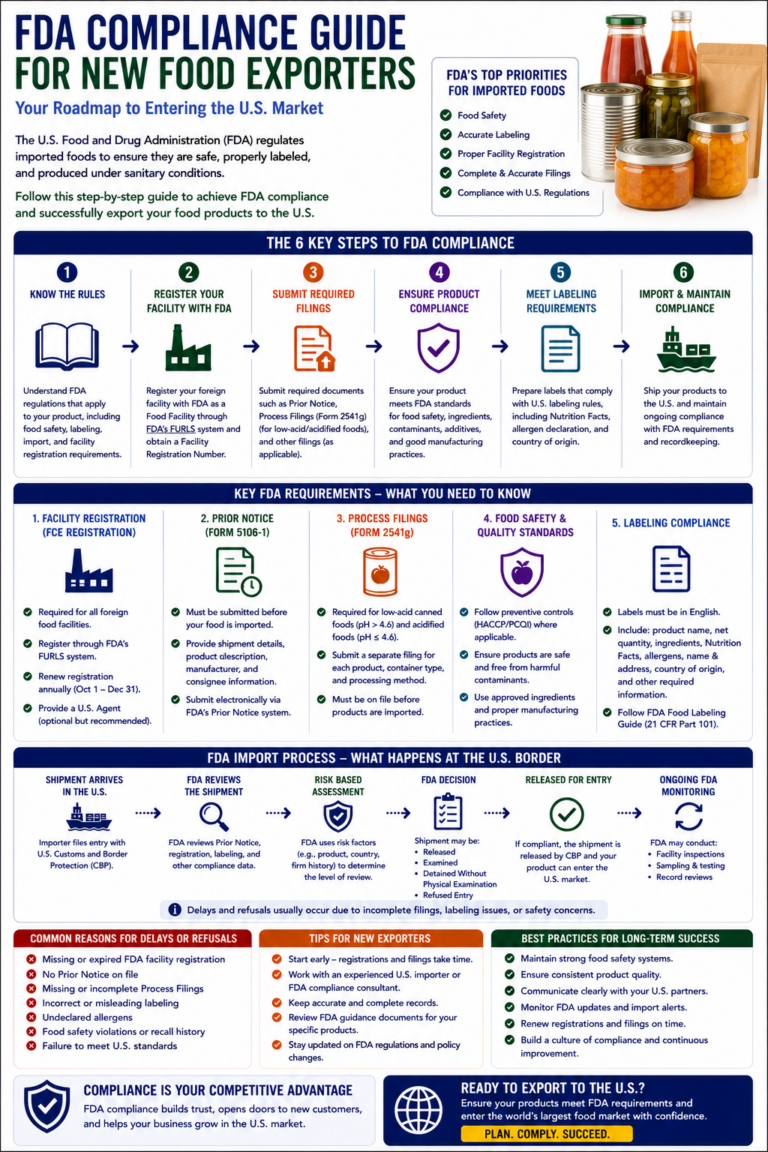
FDA Compliance Guide for New Food Exporters
The mental model and the pitfalls — so your first shipment clears instead of getting held.
Key Takeaways
- FDA reviews at entry, not before — there's no pre-approval to catch mistakes.
- Compliance is a system — the pieces interlock; one gap can hold the shipment.
- Registration isn't the finish line — labeling, FSVP, prior notice, and filings are separate.
- Your broker doesn't cover everything — registration, filings, labeling, and FSVP sit outside their scope.
- Classification comes first — it decides which requirements apply to you.
- You can't fix it at the border — prepare before the product ships.
How FDA Food Compliance Actually Works
Three ideas do most of the work in understanding the whole thing:
Reviewed at the border
FDA doesn't approve food in advance — it checks compliance at import. By then, a missing piece is expensive or impossible to fix, so everything happens before you ship.
A system, not a step
Registration, classification, filings, labeling, FSVP, and prior notice interlock. A perfect label with no FSVP importer still fails — the pieces only work together.
Classification drives it
What your product is determines which requirements apply — especially whether you need FCE and a scheduled process filing. It's the first domino.
What New Exporters Assume — vs. Reality
Almost every avoidable hold traces back to one of these misconceptions:
"I'll handle compliance once I have a buyer."
It must be complete before you ship — FDA reviews at entry, not after.
"Registration means my product is FDA-approved."
Registration is a listing, not approval — and it's only the foundation.
"Once I'm registered, I'm done."
Labeling, FSVP, prior notice, and (for some) FCE/SID are separate requirements.
"My freight forwarder or broker handles all of it."
Brokers file entry and prior notice — not registration, filings, labeling, or FSVP.
"If there's an issue, I'll fix it when the shipment lands."
A missing filing or bad label can't be fixed at the port — the shipment is held.
What Your Broker Does — and Doesn't
Over-relying on a customs broker is the classic first-timer trap. A broker is essential, but their lane is narrower than new exporters expect:
✓ Your broker typically handles
The customs entry, and filing prior notice to FDA before the shipment arrives — the port-side logistics of getting goods through.
✕ Your broker usually doesn't
Facility registration, U.S. Agent, FCE/SID filings, label compliance, or FSVP — these are separate, and someone on your side has to own them.
Your Next Steps, in Order
Once the mental model clicks, here's where to go for the actual work:
The full export roadmap
The complete ordered sequence of every requirement, start to finish.
Everything you need before exporting →Registration & U.S. Agent
The foundation: register the facility and appoint your FDA contact.
Registration & agent →Canned foods
If you make canned or acidified foods, the added FCE/SID layer.
Canned food market entry →Shelf-stable foods
Whether your shelf-stable product needs a filing — the key decision.
Selling shelf-stable food →Get Compliant Before Your First Shipment
FDA Registration Assistance helps first-time exporters map exactly what their product needs, then handles the FDA side end to end: classification guidance, registration and U.S. Agent, FCE/SID filings with process-authority coordination where needed, and label and documentation review with FSVP support — all before you ship.
Contact us at info@fdaregistrationassistance.com or call +1 (928) 275-8333. Food Facility Registration is available starting at $858. Trusted by companies across 135+ countries, with 15+ years of experience.
Frequently Asked Questions
1. What does FDA compliance mean for a new food exporter?
It means a system of interlocking requirements — facility registration, product classification, any process filings, compliant labeling, an FSVP importer, documentation, and prior notice — all in place before your product reaches the U.S. It isn't a single step or a one-time approval; it's a set of pieces that have to fit together before you ship.
2. Does FDA approve my food before I export it?
No. FDA doesn't pre-approve food or labels. It reviews your product at import — which is exactly when problems surface. There's no friendly pre-check to catch mistakes, so the review a new exporter should rely on is one arranged before shipping, not FDA's review at the border.
3. Isn't FDA registration all I need?
No — this is the most common new-exporter misconception. Registration is the foundation, but labeling, FSVP, prior notice, and (for some products) FCE and scheduled process filings are separate requirements. A registered facility whose product has a non-compliant label or no FSVP importer can still be stopped at the border.
4. Doesn't my customs broker handle all of this?
No, and assuming so causes real problems. Your broker typically files the customs entry and prior notice — but facility registration, U.S. Agent, FCE/SID filings, labeling, and FSVP are separate and outside a broker's usual scope. Someone has to own those, and it isn't automatically the broker.
5. Can I sort out compliance after I ship?
In most cases, no. FDA reviews the shipment at entry, and a missing registration, filing, or compliant label generally can't be fixed while the product sits at the port. The shipment can be held, detained, or refused. Compliance has to be complete before the product leaves.
6. What's the first thing I should do?
Classify your product. Whether it's shelf-stable, refrigerated, or frozen, and whether it's a low-acid or acidified food, determines which requirements apply — especially whether you need FCE and a scheduled process. Getting classification right first prevents missing requirements later.
7. Do all products need FCE and SID filings?
No. Only low-acid canned and acidified foods need FCE registration and a scheduled process filing. Many foods don't — but assuming yours doesn't when it actually does is a costly mistake, which is why classification comes first.
8. Who is responsible for FSVP?
The U.S. importer — the owner or consignee at entry — is legally responsible for the Foreign Supplier Verification Program. As the exporter you don't hold it yourself, but you need to ensure a compliant importer is in place and give them what they need to verify you.
9. How long does it take to get compliant?
It depends on your product and what's already in place. Facility registration and a U.S. Agent can be arranged quickly; label corrections and, for canned or acidified foods, process-authority validation and filings take longer. The safe approach is to start well before your intended ship date.
10. Why do new exporters face the most risk?
Because the requirements are unfamiliar, they interlock, some need technical validation, and the timing is unforgiving — everything must be ready before shipping. New exporters also tend to over-rely on brokers for steps a broker doesn't cover. Knowing the landscape up front removes most of that risk.
11. Do I need professional help as a first-timer?
Many new exporters use it, because a single misclassification or a label that doesn't match a filing can undo the rest. Professional support reduces the chance of a preventable hold on a shipment you've already paid to produce and move — though the decision is yours.
12. Where do I find the actual step-by-step?
This page is the orientation — the mental model and the pitfalls. For the full ordered sequence of requirements, follow the detailed food export roadmap, and the product-specific guides for canned, acidified, and shelf-stable foods. Those walk through each step in order.
13. Is the process the same for supplements?
The backbone is similar — registration, U.S. Agent, FSVP, prior notice — but dietary supplements follow the Supplement Facts labeling rules and their own claim requirements rather than the food Nutrition Facts framework. If you're exporting supplements, the labeling piece follows a different path.
14. How does FDA Registration Assistance help new exporters?
We help first-time exporters map exactly what their product needs, then handle the FDA side end to end: classification guidance, Food Facility Registration and U.S. Agent, FCE/SID filings with process-authority coordination where required, and label and documentation review with FSVP support — all before you ship. Starting at $858 for registration, for companies across 135+ countries. Contact info@fdaregistrationassistance.com or +1 (928) 275-8333.