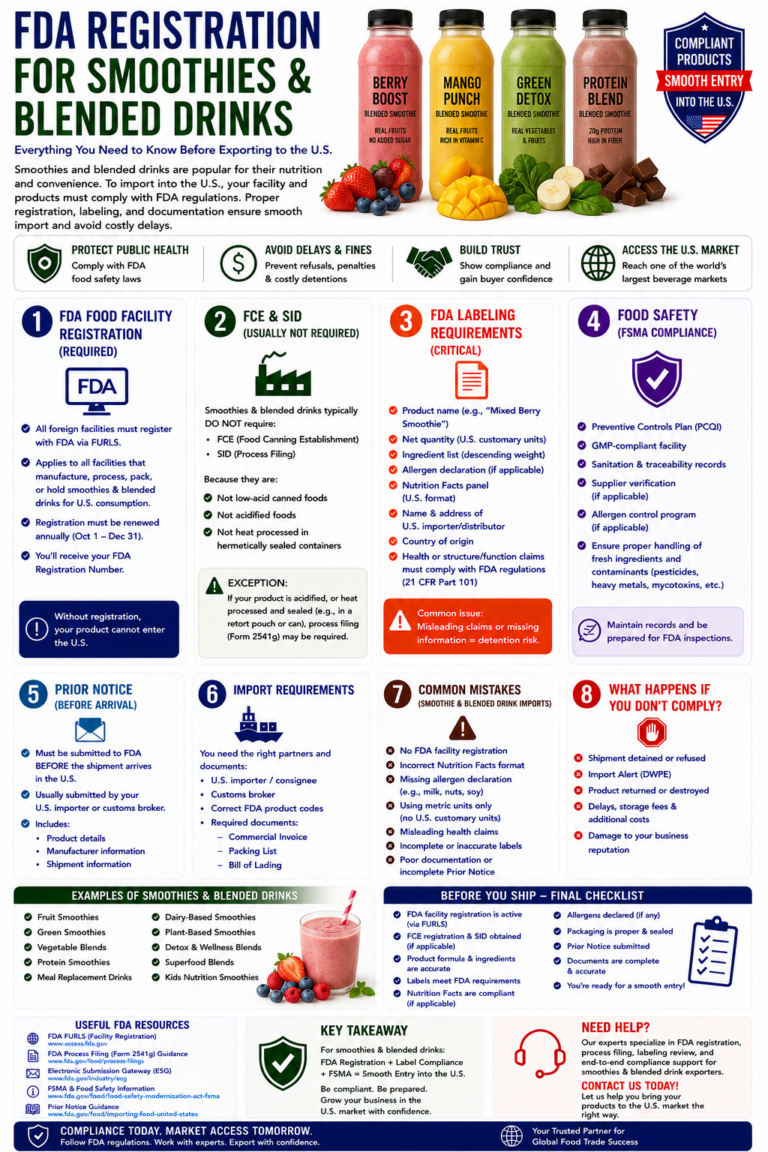
FDA Registration for Smoothies & Blended Drinks
Juice HACCP and the 5-log rule, the smoothie-shop exemption, and how low-acid and functional blends change the picture.
Key Takeaways
- Juice = Juice HACCP — a smoothie with juice is a juice beverage under Part 120.
- 5-log pathogen reduction — required in a packaged maker's HACCP plan.
- Smoothie shops are retail-exempt — but untreated juice needs a warning label.
- Packaged makers selling to stores are subject — retail status is the dividing line.
- Shelf-stable low-acid blend = LACF — FCE + a scheduled process (SID).
- Functional/protein can be a supplement — Supplement Facts, not Nutrition Facts.
Smoothies & Juice HACCP
This is the big one. Juice HACCP (21 CFR Part 120) applies to the processing of any juice, or any juice used as an ingredient in a beverage — and "juice" is the liquid or puree expressed or extracted from fruits and vegetables. A packaged smoothie made with fruit or vegetable juice or puree is a juice beverage, so:
- A HACCP plan is required — with control measures that consistently achieve a 5-log (100,000-fold) pathogen reduction in the "pertinent microorganism," held for the product's shelf life
- Pasteurization, thermal processing, or HPP are common ways to achieve the 5-log reduction
- Untreated juice needs a warning label — juice not treated to 5-log must carry the FDA "not pasteurized… may contain harmful bacteria" statement
- Juice as a minor ingredient? — even a diluted-juice blend must ensure its juice ingredient was produced in compliance with Part 120
Smoothie Shop vs Packaged Manufacturer
Whether Juice HACCP applies to you turns on whether you're retail:
Which Regime(s) Apply to Your Smoothie
Blended drinks can touch several frameworks at once. Here's how to place yours:
| If your smoothie… | Regime | What it needs |
|---|---|---|
| Contains juice, packaged, sold to stores/distributors | Juice HACCP (Part 120) | HACCP plan + 5-log pathogen reduction |
| Made to order at a shop, sold only to consumers | Retail — exempt from Juice HACCP | Warning label if juice is untreated |
| Shelf-stable & low-acid (veg/protein/dairy, pH > 4.6) | Low-acid canned food (Part 113) | FCE + scheduled process (SID) |
| Functional/protein, marketed to supplement the diet | Dietary supplement | Supplement Facts, DSHEA, supplement cGMP |
Low-Acid Blends and Functional Drinks
- Shelf-stable low-acid blend — vegetable, dairy, or protein smoothie above pH 4.6 is a low-acid canned food needing FCE + a scheduled process (the same as coconut water)
- Acidic shelf-stable juice smoothie — handled under the acidified/juice track rather than LACF
- Functional / protein smoothie — if marketed to supplement the diet, it may be a dietary supplement using Supplement Facts
- Allergens — milk/whey, soy, and tree nuts (nut milks, butters) are common and must be declared
- Claims — "100% juice," "no added sugar," and functional claims must meet their definitions and stay out of disease (drug) territory
Get Your Smoothies & Blended Drinks U.S.-Ready
FDA Registration Assistance maps which frameworks apply — Juice HACCP for juice-containing drinks, LACF process filing for shelf-stable low-acid blends, and the dietary supplement rules for functional products — then handles registration and U.S. Agent, HACCP and 5-log guidance, FCE/SID where needed, labeling and claims, and FSVP for imports.
Contact us at info@fdaregistrationassistance.com or call +1 (928) 275-8333. Food Facility Registration is available starting at $858. Trusted by companies across 135+ countries, with 15+ years of experience.
Frequently Asked Questions
1. Do smoothies and blended drinks need FDA registration?
Yes — any facility that manufactures, processes, packs, or holds smoothies or blended drinks for the U.S. market registers with FDA, with a U.S. Agent if foreign. But registration is only the start. Because most smoothies contain juice, the framework that really shapes compliance is Juice HACCP (21 CFR Part 120), plus low-acid canned food rules for shelf-stable low-acid blends — things the "smoothies are simple" assumption misses.
2. Are smoothies subject to Juice HACCP?
Usually, if they contain juice. Juice HACCP (21 CFR Part 120) applies to the processing of any juice, or any juice used as an ingredient in a beverage — and juice includes the liquid or puree expressed or extracted from fruits and vegetables. A packaged smoothie made with fruit or vegetable juice/puree is a juice beverage, so a packaged smoothie processor generally needs a HACCP plan that achieves a 5-log pathogen reduction. This is the biggest requirement most smoothie sellers don't realize applies.
3. What is the 5-log pathogen reduction?
Under Juice HACCP, a processor's HACCP plan must include control measures that consistently achieve at least a 5-log (100,000-fold) reduction in the "pertinent microorganism" — the most resistant pathogen of public-health significance likely to occur in that juice — held for the product's shelf life. Pasteurization, thermal processing, and high-pressure processing (HPP) are common ways smoothie makers achieve it. Juice not treated to a 5-log reduction has to carry an FDA warning label.
4. Is a smoothie shop exempt from Juice HACCP?
Generally yes. A smoothie shop or juice bar that makes drinks to order and sells only directly to consumers — not to other businesses — is a "retail establishment" under the rule and is exempt from Juice HACCP. But if it serves untreated juice (no 5-log reduction), it must display the FDA warning statement. A packaged smoothie manufacturer that sells to stores, distributors, or other businesses is not retail and is subject to Juice HACCP.
5. What if juice is only a minor ingredient in my blend?
If you make a diluted juice beverage where juice is a minor ingredient, you may not be a "juice processor" required to run a full HACCP system for the finished beverage — but you must ensure the juice ingredient you use complies with Part 120 (i.e., was produced under Juice HACCP with the 5-log reduction). So the juice HACCP obligation follows the juice, even when it's just one component of the blend.
6. Do shelf-stable smoothies need FCE and SID filing?
It depends on the acidity. A shelf-stable low-acid blend — think vegetable, dairy, or protein smoothies with a pH above 4.6 — is a low-acid canned food (21 CFR Part 113) and needs FCE registration and a scheduled process (SID). An acidic shelf-stable juice smoothie is handled under the acidified/juice framework instead. So for shelf-stable products, the acidity determines whether you're in LACF process filing or the acidified/juice track.
7. How do the frameworks fit together for a smoothie?
A smoothie can touch several: Juice HACCP if it contains juice; low-acid canned food rules if it's shelf-stable and low-acid; the acidified track if it's shelf-stable and acidic; and the dietary supplement framework if it's a functional/protein product marketed to supplement the diet. They aren't mutually exclusive — a shelf-stable protein smoothie could involve LACF and, depending on marketing, supplement rules. Mapping which apply is the essential first step.
8. Is a protein or functional smoothie a food or a dietary supplement?
It depends on the formulation and marketing. A conventional smoothie or protein shake sold as a beverage is a food, using a Nutrition Facts panel. A blended drink of vitamins, botanicals, or other dietary ingredients intended to supplement the diet can be a dietary supplement, using a Supplement Facts panel and following supplement rules (DSHEA, supplement cGMP). The same-looking bottle can be either, so classify it before designing the label and claims.
9. What about refrigerated low-acid smoothies like carrot juice blends?
Refrigerated low-acid juices (a carrot-based blend, for example) that aren't shelf-stable canned foods still need care: FDA specifically recommends that processors address Clostridium botulinum toxin as a hazard in their HACCP plan for such products. So a refrigerated low-acid smoothie isn't "off the hook" — it just controls the hazard through HACCP and cold chain rather than through LACF process filing.
10. What allergens and claims matter for smoothies?
Smoothies frequently contain major allergens — milk (dairy or whey), soy, and tree nuts (in nut milks or butters) — all of which must be declared. On claims, "100% juice," "no added sugar," and nutrient content claims have FDA definitions to meet, functional and health claims must be truthful and can't cross into disease (drug) claims, and any added sugars must be shown accurately in the Nutrition Facts. Blended drinks carry more claim risk simply because they have more ingredients.
11. Do imported smoothies need FSVP?
Yes. The U.S. importer holds FSVP and must verify the foreign supplier meets U.S. standards, with prior notice before each shipment. For juice-containing smoothies, that verification connects to Juice HACCP — importers of juice are required to document affirmative steps confirming the juice was produced in compliance. So FSVP and Juice HACCP link directly for imported blended drinks.
12. What are the most common compliance mistakes for smoothies?
The biggest is missing Juice HACCP entirely — treating a juice-containing smoothie as an ordinary beverage. Others include no 5-log reduction (or serving untreated juice without the warning label), missing LACF process filing on a shelf-stable low-acid blend, misclassifying a functional smoothie as food when it's a supplement (or vice versa), and missing allergens. Mapping the frameworks first prevents nearly all of them.
13. Does registration mean FDA approved my smoothie?
No. FDA doesn't pre-approve food — registration, Juice HACCP, and any FCE/SID filings are compliance obligations, not an approval. They put your facility, plan, and process on record; they don't certify the product. Your smoothie still has to meet all applicable requirements, and FDA enforces at import and in the marketplace. A juice product out of compliance with Part 120 is considered adulterated.
14. How does FDA Registration Assistance help with smoothies and blended drinks?
We map which frameworks apply to your product — Juice HACCP for juice-containing drinks, LACF process filing for shelf-stable low-acid blends, and the dietary supplement rules for functional products — then handle facility registration and U.S. Agent, guidance on the HACCP and 5-log requirements, FCE/SID filing where needed, labeling and claims review, and FSVP for imports. Starting at $858 for registration, for companies across 135+ countries. Contact info@fdaregistrationassistance.com or +1 (928) 275-8333.