
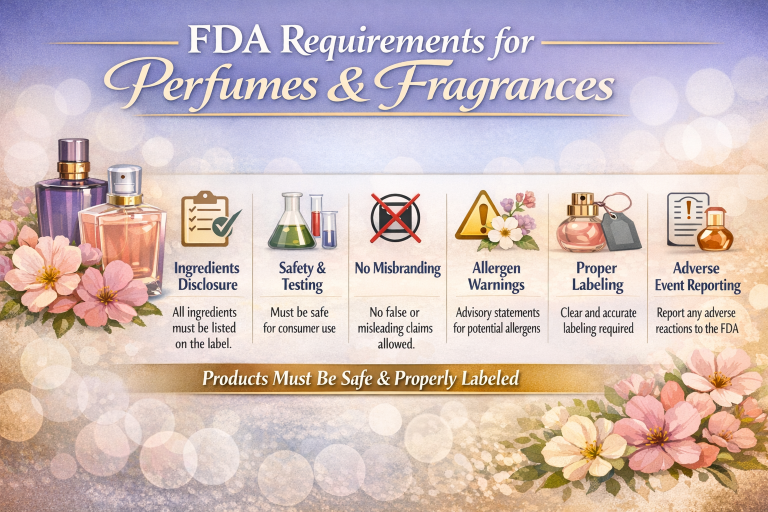
FDA Requirements for Perfumes & Fragrances
What FDA actually requires of a perfume brand — the MoCRA obligations, the fragrance label rules, and the allergen rule that's coming.
Key Takeaways
- Perfume = cosmetic (FD&C Act + MoCRA); no FDA pre-market approval.
- MoCRA applies — facility registration, product listing, Responsible Person, safety substantiation, adverse-event reporting, labeling.
- "Fragrance"/"Parfum" is still OK for now (21 CFR 701.3 trade-secret declaration).
- Fragrance-allergen rule is coming but delayed — proposed ~May 2026, final 2027+; no federal requirement yet.
- Prepare by auditing against the EU 26-allergen list (California already requires disclosure).
- Therapeutic claims make it a drug; color additives need pre-approval; TTB/CPSC also touch perfume.
Perfume Is a Cosmetic — and MoCRA Applies
- Facility registration — register your manufacturing/processing facility via Cosmetics Direct (biennial); foreign facilities too
- Product listing — list each cosmetic product with FDA (annual)
- Responsible Person — named on the label, with a U.S. contact for adverse events
- Safety substantiation — records supporting that each product is safe under customary use
- Adverse-event reporting — report serious adverse events and keep records
- No pre-market approval — FDA doesn't "approve" perfume (color additives are the exception)
Labeling & the "Fragrance" Declaration
- Identity statement — what the product is
- Net quantity of contents
- Responsible firm — name/place of business, plus the MoCRA U.S. adverse-event contact
- Ingredient declaration — with the scent declarable collectively as "Fragrance" / "Parfum" (21 CFR 701.3) for now
- Warnings & directions as needed
The Fragrance Allergen Disclosure Rule
MoCRA directs FDA to require that specific fragrance allergens be disclosed individually on cosmetic labels — a departure from the blanket "Fragrance" listing. Where it stands:
| Item | Status (2026) |
|---|---|
| Statutory deadline for the rule | Missed |
| Proposed rule expected | Around May 2026 |
| Final rule likely effective | 2027 or later |
| Current federal requirement | None yet — "Fragrance" listing still allowed |
When It's Not Just a Cosmetic
- Drug claims → it's a drug. "Treats anxiety," "repels insects," "antibacterial," most "aromatherapy" health claims — these can make a fragrance a drug (or cosmetic-drug). Keep claims about scent, not health. See the cosmetic-vs-drug line
- Color additives → FDA pre-approval. A tinted perfume must use only permitted color additives
- Denatured alcohol → TTB. Most perfumes are alcohol-based; specially denatured alcohol falls under TTB, a separate agency from FDA
- Aerosol flammability → CPSC. Pressurized-container/flammability safety is the Consumer Product Safety Commission's domain, not FDA's
Perfume & Fragrance Compliance, Handled
FDA Registration Assistance handles the full MoCRA cosmetic setup for perfumes and fragrances — facility registration, product listing, Responsible Person support, safety substantiation, labeling review (including the fragrance declaration and preparing for the allergen rule), and U.S. Agent / Responsible Person needs for foreign brands — while being clear that cosmetics aren't "FDA approved" and flagging where TTB or CPSC also apply.
Contact us at info@fdaregistrationassistance.com or call +1 (928) 275-8333. An independent compliance firm serving 1,000+ companies across 135+ countries, with 15+ years of experience.
Frequently Asked Questions — Perfumes & Fragrances
1. How does FDA regulate perfumes and fragrances?
As cosmetics - under the Federal Food, Drug, and Cosmetic Act and the Modernization of Cosmetics Regulation Act (MoCRA). There's no FDA pre-market "approval" for perfume. What applies: MoCRA facility registration and product listing, a Responsible Person, safety substantiation, adverse event reporting, and compliant labeling. A fragrance only crosses into drug territory if it makes therapeutic claims. So a typical perfume is a cosmetic, with MoCRA obligations rather than an approval process.
2. Do I need FDA approval to sell perfume in the U.S.?
No - perfume does not require pre-market FDA approval. FDA doesn't "approve" cosmetics (the main exception is color additives, which need pre-approval). You are responsible for making the product safe, properly labeled, and MoCRA-compliant before selling it. So you can't market a perfume as "FDA approved," but you do have to meet the cosmetic requirements. "Compliant," not "approved," is the accurate framing.
3. What does MoCRA require for perfume brands?
The core MoCRA obligations: register your manufacturing/processing facility with FDA (via Cosmetics Direct, renewed biennially), list each cosmetic product with FDA (annually), designate a Responsible Person, maintain safety substantiation for each product, report serious adverse events and keep adverse-event records, and meet labeling requirements (including a U.S. contact for adverse events). These apply to perfumes like other cosmetics. Small businesses have some exemptions - but not from safety or labeling.
4. Can I still just list "Fragrance" on the label?
For now, yes. Under current FDA rules (21 CFR 701.3), the components of a fragrance (or flavor) can be declared collectively as "Fragrance" or "Parfum" on the ingredient list, without naming the individual aroma chemicals - a long-standing trade-secret protection. That's still the rule today. But it's changing for allergens specifically (see the next question), so this blanket "Fragrance" listing won't cover everything indefinitely.
5. What's the fragrance allergen labeling rule?
MoCRA directs FDA to require that specific fragrance allergens be disclosed individually on cosmetic labels - a departure from the blanket "Fragrance" listing. However, FDA missed the statutory deadline: as of 2026, the proposed rule is expected around May 2026, with a final rule likely in 2027 or later. So there is currently no federal requirement to disclose specific fragrance allergens - but it's coming, and preparing now is wise.
6. What should I do to prepare for the allergen rule?
Audit your formulations against the EU's established list of fragrance allergens (commonly 26 substances), since FDA's list is expected to be similar - so you know which of your products contain disclosable allergens and at what levels. Keep good ingredient documentation from your fragrance supplier. That way, when FDA's rule is finalized, you can update labels quickly rather than scrambling. Note California already has its own fragrance allergen disclosure requirement, so some brands disclose already.
7. When does a perfume become a drug?
When it makes a therapeutic or drug-type claim. A fragrance marketed purely for scent is a cosmetic. But if you claim it treats a condition, relieves anxiety, repels insects, is "antibacterial," or otherwise affects the body's structure or function in a drug-like way (common with "aromatherapy" marketing), FDA may treat it as a drug - or a cosmetic-drug - subject to drug requirements. So keep perfume claims about scent and experience, not health effects, unless you intend to meet drug rules.
8. Do foreign perfume brands register with FDA?
Yes - a foreign facility that manufactures/processes perfume for the U.S. market registers under MoCRA (via Cosmetics Direct), and the products are listed. You also need a Responsible Person whose U.S. contact information appears on the label for adverse-event reporting. So a foreign perfume brand selling into the U.S. has the same MoCRA obligations as a domestic one, plus the U.S.-facing Responsible Person. See our cosmetics export/MoCRA page.
9. What has to be on a perfume label?
A compliant cosmetic label needs: an identity statement (what the product is), net quantity of contents, the name and place of business of the manufacturer/packer/distributor (and, under MoCRA, a U.S. contact for adverse events), an ingredient declaration (with fragrance declarable as "Fragrance"/"Parfum" for now), and any necessary warnings and directions. Labeling is governed by the FD&C Act, the Fair Packaging and Labeling Act, and 21 CFR Part 701. See our cosmetic labeling mistakes guide.
10. Are there safety requirements for fragrance ingredients?
Yes - under MoCRA you must maintain adequate safety substantiation for each cosmetic product, meaning records supporting that the product is safe under customary use. Cosmetic ingredients (other than color additives and a few prohibited/restricted substances) don't need FDA pre-approval, but the responsibility to ensure safety is yours. For fragrances, that includes the aroma chemicals and any allergens. Keeping supplier safety data and your own substantiation is part of compliance.
11. Do colored perfumes need anything extra?
If your perfume contains color additives (for a tinted liquid, for example), those color additives must be FDA-approved for that use and meet any specifications - color additives are the one cosmetic ingredient category that does require FDA pre-approval. So a clear fragrance generally has no color-additive issue, but a colored one needs to use only permitted color additives. We can check your formulation against the approved color additive list.
12. What about alcohol in perfume — is that FDA?
Partly another agency. Most perfumes are alcohol-based, and the denatured alcohol used often falls under the Alcohol and Tobacco Tax and Trade Bureau (TTB), which administers specially denatured alcohol (SDA) formulas and permits - separate from FDA. FDA covers the cosmetic side (MoCRA, labeling, safety); TTB covers the denatured-alcohol side. So an alcohol-based perfume maker may deal with both agencies. We focus on the FDA/cosmetic requirements and can flag the TTB angle.
13. Is aerosol/flammability an FDA issue?
Generally no - that's the Consumer Product Safety Commission (CPSC), not FDA. Flammability warnings and aerosol/pressurized-container safety for consumer products fall under CPSC rules. FDA's role for a perfume is the cosmetic side (MoCRA, labeling content, safety substantiation, ingredients). So an aerosol body spray has an FDA cosmetic layer and a CPSC safety layer. We handle the FDA side and flag where CPSC applies.
14. Are small perfume businesses exempt from MoCRA?
Partly. "Small businesses" (under MoCRA's revenue threshold) are exempt from the facility registration, product listing, and GMP requirements - but NOT from safety substantiation, adverse event reporting, or labeling, and not if they make certain higher-risk products (e.g., injectables, products for the eye area or mucous membranes, or that alter appearance for more than 24 hours). So a small perfume maker still must keep safety records and comply with labeling. We help confirm whether you qualify.
15. What are the most common perfume compliance mistakes?
Assuming perfume is unregulated (it's a cosmetic with MoCRA obligations); claiming "FDA approved" (not a thing for perfume); making drug-type/aromatherapy health claims that turn it into a drug; missing the MoCRA facility registration, product listing, or Responsible Person; no safety substantiation; a non-compliant label (missing U.S. contact, wrong ingredient declaration); and not preparing for the coming fragrance allergen rule. Each is avoidable with the right setup. We help get them right.
16. How does FDA Registration Assistance help perfume brands?
We handle the full MoCRA cosmetic setup for perfumes and fragrances: facility registration (Cosmetics Direct), product listing, Responsible Person support, safety substantiation, labeling review (including the fragrance declaration and preparing for the allergen rule), and U.S. Agent/Responsible Person needs for foreign brands - while being clear that cosmetics aren't "FDA approved" and flagging where TTB or CPSC also apply. We're an independent compliance firm serving 1,000+ companies across 135+ countries with 15+ years of experience. Contact info@fdaregistrationassistance.com or +1 (928) 275-8333.
