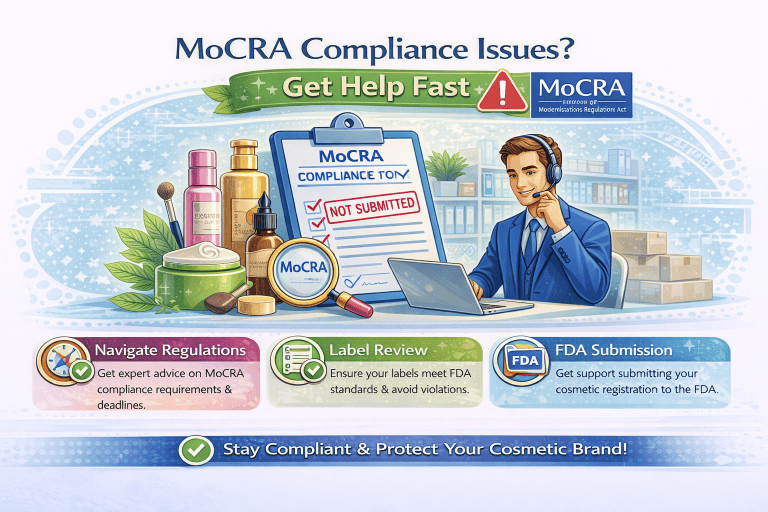
MoCRA Compliance Issues? Get Help Fast
Find your specific MoCRA issue below, see what's actually going on, and go straight to the fix.
Key Takeaways
- Most "MoCRA issues" are one broken link — not the whole chain.
- Classification comes first — cosmetic, drug, or exempt decides the pathway.
- Registration + FEI are the foundation — listings depend on them.
- Each issue has a defined fix — and a dedicated guide.
- You're past the July 1, 2024 deadline — issues are active, not future.
- Full service or targeted repair — end-to-end, or fix one piece.
The Common MoCRA Issues — and the Fix
| Your issue | What's happening | Go to |
|---|---|---|
| "Is my product even under MoCRA?" | Cosmetic, drug, or exempt — scope decides everything | What falls under MoCRA · Cosmetic or drug? |
| "My registration/listing didn't submit" | Usually a missing FEI, account, U.S. Agent field, or a draft | Registration not submitted |
| "I don't know the requirements" | You need the full MoCRA picture | Cosmetics registrar |
| "My label isn't compliant" | PDP/INCI/claims/"FDA Approved"/MoCRA contact issues | Labeling mistakes |
| "I'm a foreign brand / need a U.S. Agent" | Required field; distinct from the Responsible Person | MoCRA U.S. Agent |
| "My makeup / color additives" | Color additives need FDA approval & batch certification | Makeup listing |
| "My serum/cream/lotion claims" | Anti-aging/barrier/acne claims can flip it to a drug | Serums, creams & lotions |
High-Risk Situations
Some situations can't wait — they mean market access is already affected:
- A shipment held or refused at the port — usually an unregistered facility or unlisted product
- An FDA inquiry or warning letter — respond promptly; a responsive U.S. Agent matters
- Products removed from Amazon or a retailer — the marketplace wants compliance proof
- You discover nothing was ever registered or listed — you're non-compliant now, past the deadline
What MoCRA Compliance Involves
Every MoCRA issue is one of these links being broken. Getting them all aligned is what compliance actually is:
- Classification — confirm the product is a cosmetic (not a drug or exempt soap)
- Facility registration — via Cosmetics Direct, with an FEI (and a U.S. Agent if foreign); biennial renewal
- Product listing — each product, linked to the facility, updated annually
- Responsible Person & safety substantiation — the accountable party and the safety file
- Adverse-event reporting — serious events within 15 business days; records kept
- Compliant labeling — INCI, net quantity, warnings, and the adverse-event contact
If Any of These Is You
- Cosmetic manufacturers & processors — domestic or foreign
- Brand owners & private-label brands — the Responsible Person for listing and safety
- Importers & distributors — keeping shipments clearing
- Foreign brands entering the U.S. — registration, U.S. Agent, and labeling
- Amazon & e-commerce sellers — needing compliance proof for marketplaces
Tell Us Where You're Stuck
Send us your product and the issue you're hitting. We'll identify the specific MoCRA problem — or the full scope — tell you the pathway honestly, and handle it: classification, facility registration, product listing, labeling and claims review, U.S. Agent, and safety/adverse-event setup. Many clients come to us mid-problem — we diagnose it and resolve it.
Contact us at info@fdaregistrationassistance.com or call +1 (928) 275-8333 for a quote. An independent compliance firm serving 1,000+ companies across 135+ countries, with 15+ years of experience.
Frequently Asked Questions — MoCRA Compliance Help
1. Why is MoCRA compliance so hard to get right?
Because several requirements have to line up at once: confirming the product is a cosmetic (not a drug), registering the facility (with an FEI and, if foreign, a U.S. Agent), listing each product, naming a Responsible Person, maintaining safety substantiation, having an adverse-event process, and compliant labeling. A gap in any one can stall your U.S. market access — so most "MoCRA issues" are really one specific link in that chain being broken. This page maps the common ones to their fixes.
2. I'm not sure my product is even under MoCRA - where do I start?
Start with scope and classification. MoCRA covers cosmetics; if your product is a drug (or a drug/cosmetic combination), or true soap, different rules apply. And a claim can flip a cosmetic into a drug. Confirm the category first — our "what products fall under MoCRA" and "cosmetic vs OTC drug" guides walk it — so you don't build compliance on the wrong pathway.
3. My registration or listing didn't submit - what do I do?
This is one of the most common issues. It's usually a missing FEI (the FDA Establishment Identifier you need before registering), an account not set up, a blank U.S. Agent field (foreign), a P.O. box instead of a physical address, a listing not linked to a registered facility, or a submission left in draft that never actually sent. Our "registration not submitted - fix now" guide diagnoses and resolves each.
4. My cosmetic label isn't compliant - how do I fix it?
Labeling is a top failure point. The label needs a Principal Display Panel (statement of identity + net quantity) and an information panel (INCI ingredient list, responsible-party address, required warnings, and the MoCRA adverse-event contact) — and it can't carry drug claims or say "FDA Approved." Our cosmetic-labeling-mistakes guide covers the anatomy and the common errors, with fixes.
5. I'm a foreign brand and need a U.S. Agent - is that the issue?
Very likely. A foreign facility must designate a U.S. Agent as part of its MoCRA registration, and the U.S. Agent field is required — the system won't complete registration without it. It's a separate role from the Responsible Person, and you generally need both. Our MoCRA U.S. Agent guide explains the distinction and the requirements; we can also serve as your U.S. Agent.
6. My makeup has color-additive questions - where does that go?
Makeup's defining issue is color additives — the one cosmetic area needing FDA pre-approval, with certified colors requiring batch certification and area-of-use limits (eye, lips). If your issue is color compliance or listing a multi-shade line, our makeup product-listing guide is the place to start. Getting an unapproved or misused color right is essential, because it can make the product adulterated.
7. My serum/cream/lotion claims might be a problem - what now?
Skincare is where drug claims most often creep in — "boosts collagen," "repairs the barrier," "treats acne," "lightens dark spots" turn a cosmetic into a drug. If your issue is claims (or the safety data for an emulsion), our serums/creams/lotions guide covers the claim trap and the safety substantiation these products need. Keep claims to appearance to stay a cosmetic.
8. What high-risk situations need immediate action?
A shipment held or refused at the port; an FDA inquiry or warning letter; products removed from Amazon or a retailer; or discovering that no registration or listing was ever completed. These are active problems, not future ones — especially since FDA began enforcing MoCRA on July 1, 2024. In these cases, correcting the underlying registration/listing/labeling issue quickly is what restores market access.
9. Can I fix MoCRA issues after products are already on the market?
Yes — and you should, quickly. Because the enforcement date has passed, unregistered facilities and unlisted or mislabeled products are exposed now. The fix is to audit what's missing, complete or correct the registration and listings, fix the label and claims, and confirm everything was accepted by FDA. Acting fast limits import holds, marketplace removals, and enforcement exposure.
10. Do I need both facility registration and product listing?
Yes. They're separate: registration covers the facility (with its FEI, and a U.S. Agent if foreign), and listing covers each marketed product (with ingredients, category, and the Responsible Person). You can have one without the other and still be non-compliant. A common issue is a facility that registered but never listed its products — or vice versa.
11. How is safety substantiation an issue?
MoCRA requires adequate safety substantiation for every product, with records kept and available to FDA. Many brands have registered and listed but don't have the safety file assembled — which is a problem if FDA asks. For water-based products like serums and creams, that means stability and preservative-efficacy data in particular. It's an obligation even for small businesses that are exempt from registration/listing.
12. Who is the Responsible Person, and why does it matter here?
The Responsible Person is the manufacturer, packer, or distributor named on the label, accountable for listing, safety substantiation, adverse-event reporting, and labeling. A frequent MoCRA issue is confusion over who the Responsible Person is (versus the U.S. Agent), or a foreign brand assuming a distributor covers it. Getting the roles mapped correctly resolves a lot of downstream problems.
13. Do online marketplaces really check MoCRA compliance?
Increasingly, yes. Amazon and other platforms request evidence of FDA/MoCRA compliance for cosmetics and can remove non-compliant listings. And online claims (titles, descriptions, images) count toward how FDA views the product — so an Amazon listing can create a compliance issue even when the physical label is fine. If a product was removed, review the compliance status and correct it.
14. Where do I start if I have several issues at once?
Start with classification and the registration foundation, because most other issues depend on them — a listing can't complete without a registered facility and FEI, and labeling/claims sit on top of correct classification. We triage: confirm the product's classification, get the FEI, facility registration, and U.S. Agent solid, then fix listing, labeling, and safety on that foundation. A quick review shows the right order.
15. Does registration mean my cosmetic is FDA-approved?
No. FDA doesn't approve cosmetics. Registration and listing make you compliant with those MoCRA requirements and put your facility and products in FDA's system — they aren't approval or an endorsement, and claiming "FDA-approved" is itself a labeling problem. We help you describe your status accurately while getting the actual compliance in place.
16. How do I get help from FDA Registration Assistance?
Contact us with your product and where you're stuck. We'll identify the specific MoCRA issue (or the full scope), tell you the pathway honestly, and handle it — classification, facility registration, product listing, labeling and claims review, U.S. Agent, and safety/adverse-event setup. We're an independent compliance firm serving 1,000+ companies across 135+ countries with 15+ years of experience. Contact info@fdaregistrationassistance.com or +1 (928) 275-8333.