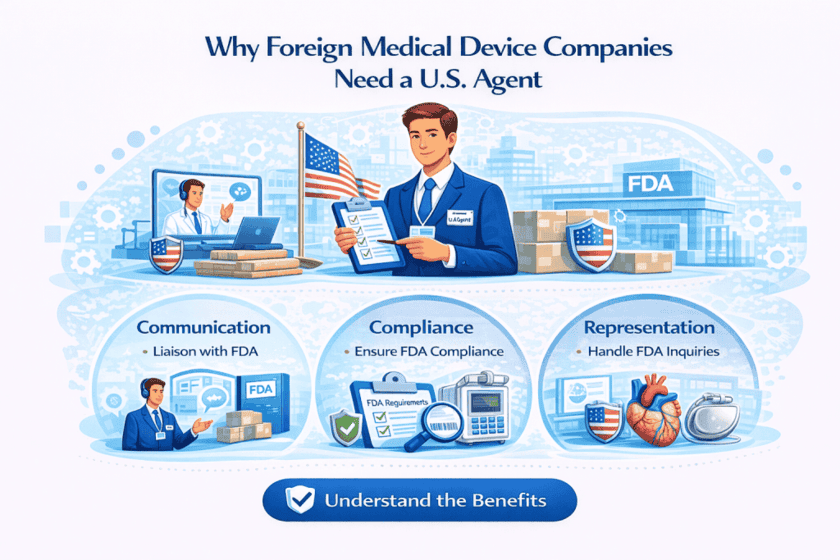
Why Foreign Medical Device Companies Need a U.S. Agent
The short answer for foreign device makers — plus where to get the full U.S. Agent guide.
Key Takeaways
- Required by 21 CFR 807.40 — a foreign device establishment must designate a U.S. Agent.
- No agent, no registration — and no registration means you can't import the device.
- It's FDA's U.S. contact — communication, product questions, inspection scheduling; a limited role.
- Not the initial importer — the U.S. first-receiver that registers/lists is a separate party.
- Not FDA approval — an agent confers no authorization.
- Full details are in the FDA U.S. Agents guide.
The Full Guide & Device Pages
This is a short overview. For the role, requirements, and device specifics, use the hub and the related pages:
FDA U.S. Agents (full guide)
The role, requirements & by-program service.
Open the hub →Medical device U.S. Agent
The device U.S. Agent service.
Device agent →Class I device U.S. Agent
For Class I manufacturers.
Class I →Device registration checklist
Register & list a device, step by step.
Register →Get a U.S. Agent for Your Foreign Device Company
FDA Registration Assistance acts as the U.S. Agent for foreign medical device establishments and completes the establishment registration and listing alongside it — forwarding FDA communications, helping coordinate inspection scheduling, and keeping your designation current. We keep the government MDUFA fee separate from our service fee and don't imply your device is "FDA approved."
Contact us at info@fdaregistrationassistance.com or call +1 (928) 275-8333 for a quote. An independent compliance firm serving 1,000+ companies across 135+ countries, with 15+ years of experience.
Frequently Asked Questions — Foreign Device Companies & U.S. Agents
1. Why do foreign medical device companies need a U.S. Agent?
Because FDA requires it: any foreign establishment that registers a medical device with FDA must designate a U.S. Agent (21 CFR 807.40) - a U.S.-based contact for FDA. You literally can't complete the device establishment registration without one, and without registration you can't lawfully import your device. The U.S. Agent gives FDA someone in the United States to communicate with about your establishment. See our full FDA U.S. Agents guide for the role and requirements.
2. Is a U.S. Agent legally required for a foreign device establishment?
Yes. Under 21 CFR 807.40, a foreign device establishment that registers with FDA must designate a single U.S. Agent, and the registration in FDA's system (FURLS/DRLM) can't be completed without one. It's not optional for foreign establishments. See the FDA U.S. Agents guide.
3. What does the device U.S. Agent do?
The role is defined and limited: the U.S. Agent assists FDA in communicating with the foreign establishment, answers questions about the establishment's devices, helps FDA schedule inspections of the foreign establishment, and (if FDA can't reach the establishment directly) receives communications on its behalf. It's a communication/contact role - not legal responsibility for the device. See the FDA U.S. Agents guide for the full duties.
4. What happens if a foreign device company doesn't have a U.S. Agent?
You can't complete FDA establishment registration, which means you can't lawfully import the device - shipments can be detained or refused at the border. An outdated or unresponsive U.S. Agent causes similar problems: missed FDA communications and inspection-scheduling issues. For a foreign device company, a valid U.S. Agent is a gate you must pass to reach the U.S. market. See the FDA U.S. Agents guide.
5. Is the U.S. Agent the same as the initial importer?
No - and both are needed for a foreign device. The U.S. Agent is the FDA contact for the foreign establishment. The initial importer is the first U.S. party that receives the imported device and must itself register and list with FDA. They're different roles (one firm may or may not do both). So a foreign device typically has two registered parties: the foreign manufacturer (with a U.S. Agent) and the U.S. initial importer. See the FDA U.S. Agents guide and our device registration checklist.
6. Does having a U.S. Agent make my device FDA-approved?
No. A U.S. Agent (and registration) is administrative - it gives FDA a contact and puts your establishment in FDA's system. It does not mean FDA reviewed, cleared, or approved your device, and implying that is prohibited (21 CFR 807.39). Your device still needs whatever premarket pathway applies (for most Class II devices, a 510(k); many Class I devices are exempt). A U.S. Agent confers no FDA authorization.
7. Can I be my own U.S. Agent if I'm a foreign company?
No - the U.S. Agent must be located in the United States (a U.S. address, not a P.O. box) and reachable during business hours. A foreign company with no U.S. presence appoints a U.S.-based party as its agent. Many foreign device manufacturers use a compliance firm (like us) for this role. See the FDA U.S. Agents guide.
8. Does the U.S. Agent handle my 510(k) or device listing?
Not as part of the U.S. Agent role itself - that role is limited to being FDA's contact. Preparing a 510(k), doing your device listing, or handling labeling are consulting tasks, which the same firm may also provide separately. It's worth confirming in writing what's included: a bare U.S. Agent just forwards FDA communications, while a consultant does the compliance work. See our U.S. Agent vs consultant comparison via the U.S. Agents guide.
9. Do Class I device makers need a U.S. Agent too?
Yes - the U.S. Agent requirement applies to foreign establishments across device classes, including Class I. Even though most Class I devices are 510(k)-exempt, the foreign establishment still registers and still must designate a U.S. Agent. See our page for U.S. Agents for Class I device manufacturers.
10. Is there a fee tied to the U.S. Agent?
The U.S. Agent service itself is a consulting fee (quoted by scope). Separately, device establishment registration carries an annual MDUFA fee paid to FDA regardless of who is your agent. So there are two different costs: the agent service (ours) and the government MDUFA fee (FDA's). We keep them clearly separate. See the FDA U.S. Agents guide.
11. Can I change my device U.S. Agent?
Yes - you can switch your U.S. Agent, for example if your current one is unresponsive or you want registration and the agent handled together. The change is made in FDA's device registration system (DRLM), and the key is switching without a coverage gap so FDA always has a valid agent on file. See the FDA U.S. Agents guide.
12. Does FDA verify the U.S. Agent?
Yes - when you designate a U.S. Agent, FDA confirms the agent's acceptance of the role. The agent has to be a real, consenting U.S.-based party, not just a name entered in the system. A responsive agent makes this quick. See the FDA U.S. Agents guide.
13. Does one U.S. Agent cover all my devices?
A foreign establishment designates one U.S. Agent for its registration, and that agent covers the establishment (and the devices it lists). If you have multiple foreign establishments, each designates a U.S. Agent - but it can be the same firm across all of them, giving you one point of contact. See the FDA U.S. Agents guide.
14. How is a device U.S. Agent different from other programs?
The core role is the same across FDA programs - a U.S. contact for a foreign establishment - but the governing rule and system differ. For devices it's 21 CFR 807.40, handled in FURLS/DRLM, alongside the annual MDUFA establishment fee. Food, drug, and cosmetic programs have their own rules and cadences. See the FDA U.S. Agents guide for the by-program view.
15. Where's the full guide to U.S. Agents?
See our FDA U.S. Agents guide - the complete hub covering what a U.S. Agent is, who needs one, the role and requirements, and the service for each FDA program including devices. This page is a short overview of why foreign device companies need one; the guide has the full detail.
16. How does FDA Registration Assistance help foreign device companies?
We act as the U.S. Agent for foreign medical device establishments and complete the FDA establishment registration and device listing alongside it - forwarding FDA communications, helping coordinate inspection scheduling, and keeping your designation current. We can also support classification, the 510(k) where required, and the U.S. initial importer setup. We keep the government MDUFA fee separate from our service fee and don't imply your device is "FDA approved." We're an independent compliance firm serving 1,000+ companies across 135+ countries with 15+ years of experience. Contact info@fdaregistrationassistance.com or +1 (928) 275-8333.