Importing Food to Sell Online (E-Commerce) in the USA
The full picture for the e-commerce food importer — the import compliance and the online-selling rules, in one place.
Key Takeaways
- Selling online doesn't remove any FDA requirement — the import rules apply regardless of channel.
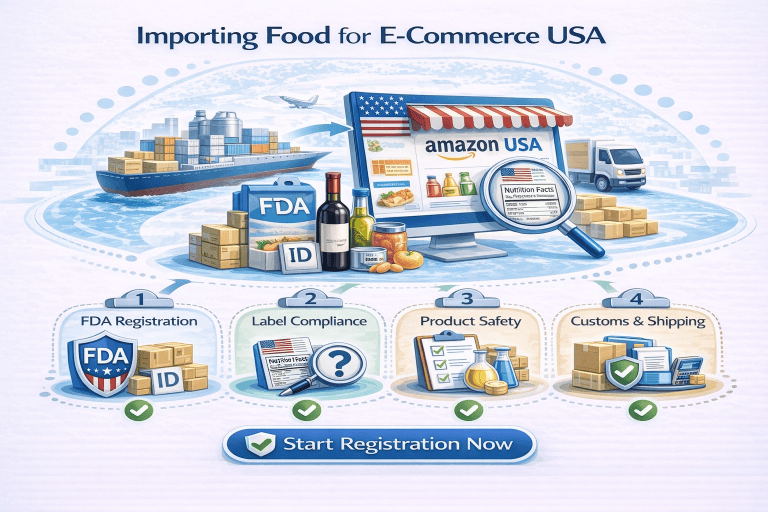
- Import side — facility registration + U.S. Agent + FSVP + Prior Notice + U.S. labeling + a U.S. importer.
- Marketplace ≠ FDA — platforms police FDA compliance as policy; that's not the same as being compliant.
- Disease/health claims are the #1 listing-removal trigger.
- "Proof of FDA registration" = a number, not a certificate.
- DTC still needs full FDA compliance; registration ≠ approval.
FDA Requirements to Import the Food
- Foreign facility registration — free ($0 government fee), biennial, with a DUNS number, plus a U.S. Agent
- FSVP — a U.S.-based importer verifies the foreign supplier's food safety (21 CFR 1 Subpart L)
- Prior Notice — advance notice to FDA of each shipment before arrival
- Compliant U.S. labeling — Nutrition Facts, ingredients, the 9 major allergens, identity, net quantity, responsible party (differs from foreign labels)
- A U.S. importer for entry — importer of record for customs; FSVP importer for FDA
Selling It Online — the Extra Layer
- Marketplace ≠ FDA — Amazon and others enforce FDA law as their own selling policy; that's an extra gatekeeper, not a substitute for FDA compliance
- Marketplace compliance ≠ FDA registration — satisfying a platform request doesn't make a non-compliant product compliant
- Disease/health claims = #1 removal trigger — in the title, bullets, description, A+ content, or images
- "Proof of FDA registration" = your number, not a purchased certificate
- The physical label must comply regardless of channel; listing content is judged for claims
Marketplace vs Your Own DTC Site
| Marketplace (Amazon, etc.) | Your own DTC site | |
|---|---|---|
| FDA import rules | Apply in full | Apply in full |
| Who polices compliance | The marketplace (actively) + FDA | No one polices your listing — but FDA still enforces at import |
| Claims risk | Listing removal for disease claims | Same FDA rules; still an unapproved-drug problem if you make disease claims |
| "Proof of registration" asks | Common — provide your number | Less common, but the registration is still required |
Common Mistakes
- Assuming the marketplace "handles" FDA compliance — it doesn't
- Using a foreign-market label unchanged for the U.S.
- Disease/health claims in the listing
- Skipping FSVP or Prior Notice; no valid U.S. Agent for the foreign facility
- Buying a fake "FDA certificate" to satisfy a request
- Treating "registered" as "approved"
Import Food to Sell Online in the U.S.
FDA Registration Assistance sets up the whole picture: registering the foreign facility (free government fee) and serving as U.S. Agent, building the FSVP program, supporting Prior Notice, reviewing and adapting your label for the U.S., and advising on listing/claims compliance so marketplaces don't remove you — with our service fee kept separate from the $0 government fee, and clear that registration isn't approval.
Contact us at info@fdaregistrationassistance.com or call +1 (928) 275-8333 for a quote. An independent compliance firm serving 1,000+ companies across 135+ countries, with 15+ years of experience.
Frequently Asked Questions — Importing Food for E-Commerce
1. What do I need to import food to sell online in the U.S.?
You need to meet both the FDA import requirements and the online-selling rules. On the import side: the foreign facility registered with FDA (free, biennial, with a DUNS number) and a U.S. Agent; FSVP (a U.S. importer verifies the foreign supplier's food safety); Prior Notice for each shipment; compliant U.S. labeling; and a U.S. importer for the customs entry. On the e-commerce side: compliant listings (no disease claims) and, on marketplaces, meeting the platform's FDA-related policies. Selling online doesn't remove any FDA requirement.
2. Does selling on a marketplace change the FDA rules?
No. Whether you sell on Amazon, another marketplace, or your own DTC website, the FDA import and food rules are the same - registration, U.S. Agent, FSVP, Prior Notice, and compliant labeling all still apply. What marketplaces add is their own enforcement: platforms like Amazon police FDA-related compliance as a selling policy and can suppress or remove listings. So a marketplace is an extra gatekeeper on top of FDA - not a substitute for FDA compliance.
3. Is "Amazon compliance" the same as FDA registration?
No - and conflating them causes problems. Amazon (and other marketplaces) enforce FDA law as their own policy; that's separate from actually being FDA-compliant. Satisfying a marketplace's document request doesn't make a non-compliant product compliant, and being FDA-registered doesn't automatically satisfy a marketplace if a claim or label triggered a review. You need genuine FDA compliance and to meet the platform's policies - they're two different things.
4. Does my foreign facility need to be registered with FDA?
Yes - a foreign facility that manufactures/processes/packs/holds the food generally must register with FDA (free, renewed every two years, with a DUNS number) and designate a U.S. Agent. This applies regardless of sales channel. If you're importing to sell online, the registration is foundational - shipments from an unregistered foreign facility can be refused at the border, and marketplaces may ask for proof of registration. See our food facility registration guide.
5. What is FSVP and do I need it for e-commerce food?
FSVP (the Foreign Supplier Verification Program) requires a U.S.-based importer to verify that each foreign supplier produces food meeting U.S. safety standards, with records FDA can inspect. It applies to most imported human/animal food regardless of whether you sell it online or in stores. So yes - if you import food to sell via e-commerce, an FSVP importer and program are generally required. See our FSVP for importers guide.
6. What about Prior Notice?
Prior Notice is advance notice to FDA of each imported food shipment before it arrives - required for essentially all food imports, e-commerce included. It's separate from FSVP and from registration. Missing or deficient Prior Notice can cause a shipment to be held or refused. If you import food to sell online, budget for Prior Notice on every shipment. Our importer support page explains how it fits with the other import steps.
7. Does my label need to change for the U.S.?
Usually yes. U.S. food labels require a Nutrition Facts panel (U.S. format), an ingredient list in descending order, declaration of the nine major allergens, a statement of identity, net quantity, and a responsible-party contact - and English. A label compliant in your home market isn't automatically U.S.-compliant. The physical product label must comply no matter where you sell it online, and labeling problems (especially undeclared allergens) are a top cause of both border detentions and marketplace removals. See our e-commerce food label guide.
8. What listing content gets food removed online?
Disease and health claims are the number-one trigger: if your listing (title, bullets, description, A+ content, or images) says or implies the food treats, cures, or prevents a condition, FDA treats it as an unapproved drug and marketplaces remove it. Other triggers: missing/incorrect labeling, undeclared allergens, prohibited ingredients, or unverifiable registration. Keep claims truthful and non-disease, and make sure the label is compliant. See our Amazon compliance guide.
9. Do I need FDA registration if I only sell on my own website (DTC)?
Yes - the FDA import and food rules don't depend on the sales channel. If you import food, the foreign facility still needs registration and a U.S. Agent, FSVP and Prior Notice still apply, and the label still must comply - even if you sell only through your own Shopify or DTC site with no marketplace involved. The difference is that a marketplace actively polices compliance, while on your own site no one polices it for you - but FDA's rules (and enforcement at import) still apply.
10. Does "proof of FDA registration" mean a certificate?
No - FDA issues a registration number, not a certificate. If a marketplace or partner asks for "proof of FDA registration," the genuine proof is your registration number (and your FDA account record), not a purchased "FDA registration certificate." Third-party certificates aren't FDA documents. Don't buy one to satisfy a request, and be wary of anyone selling them. See our registration verification page.
11. Does registering my facility make my food "FDA approved"?
No. FDA doesn't "approve" food, and registration is administrative - it puts your facility in FDA's system so you can import; it's not approval. So you can't market imported food as "FDA approved," online or anywhere. The accurate description is that your facility is registered and your product is compliant. Using "FDA approved" or "FDA registered" as a marketing badge on a listing is misleading and can itself trigger issues.
12. Who is the U.S. importer for my e-commerce food?
There are a few U.S.-side roles: the importer of record handles the customs entry and duties; the FSVP importer (a U.S.-based party) is responsible for foreign-supplier verification; and, for the foreign facility, a U.S. Agent is the FDA contact. If you're a foreign brand selling DTC into the U.S., you'll need to arrange these U.S.-side roles. If you're a U.S.-based seller importing from a foreign supplier, you often hold several of them. We help map who's who.
13. What can stop my imported food at the border?
Common causes: the foreign facility isn't registered (or the U.S. Agent is missing); FSVP or Prior Notice is deficient; the label is non-compliant (especially undeclared allergens); a prohibited ingredient; or the product appears adulterated. Any of these can lead to detention or refusal, and repeated problems can trigger an import alert (automatic detention of future shipments). For e-commerce sellers, a border problem also means no inventory to sell - so getting compliance right up front protects both entry and sales.
14. Is importing food for e-commerce different from wholesale/retail?
The FDA import requirements are the same - registration, U.S. Agent, FSVP, Prior Notice, and labeling apply regardless of how you sell. What differs is the go-to-market layer: e-commerce adds marketplace policies (and their enforcement) and online-listing rules on top of the FDA baseline, while wholesale/retail adds buyer/retailer requirements. Either way, the FDA foundation is identical; the channel just adds its own rules on top.
15. What are the most common mistakes?
Assuming a marketplace "handles" FDA compliance (it doesn't); using a foreign-market label unchanged for the U.S.; disease/health claims in the listing; skipping FSVP or Prior Notice; no valid U.S. Agent for the foreign facility; buying a fake "FDA certificate"; and treating "registered" as "approved." Each can cause a border detention, a marketplace removal, or both. Getting the import and listing compliance right before you ship and list avoids the expensive version of learning these.
16. How does FDA Registration Assistance help e-commerce food importers?
We set up the whole picture for importing food to sell online: registering the foreign facility (free government fee) and serving as U.S. Agent, building the FSVP program, supporting Prior Notice, reviewing and adapting your label for the U.S., and advising on listing/claims compliance so marketplaces don't remove you - while keeping our service fee separate from the $0 government fee and being clear that registration isn't approval. We're an independent compliance firm serving 1,000+ companies across 135+ countries with 15+ years of experience. Contact info@fdaregistrationassistance.com or +1 (928) 275-8333.