
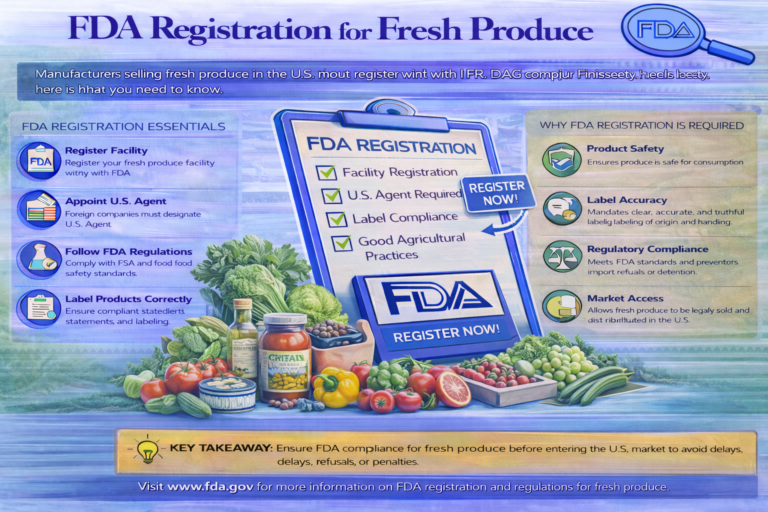
FDA Registration for Fresh Produce
Farm vs facility, the Produce Safety Rule, which produce is exempt, the 2024 agricultural water rule, and FSMA 204 traceability.
Key Takeaways
- Farm vs facility is the first question — it decides whether you register at all.
- Farms follow the Produce Safety Rule — 21 CFR 112; they generally don't register.
- Processing makes you a facility — cutting, bagging, manufacturing → register + preventive controls.
- Not all produce is covered — rarely-consumed-raw items (potatoes, beans) are exempt.
- 2024 agricultural water rule — replaced testing with a water-system assessment.
- Much produce is on the FSMA 204 list — leafy greens, melons, tomatoes, herbs, sprouts.
Farm or Facility?
Everything in produce compliance starts here. A farm that grows, harvests, packs, and holds raw produce is not a "food facility" — it doesn't register with FDA and instead follows the Produce Safety Rule. Cross into processing — cutting, bagging, or manufacturing — and you become a facility that registers and runs a preventive-controls plan.
| Your activity | You are a… | Register with FDA? | Governing rule |
|---|---|---|---|
| Growing / harvesting / packing / holding raw produce | Farm | No | Produce Safety Rule (21 CFR 112) |
| Cutting / bagging fresh-cut produce & salads | Facility | Yes | Preventive Controls (21 CFR 117) |
| Manufacturing — canning, juicing, drying | Facility | Yes | Preventive Controls / LACF / Juice HACCP |
Inside the Produce Safety Rule
The Produce Safety Rule (21 CFR 112) is the first federal food-safety standard for farms, aimed at preventing microbial contamination of produce eaten raw. A farm is a "covered farm" if its average annual produce sales exceed $25,000. Covered farms address:
- Agricultural water — the biggest contamination route (see the 2024 update below)
- Biological soil amendments — manure and compost handling
- Domesticated & wild animals — intrusion into growing areas
- Worker health, hygiene & training — at least one supervisor completes recognized produce-safety training
- Equipment, tools & buildings — sanitation; sprouts have their own high-risk provisions
Covered vs Exempt Produce
- Rarely consumed raw — exempt — an exhaustive FDA list: potatoes, most beans, beets, sweet corn, pumpkins, winter squash, sweet potatoes, eggplant, figs, cranberries, and peanuts/tree nuts (pecans, cashews). If your commodity isn't on the list, it's not exempt this way
- Commercial processing with a kill step — exempt — if destined for processing that adequately reduces pathogens (requires disclosure statements and records)
- Personal / on-farm consumption — exempt, and anything that isn't a raw agricultural commodity
- Qualified exemption (small local farms) — average annual food sales under $500,000 AND more than half sold to qualified end-users (consumers, or retail/restaurants in-state or within 275 miles): reduced requirements, with farm name/address labeling
The New Agricultural Water Rule
Agricultural water is the leading contamination route for produce, and in May 2024 FDA overhauled how covered farms handle it. The old approach — testing pre-harvest water against fixed microbial numbers — is replaced by a systems-based "agricultural water assessment" (§112.43).
- Assess the whole system — farms evaluate and document the risk factors of their water source, use, conditions, and practices
- Act on findings — implement corrective or mitigation measures where the assessment identifies risk
- Phased compliance — dates begin April 2025, staggered by farm size (larger farms first)
- Sprouts keep separate water provisions — given their higher risk
Traceability & Imports
- FSMA 204 traceability — FDA's Food Traceability List is produce-heavy (leafy greens, melons, tomatoes, cucumbers, peppers, herbs, sprouts, tropical fruits, fresh-cut); listed commodities need lot-level records, retrievable within 24 hours (compliance now July 20, 2028)
- Imports — foreign farms follow the Produce Safety Rule, and the U.S. importer runs FSVP with prior notice regardless
- Processed produce moves regimes — canned/shelf-stable → canned foods; juiced → Juice HACCP; dried → low-moisture rules
Get Your Fresh Produce Compliant
FDA Registration Assistance starts by determining whether you're a farm (Produce Safety Rule, generally no registration) or a facility (registration + preventive controls) — and handles registration and U.S. Agent where they apply. We help align Produce Safety Rule obligations (including the agricultural water assessment), FSMA 204 traceability, and FSVP for imports — and if you're processing, we route you to the right regime.
Contact us at info@fdaregistrationassistance.com or call +1 (928) 275-8333. Food Facility Registration, when required, is available starting at $858. Trusted by companies across 135+ countries, with 15+ years of experience.
Frequently Asked Questions
1. Does fresh produce require FDA registration?
It depends on whether you're a farm or a facility — which is the first thing to determine. A farm that only grows, harvests, packs, and holds raw produce is generally NOT a food facility and does not register with FDA; it's governed by the Produce Safety Rule instead. Once you process produce beyond farming — cutting, bagging, or manufacturing it — you become a food facility that must register and follow preventive controls. So many produce operations register and many don't, based on that line.
2. What is the Produce Safety Rule?
The Produce Safety Rule (21 CFR Part 112) is the first federal food-safety standard for farms that grow, harvest, pack, or hold produce. It sets science-based standards to prevent microbial contamination, covering agricultural water, biological soil amendments (like manure), domesticated and wild animals, worker health/hygiene and training, equipment and buildings, and special provisions for sprouts. It applies to both domestic and foreign farms whose produce is sold in the U.S.
3. Is my farm "covered" by the Produce Safety Rule?
A farm is a "covered farm" if its average annual value of produce sold over the previous three years is more than $25,000 (inflation-adjusted). Below that, the farm is excluded. Covered farms must meet the rule's requirements and have at least one supervisor complete recognized produce-safety training. Foreign farms exporting to the U.S. are covered on the same basis as domestic ones.
4. Which produce is exempt from the rule?
Several categories. Produce "rarely consumed raw" is exempt — and it's an exhaustive FDA list including potatoes, most beans, beets, sweet corn, pumpkins, winter squash, sweet potatoes, eggplant, figs, cranberries, and peanuts/tree nuts like pecans and cashews. Also exempt: produce for personal or on-farm consumption; anything that isn't a raw agricultural commodity; and produce destined for commercial processing with a "kill step" (which requires disclosure statements and records). If your commodity isn't on the rarely-consumed-raw list, it's not exempt on that basis.
5. What is the qualified exemption for small farms?
A farm can qualify for a "qualified exemption" with modified requirements if, over the previous three years, its average annual food sales were less than $500,000 AND more than half of its food sales (by value) went to "qualified end-users" — consumers, or restaurants/retail food establishments in the same state or within 275 miles of the farm. Qualified-exempt farms follow reduced requirements, including labeling with the farm's name and business address, and the exemption can be withdrawn if there's a problem.
6. What changed with the 2024 agricultural water rule?
In May 2024, FDA revised the pre-harvest agricultural water requirements (Subpart E). Instead of requiring farms to test water against fixed microbial numbers, the rule now requires a systems-based "agricultural water assessment" — farms evaluate and document the risk factors of their whole water system (source, use, conditions, practices) and take corrective measures as needed. Compliance dates are phased in beginning April 2025, staggered by farm size, with larger farms first. Sprouts keep their own separate water provisions.
7. Are fresh-cut produce and salads treated the same as whole produce?
No — cutting changes the classification. Whole produce on a farm is Produce Safety Rule territory (and generally no facility registration). But cutting, bagging, or otherwise processing produce is a facility activity that requires food-facility registration and a preventive-controls food-safety plan (with Listeria control, since fresh-cut items are ready-to-eat). We cover the fresh-cut side in dedicated guides for packaged salads and cut fruit.
8. Is produce covered by FSMA 204 traceability?
Much of it is. FDA's Food Traceability List is heavy on produce — fresh leafy greens, melons, tomatoes, cucumbers, peppers, herbs, sprouts, tropical fruits, and fresh-cut produce — so businesses handling these must keep enhanced lot-level records and produce them to FDA within 24 hours of a request. The compliance date was extended to July 20, 2028, but building the records now is the sensible course given produce's outbreak history.
9. Does importing fresh produce require registration?
Foreign farms are subject to the Produce Safety Rule just like domestic ones, and whether they register depends on the same farm-vs-facility line. The U.S. importer, regardless, must run FSVP (Foreign Supplier Verification Program) with prior notice for each shipment. So an imported whole-produce supplier may be a non-registering farm, while its importer still carries full FSVP obligations — two different responsibilities to get right.
10. What are the main hazards for fresh produce?
Because produce is eaten raw with no kill step, microbial contamination is the central concern — Salmonella, E. coli (including O157:H7), and Listeria. The rule targets the main contamination routes: agricultural water, untreated or improperly treated manure, animal intrusion, and worker hygiene. Sprouts are singled out as especially high-risk and have their own dedicated requirements.
11. What about canned, juiced, or dried produce?
Those are processing activities that take you out of "fresh produce" and into other regimes at a registered facility. Canned/shelf-stable produce follows the low-acid or acidified canned-foods rules; juice follows Juice HACCP; drying follows low-moisture/preventive-controls rules. The Produce Safety Rule is specifically about fresh, raw produce — once you preserve or transform it, a different framework applies.
12. Does FDA approve fresh produce?
No. FDA doesn't pre-approve produce. Farms comply with the Produce Safety Rule; facilities register and run preventive controls; importers run FSVP. FDA inspects farms and facilities and enforces at the border for imports. There's no "produce approval" — there's compliance with the rule that applies to your role in the supply chain.
13. What's the most common mistake in produce compliance?
Getting the farm-vs-facility line wrong in either direction — a processor assuming it's "just a farm" and skipping registration and preventive controls, or a farm assuming it must register when it doesn't. Close behind: overlooking the new agricultural water assessment, and underestimating FSMA 204 traceability for listed commodities. Correct classification first prevents both over- and under-compliance.
14. How does FDA Registration Assistance help with fresh produce?
We start by determining whether you're a farm (Produce Safety Rule, generally no registration) or a facility (registration + preventive controls) — and handle registration and U.S. Agent where they apply. We help align Produce Safety Rule obligations (including the agricultural water assessment), FSMA 204 traceability, labeling where required, and FSVP for imports; and if you're processing, we route you to the right regime (fresh-cut, canned, juice). Registration, when required, is available starting at $858, for companies across 135+ countries. Contact info@fdaregistrationassistance.com or +1 (928) 275-8333.
