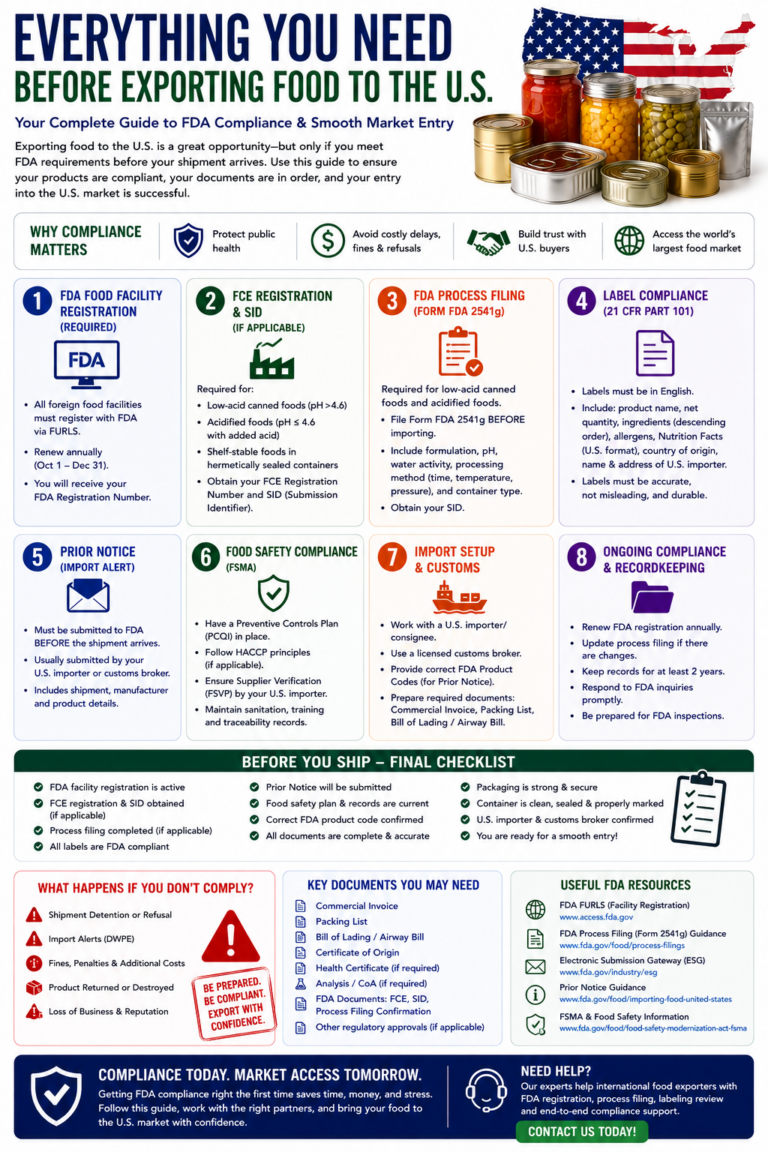
Everything You Need Before Exporting Food to the U.S.
The full pre-export checklist for foreign food companies — everything FDA expects in place before your product reaches the U.S.
Key Takeaways
- FDA checks at entry — nothing is pre-approved, so preparation must come first.
- Classification drives everything — it decides which requirements apply.
- Foreign facilities need a U.S. Agent — alongside facility registration.
- Canned & acidified foods need FCE/SID — most other foods don't.
- The importer holds FSVP — but you must ensure one is in place.
- Everything must match — label, filings, and documents have to agree.
Seven Steps to Export-Ready
Work through these in order — each links to the full detail. The sequence matters, because classification and registration shape everything after them:
Classify your product
Shelf-stable, refrigerated, or frozen? A standard food, or a low-acid canned or acidified food? Classification decides which requirements apply — and misclassifying it cascades into missing steps later.
LACF & acidified foods →Register the facility & appoint a U.S. Agent
Every manufacturing, processing, packing, or holding facility must hold an active FDA Food Facility Registration. Foreign facilities must also designate a U.S. Agent as their FDA contact.
Registration & agent → How to appoint →File FCE/SID if your product needs it
Low-acid canned and acidified foods require Food Canning Establishment registration and scheduled process filings, validated by a process authority. Skipping these is a top cause of holds for canned goods and sauces.
FCE/SID checklist →Make the label compliant
Identity, Nutrition Facts, ingredients in descending order, allergens, net quantity, and a responsible party — and the label must match your formulation and filings exactly. Labeling errors are among the most common causes of delays.
Export labeling → Labeling rules →Set up an FSVP-compliant importer
Your U.S. importer runs a Foreign Supplier Verification Program, keeps the records, and holds responsibility for the entry. Without a compliant importer, the food can't legally enter — so line this up early.
FSVP guidance → Importer setup →Prepare your documentation
Commercial invoice, bill of lading or airway bill, packing list, product specifications, and any certificates of analysis — all consistent with your registration, filings, and label. Discrepancies invite questions and holds.
Documents needed →Submit prior notice, then verify
Prior notice must reach FDA before the shipment arrives — usually filed by your customs broker or importer. Then confirm everything: registrations active, filings complete, label compliant, importer set, documents aligned.
International compliance →The Mistakes That Cause Most Holds
Assuming registration is enough
Facility registration is necessary but not sufficient — FCE/SID, labeling, FSVP, and prior notice all still apply.
Skipping FCE/SID filings
Canned and acidified foods that ship without scheduled process filings are stopped — this is a frequent, avoidable miss.
Label not matching the filing
A label that doesn't match the formulation or the filed process is treated as a discrepancy — and can hold the shipment.
No FSVP importer in place
Without a compliant U.S. importer running FSVP, the food can't legally enter — no matter how good everything else is.
Get Export-Ready Before You Ship
FDA Registration Assistance handles the FDA side end to end: Food Facility Registration and U.S. Agent, FCE/SID filings with process-authority coordination, FSVP support, and label and documentation review — all aligned before you ship. Prior notice is generally filed by your customs broker; we make sure everything upstream is ready so it goes smoothly.
Contact us at info@fdaregistrationassistance.com or call +1 (928) 275-8333. Food Facility Registration is available starting at $858. Trusted by companies across 135+ countries, with 15+ years of experience.
Frequently Asked Questions
1. What do I need before exporting food to the U.S.?
The core requirements: correct product classification, FDA Food Facility Registration (with a U.S. Agent for foreign facilities), any FCE/SID filings your product needs, a compliant U.S. label, an FSVP-compliant U.S. importer, complete shipment documentation, and prior notice before arrival. All of it should be in place before you ship, because FDA reviews the shipment at entry.
2. Do all foods require FCE and SID filings?
No — only certain categories, chiefly low-acid canned foods and acidified foods. These require Food Canning Establishment registration and scheduled process filings validated by a process authority. Most other foods don't, which is why correct classification is the first step.
3. Does my food need FDA approval before export?
No. FDA doesn't pre-approve food or food labels. But it does enforce its requirements — registration, labeling, FSVP, prior notice — at import. There's no approval to obtain, but there are requirements to meet, and missing any of them can hold your shipment.
4. What is the most important step?
Correct classification, because it determines everything downstream — whether you need FCE/SID filings, which labeling rules apply, and what documentation is required. A misclassification at the start cascades into missing requirements later, so it's worth getting right first.
5. Who is responsible for FSVP?
The U.S. importer — the owner or consignee at the time of entry — is legally responsible for the Foreign Supplier Verification Program. As the exporter, you don't hold the FSVP yourself, but you need to ensure a compliant importer is in place and provide the information they need to verify you.
6. Do labeling errors really cause delays?
Yes — labeling is one of the most common reasons food shipments are held. A non-compliant label makes the product misbranded, and the label must also match your formulation and filings. Reviewing it before you print and ship is far cheaper than a border hold.
7. Who submits prior notice?
Prior notice is submitted to FDA before the shipment arrives, and in practice it's usually filed by the customs broker or the importer. Errors or omissions can lead to refusal at entry, so it needs to be accurate and consistent with your other filings.
8. What documents does my shipment need?
Typically a commercial invoice, a bill of lading or airway bill, a packing list, product specifications, and any applicable certificates of analysis. The key is consistency — every document should match your registration, filings, and label, since discrepancies are a common trigger for questions or holds.
9. What happens if I ship without full compliance?
The shipment can be held, detained, or refused at entry. That means delays of days or weeks, added storage and logistics costs, possible re-export or destruction, and damaged relationships with your U.S. buyer. Most of it is preventable by completing every requirement before shipping.
10. How long does it take to get export-ready?
It varies by product and how much is already in place. Facility registration and a U.S. Agent can be arranged quickly; FCE/SID filings and label corrections take longer because they involve a process authority or artwork changes. The safe approach is to start well before your intended ship date.
11. Is this the same process for dietary supplements?
The backbone is similar — registration, U.S. Agent, FSVP, prior notice — but supplements follow the Supplement Facts labeling rules and their own claim requirements rather than the food Nutrition Facts framework. If you're exporting supplements, the labeling piece in particular follows a different path.
12. Can you handle the whole process for me?
We handle the FDA side end to end: facility registration, U.S. Agent, FCE/SID filings, coordination with a process authority, FSVP support, and label and documentation review. Prior notice is generally filed by your customs broker; we make sure everything upstream is aligned so that filing goes smoothly.
13. Should I get professional help?
Most exporters do, because the requirements interlock — a misclassification or a label that doesn't match a filing can undo the rest. Professional support reduces the risk of a preventable hold on a shipment you've already paid to produce and move.
14. How does FDA Registration Assistance help?
We prepare foreign food companies to export to the U.S.: FDA Food Facility Registration and U.S. Agent, FCE/SID filings with process-authority coordination, FSVP support, and label and documentation review — all aligned before you ship. Starting at $858 for registration, for companies across 135+ countries. Contact info@fdaregistrationassistance.com or +1 (928) 275-8333.