
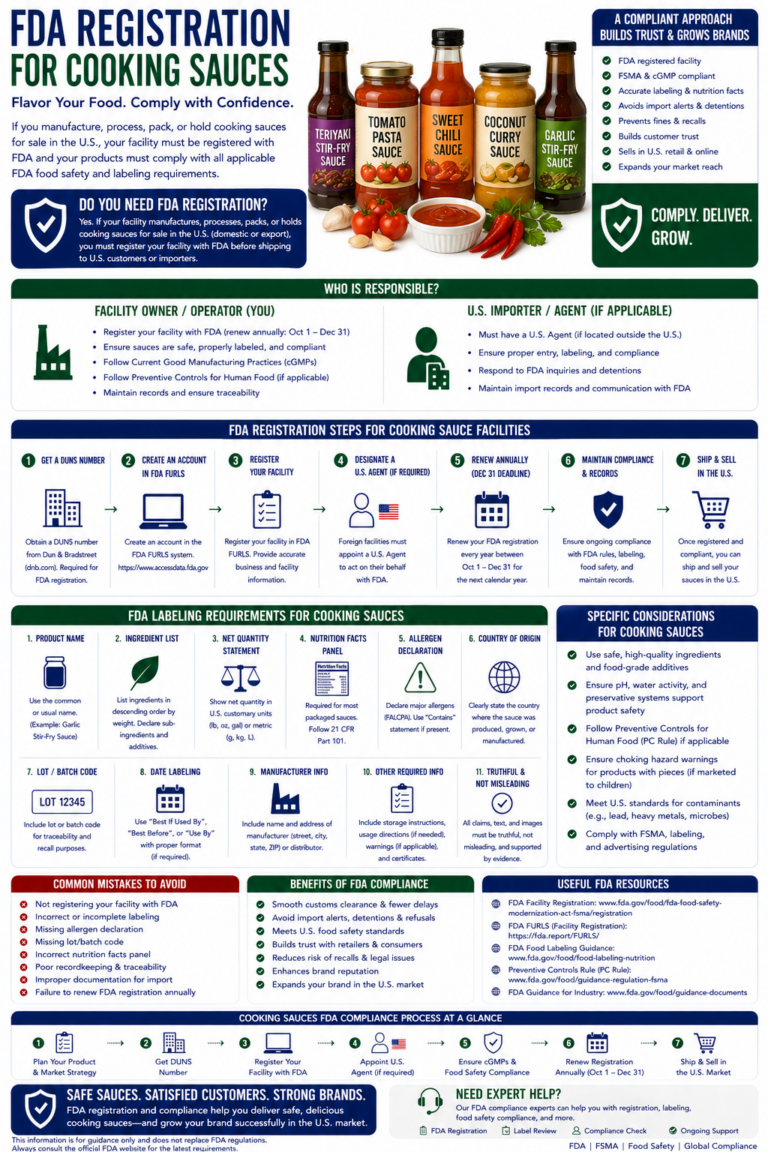
FDA Registration for Cooking Sauces
Why so many cooking sauces need process filing — and how to tell which category yours is.
Key Takeaways
- Classification is the whole game — it decides whether you need process filing.
- Low-acid ingredients push pH up — meat, dairy, coconut, vegetables.
- Most jarred cooking sauces need FCE + SID — as LACF or acidified.
- A process authority confirms & validates — from your finished pH.
- Meat-heavy sauces can be USDA — over ~3% raw / 2% cooked meat.
- Refrigerated sauces differ — not shelf-stable, so a different path.
Why Cooking Sauces Are a Classification Challenge
A "simple" sauce is rarely simple to classify. Cooking sauces are built from ingredients that move the finished pH around — and pH is exactly what decides the regulatory category. Add meat, dairy, coconut, or vegetables to an acidic tomato base and the finished product can rise above pH 4.6, turning a sauce you'd assume is "just tomatoes" into a low-acid canned food.
There are three possible outcomes, and a jarred cooking sauce lands in one of them based on its finished equilibrium pH:
- Above pH 4.6 — a low-acid canned food (LACF), safe by heat, under Part 113 → FCE + SID
- 4.6 or below, with added acid — an acidified food, under Part 114 → FCE + SID
- Naturally at or below 4.6, no acid added — an acid food, generally no FCE/SID
Which Category Is Your Cooking Sauce?
A rough guide by sauce type — the finished pH still decides, but this is where each commonly lands:
| Cooking sauce | Often is… | What it triggers |
|---|---|---|
| Tomato pasta / pizza sauce | Borderline — acid base, but meat/veg/cream can push pH up | Often LACF or acidified → FCE + SID |
| Curry / coconut / simmer sauce | Low-acid (coconut, vegetables, dairy) | Usually LACF or acidified → FCE + SID |
| Meat-containing sauce (bolognese, meat curry) | Low-acid + meat | FCE + SID — or USDA if meat is high |
| Stir-fry / soy-based sauce | Varies — salt/acid controlled | Depends — process authority confirms |
| Acidified marinade / vinegar-based | Acidified (added acid → pH ≤ 4.6) | FCE + SID (Part 114) |
| Refrigerated sauce | Not shelf-stable | Different path — no LACF/acidified filing |
The Meat Trap: When Your Sauce Is USDA, Not FDA
A cooking sauce with meat or poultry can leave FDA's jurisdiction entirely. If the product contains more than a small proportion of meat — generally more than 3% raw, or 2% cooked — it falls under USDA's Food Safety and Inspection Service (FSIS) instead of FDA, following a different agency's rules and inspection regime.
Labeling & Allergens in Cooking Sauces
Sauces are ingredient-dense, which makes labeling — especially allergens — a frequent failure point:
- Break down compound ingredients — soy sauce, fish sauce, pastes, and spice blends must disclose sub-ingredients
- Surface hidden allergens — soy, wheat, sesame, milk, tree nuts, fish/shellfish are common and often buried in blends
- Match the label to the formulation — the ingredient list has to reflect what's actually in the jar
- Include the full panel — identity, Nutrition Facts, net quantity, and responsible firm
Get Your Cooking Sauce Classified & Compliant
FDA Registration Assistance starts by classifying your sauce — checking finished pH and meat content to determine whether it's a standard food, a low-acid canned or acidified food, or a USDA product — then handles what follows: registration and U.S. Agent, FCE and scheduled process (SID) filing with process-authority coordination, FSVP for imports, and label review.
Contact us at info@fdaregistrationassistance.com or call +1 (928) 275-8333. Food Facility Registration is available starting at $858. Trusted by companies across 135+ countries, with 15+ years of experience.
Frequently Asked Questions
1. Do cooking sauces need FDA registration?
Yes. Any facility that manufactures, processes, packs, or holds cooking sauces must be registered with FDA, domestic or foreign, and foreign facilities need a U.S. Agent. But registration is only the start — for many cooking sauces the bigger question is whether the product also needs process filing, which depends on its classification.
2. Why is classification such a big deal for cooking sauces?
Because cooking sauces often contain low-acid ingredients — meat, dairy, coconut, vegetables — that push the finished pH above 4.6. A shelf-stable sauce above pH 4.6 is a low-acid canned food (Part 113); one brought to 4.6 or below with added acid is an acidified food (Part 114). Both require FCE registration and a scheduled process. So a jarred cooking sauce frequently needs process filing, unlike a simple naturally acidic sauce.
3. Does my pasta or curry sauce need FCE and SID?
Very often, yes. A tomato pasta sauce with added meat, vegetables, or cream can rise above pH 4.6 and become a low-acid canned food; a curry or coconut simmer sauce is usually low-acid to begin with. Both typically need FCE registration and a scheduled process, validated by a process authority. A process authority should confirm the classification from your finished pH.
4. When is a cooking sauce USDA rather than FDA?
When it contains enough meat or poultry. A sauce with more than a small proportion of meat — generally more than 3% raw or 2% cooked meat — falls under USDA's Food Safety and Inspection Service (FSIS) instead of FDA. So a meat bolognese or a meat-heavy curry sauce may be a USDA product, following a different agency's rules entirely. It's worth checking meat content early.
5. What role does a process authority play?
For a cooking sauce that's low-acid or acidified, a process authority evaluates the formulation and finished pH, confirms the classification, and establishes and validates the scheduled process — the parameters that make it safe. FDA doesn't "approve" the process; the process authority validates it, and the scheduled process (SID) depends on that documentation. It's usually the longest-lead step.
6. What if my cooking sauce is refrigerated, not shelf-stable?
A refrigerated cooking sauce isn't a shelf-stable canned food, so it generally doesn't fall under the low-acid canned or acidified process-filing rules. It follows a different path, with its own food-safety controls. The process-filing question mainly applies to shelf-stable, hermetically sealed sauces intended to be stored at room temperature.
7. Do acidified marinades and vinegar-based sauces need filing?
If they're acidified foods — a low-acid base brought to pH 4.6 or below with added acid, shelf-stable in a sealed container — then yes, they need FCE registration and a scheduled process under Part 114. Many marinades and vinegar-based cooking sauces fall here. A naturally acidic sauce with no added acid is treated differently, so the distinction matters.
8. What allergens are common in cooking sauces?
Soy, wheat, sesame, milk, tree nuts, and fish or shellfish (in some Asian sauces) are all common. Allergens are frequently hidden inside compound ingredients like soy sauce, fish sauce, or spice blends, which have to be broken down so the allergen is declared. Allergen labeling is one of the highest-risk areas for cooking sauces.
9. Do imported cooking sauces need FSVP?
Yes. If the sauce is imported, the U.S. importer holds FSVP and must verify the foreign supplier meets U.S. standards, with records available to FDA. For a low-acid or acidified sauce, the supplier's FCE and scheduled process are core evidence for that verification, so FSVP and process filing connect directly.
10. What labeling do cooking sauces need?
A statement of identity, a full ingredient list in descending order (with sub-ingredients of any compound ingredient), allergen declarations, a Nutrition Facts panel, net quantity, and the responsible firm. Because sauces have complex blends, the ingredient list and allergens are where problems most often appear — the label has to match the actual formulation.
11. What are the most common compliance mistakes for cooking sauces?
Misclassifying an acidified or low-acid product (or not realizing filing is needed at all); missing or incorrect process filings; not recognizing a meat sauce is USDA; ingredient lists that don't match the formulation; and unclear allergen declarations in compound ingredients. Most trace back to skipping the classification step, which drives everything else.
12. Does registration or filing mean FDA approved my sauce?
No. Registration and the FCE/SID filings are compliance steps, not an FDA approval or endorsement. FDA doesn't pre-approve foods; the filings put your facility and validated process on record. Your sauce still has to meet all applicable requirements, including labeling, at import and on the market.
13. How long does it take to get a cooking sauce compliant?
There's no single fixed number — registration is quick, but if the sauce is low-acid or acidified, the process-authority validation behind the scheduled process is usually the long pole. Confirming classification early tells you whether you're facing a simple label review or a full process filing, so that's the first step.
14. How does FDA Registration Assistance help with cooking sauces?
We start by classifying the sauce — checking finished pH and meat content to determine whether it's a standard food, a low-acid canned or acidified food, or a USDA product — then handle what follows: facility registration and U.S. Agent, FCE and scheduled process (SID) filing with process-authority coordination, FSVP for imports, and label review. Starting at $858 for registration, for companies across 135+ countries. Contact info@fdaregistrationassistance.com or +1 (928) 275-8333.