FDA Registration for Pulses
The relief on the farm side lulls people into thinking pulses are low-risk. The residue and import-alert side is where shipments actually get stuck.
Key Takeaways
- Pulses sit outside the Produce Safety Rule — "rarely consumed raw" list + 2019 enforcement discretion.
- But adulteration rules still apply, and processing changes everything.
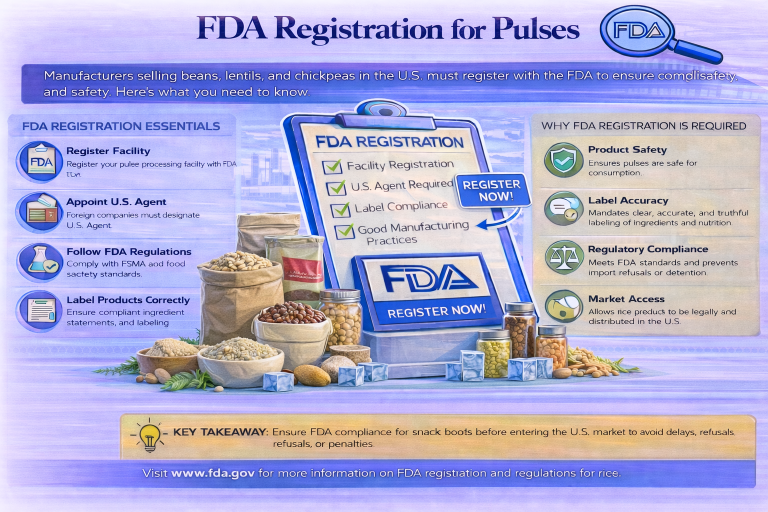
- Processed pulses (flour, pea protein, hummus, roasted) → facility registration + Part 117.
- Pesticide residues are the #1 import risk — glyphosate found in chickpeas, lentils, beans.
- Violative residues → refusal + Import Alert (DWPE).
- Pulses aren't major U.S. allergens — unlike peanuts and soy (both legumes).
Raw Commodity vs Processed Product
The single biggest factor in what applies to your pulses is whether they're still a raw commodity or have become a processed product:
Raw pulses (RAC)
Grown, dried, cleaned, and bagged — a raw agricultural commodity. Farm side sits outside the Produce Safety Rule; the adulteration prohibition still applies, and imports still need prior notice and supplier verification.
Processed pulses
Milled to flour, extracted to pea protein, made into hummus, roasted, or blended. Now a food facility is involved — it registers and meets preventive controls (Part 117). Ready-to-eat products draw the closest attention.
Pesticide Residues — the #1 Pulse Import Risk
When a residue exceeds its EPA tolerance (or no tolerance exists for that pesticide on that commodity), the consequences at import are serious:
- The shipment can be refused entry.
- The firm and product can be placed on an Import Alert under Detention Without Physical Examination (DWPE).
- A single violative shipment can trigger the alert — which then applies to future shipments.
- Getting off the list means demonstrating control and petitioning — see how to remove an import alert.
Pulses and Allergens
Registration & Imports
| Requirement | When it applies |
|---|---|
| Facility registration | When pulses are processed/packed/held by a facility (foreign adds U.S. Agent) |
| Preventive controls | Processing facilities — hazard analysis under Part 117 |
| Prior notice | Every imported shipment, before arrival |
| FSVP | Importer verifies the supplier — residues included |
| Labeling | Processed/seasoned/blended products — ingredients + Nutrition Facts |
Bringing Pulses to Market
Know your farm status
Raw pulses sit outside the Produce Safety Rule — but adulteration rules still apply.
Determine raw vs processed
Raw commodity, or a processed product (flour, pea protein, hummus, roasted)?
Register the facility if processing
Processing facilities register and meet Part 117; foreign facilities add a U.S. Agent.
Manage pesticide residues
Supplier controls and testing against EPA tolerances — glyphosate especially.
Handle imports
Prior notice + FSVP, plus registration/U.S. Agent where a facility is involved.
Label & keep current
Label processed products correctly; renew every two years; keep records.
Get Your Pulses to Market
FDA Registration Assistance registers pulse-processing facilities, serves as U.S. Agent, supports pesticide-residue and supplier-verification strategy, reviews labeling, and handles FSVP and prior notice — so the residue exposure is managed before the port, not discovered at it.
Contact us at info@fdaregistrationassistance.com or call +1 (928) 275-8333. Trusted by companies across 135+ countries, with 15+ years of experience.
Frequently Asked Questions
1. Do pulses need FDA registration?
It depends on processing. Raw pulses are raw agricultural commodities and the farm side largely sits outside the Produce Safety Rule. But a facility that mills, processes, packs, or holds pulses registers, and foreign facilities need a U.S. Agent. Registration isn't approval.
2. Are pulses covered by the Produce Safety Rule?
Largely no — dry beans, chickpeas, and lentils are on FDA's "rarely consumed raw" list, and in March 2019 FDA announced enforcement discretion for pulse crops (with wine grapes, hops, almonds). Either way, the ban on adulterated food still applies.
3. What counts as a "pulse"?
The dried edible seeds of legumes — dry beans (black, kidney, pinto, navy, and more), lentils, chickpeas (garbanzo beans), and dry/field peas. Fresh green beans and green peas are vegetables, not pulses. Dried pulses are treated as raw agricultural commodities.
4. When do pulses trigger facility registration?
Once processed rather than just grown and dried — milled to flour, turned into pea protein, made into hummus, roasted, or blended and packaged. Then a facility is involved, and it registers and meets preventive controls under Part 117.
5. What's the biggest import risk for pulses?
Pesticide residues. FDA testing has found residues — glyphosate especially, often used as a pre-harvest desiccant — in chickpeas, lentils, and beans, sometimes over the legal limit. EPA sets tolerances and FDA enforces them; imports over tolerance can be refused.
6. What if my pulses exceed a pesticide tolerance?
FDA can refuse the shipment, and the firm and product can be placed on an Import Alert under DWPE — which a single violative shipment can trigger, then applies to future shipments until the firm shows control and petitions for removal.
7. How do I control pesticide residues?
Supplier selection and controls, awareness of how pulses are grown and desiccated in the origin country, and residue testing against the applicable EPA tolerances before shipping. For importers, this fits into FSVP supplier verification.
8. Are pulses a major food allergen?
Generally no — lentils, chickpeas, dry beans, and dry peas aren't among the nine major U.S. allergens, even though their cousins peanuts and soybeans are. Lupin is an EU major allergen but not U.S. Any actual major allergen from other ingredients must still be declared.
9. Do pulse facilities need preventive controls?
A processing facility generally evaluates Part 117, does a hazard analysis, and controls relevant hazards. Ready-to-eat and processed products (roasted chickpeas, pulse flours) get closer attention than raw dried commodities. Small/qualified facilities have modified requirements.
10. Do importers need FSVP and prior notice?
Yes — prior notice per shipment and an importer FSVP, plus registration and a U.S. Agent where a foreign facility is involved. Given the residue risk, supplier verification and testing are central for pulses.
11. Is "FDA registered" the same as "FDA approved"?
No — registration tells FDA a facility exists and what it does; it isn't approval of the product. Calling pulses "FDA approved" because a facility is registered is inaccurate.
12. What labeling applies to pulses?
Plain dried pulses need accurate identity and net quantity. Processed, seasoned, or blended products need a full ingredient list and Nutrition Facts, and any major allergen from added ingredients must be declared.
13. What's the most common mistake pulse importers make?
Assuming pulses are low-risk and skipping pesticide-residue controls. The farm-side relief creates false security — the residue and import-alert exposure is real, and it's where most pulse shipments run into trouble.
14. How does FDA Registration Assistance help?
It registers pulse-processing facilities, serves as U.S. Agent, supports pesticide-residue and supplier-verification strategy, reviews labeling, and handles FSVP and prior notice, for companies across 135+ countries. Contact info@fdaregistrationassistance.com or +1 (928) 275-8333.