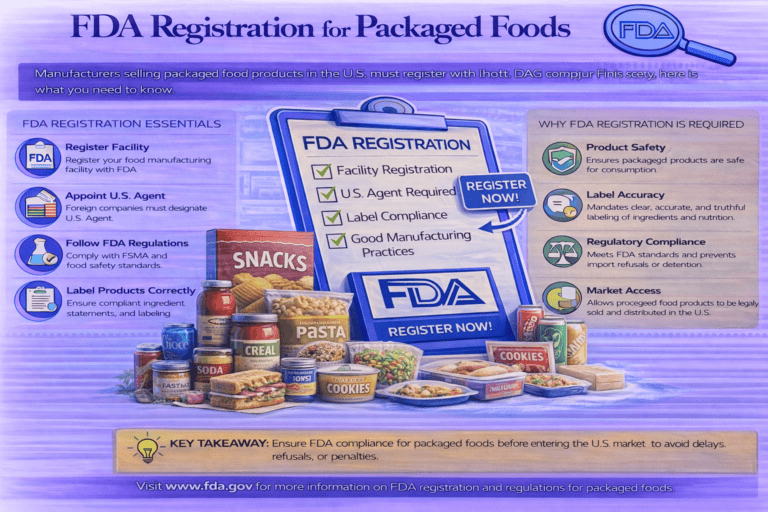
FDA Registration for Packaged Foods
The baseline every packaged food needs, the complete consumer label, and how to classify your product for any additional rules.
Key Takeaways
- "Packaged" is the baseline — not a special or lighter category; it triggers the full set.
- The complete consumer label — six elements are what "packaged" specifically requires.
- Registration + preventive controls — the food-safety half of the baseline.
- Then classify by the food — canned, acidified, dried, refrigerated, seafood, USDA.
- Bulk ≠ consumer package — bulk-for-processing has reduced labeling.
- Nutrition Facts exemptions are narrow — and the other label elements still apply.
Baseline First, Then Classify
There's no single "packaged food rule." Being a packaged food consumed by the public simply puts you on the standard framework — the same starting point for a snack, a beverage, a canned soup, or a frozen entrée. What differs between them isn't whether the baseline applies; it's which additional regime layers on top.
The Complete Consumer Label
The label is the piece genuinely distinctive to packaged goods — it's where most packaged-food problems occur. Under 21 CFR Part 101, a packaged food sold to consumers carries six core elements:
- Statement of identity — the common/usual name, on the principal display panel
- Net quantity of contents — accurate weight/volume/count
- Ingredient list — in descending order by weight
- Allergen declaration — the 9 major allergens (sesame is now the 9th)
- Name & address — of the manufacturer, packer, or distributor
- Nutrition Facts panel — in the current required format
Classify by the Food
Once the baseline is met, your product's own attributes decide what else applies:
| Your packaged food is… | Additional regime |
|---|---|
| Shelf-stable & low-acid (pH > 4.6) | Low-acid canned food → FCE + scheduled process |
| Acid added to preserve (pH ≤ 4.6) | Acidified food → FCE + scheduled process |
| Dry / low-moisture | Preventive controls focused on Salmonella (generally no FCE) |
| Refrigerated or frozen | Cold chain, Listeria control, date marking |
| Vacuum / reduced-oxygen packed | C. botulinum barrier controls |
| Seafood | Adds Seafood HACCP |
| Meat / poultry (above small thresholds) | USDA-FSIS, not FDA |
Claims & Imports
- Claims are regulated — nutrient content ("low fat") and health claims have defined conditions; disease claims can turn a food into an unapproved drug; undefined terms ("natural," "keto") must still be truthful
- Allergens are the top recall driver — undeclared/mis-declared allergens outrank every other label error
- Imports — foreign facility registers + U.S. Agent; importer runs FSVP with prior notice; the label must be fully U.S.-compliant
- Ongoing, not one-time — biennial registration renewal, maintained food-safety plan, and label updates when rules or formulas change
Get Your Packaged Foods Compliant
FDA Registration Assistance covers the baseline every packaged food needs — facility registration, U.S. Agent, a compliant consumer label, and support for the preventive-controls plan — and then classifies your product to flag any additional regime (canned, acidified, dried, refrigerated, seafood, or USDA). Plus FSVP for imports.
Contact us at info@fdaregistrationassistance.com or call +1 (928) 275-8333. Food Facility Registration is available starting at $858. Trusted by companies across 135+ countries, with 15+ years of experience.
Frequently Asked Questions
1. Do packaged foods require FDA registration?
Yes — a facility that manufactures, processes, packs, or holds packaged foods for the U.S. registers with FDA (foreign facilities also need a U.S. Agent). "Packaged food" isn't a special or lighter category; it's the default, and it triggers the full standard set of requirements: registration, a preventive-controls food-safety plan, the complete consumer label, and — for imports — FSVP.
2. Is "packaged food" a specific FDA category?
No — it's the baseline. There isn't a single "packaged food rule"; instead, being a packaged food consumed by the public triggers the standard framework (registration, food safety, and a full label). From there, the specific food determines whether any additional regime applies — canned/low-acid, acidified, dried, refrigerated/frozen, seafood, and so on. So the right way to think about it is: baseline first, then classify by what the food actually is.
3. What label does a packaged food need?
Because it's in package form and sold to consumers, a packaged food must carry six core elements under 21 CFR Part 101: a statement of identity (the common name), the net quantity of contents, an ingredient list (in descending order by weight), an allergen declaration, the name and address of the manufacturer/packer/distributor, and a Nutrition Facts panel. The complete consumer label is the part that's genuinely distinctive to packaged goods — it's where most packaged-food problems occur.
4. Is bulk food labeled the same as consumer packages?
No. Food shipped in bulk containers for further manufacturing, processing, or repacking — not in consumer package form — has modified labeling (the required information can appear on shipping documents rather than a full retail label, under 21 CFR 101.100). The full consumer label attaches when the food is packaged for the end consumer. This bulk-vs-consumer distinction is a common source of confusion for ingredient suppliers.
5. Are any packaged foods exempt from the Nutrition Facts panel?
A few narrow categories: very small packages (under 12 square inches, which must give a phone/address for the information), qualifying small businesses (generally fewer than 100,000 units and fewer than 100 full-time employees, via FDA notification), raw whole produce and single-ingredient raw fish (a voluntary program), and foods for immediate consumption. Crucially, even when the Nutrition Facts panel is exempt, the other elements — identity, net quantity, ingredients, allergens, and name/address — are still required. And any nutrient content or health claim removes the small-business exemption.
6. Do packaged foods need a food safety plan?
Generally yes. Under FSMA's preventive controls rule (21 CFR 117), a facility conducts a hazard analysis and puts preventive controls in place for the hazards it identifies. What those controls look like depends on the food — a dry snack, a refrigerated dip, and a canned soup have very different hazard profiles — which is why classifying the product correctly drives the food-safety plan as much as the label.
7. How do I know if my packaged food needs extra requirements?
Classify it by its key attributes. Shelf-stable and low-acid (pH above 4.6)? It's a low-acid canned food needing an FCE and scheduled process. Acid added to preserve it? Acidified food. Dry/low-moisture? Preventive controls focused on Salmonella. Refrigerated or frozen? Cold chain and Listeria control. Seafood? Add Seafood HACCP. Contains enough meat/poultry? It may fall under USDA instead of FDA. The baseline is the same; these are the add-ons.
8. What are the most common labeling mistakes on packaged foods?
Undeclared or mis-declared allergens (the single biggest recall driver), an incorrect or outdated Nutrition Facts format, a missing or vague statement of identity, inaccurate net quantity, and non-compliant claims (health or nutrient-content claims that aren't substantiated or authorized). Because packaged foods live or die on the label, getting these right is the highest-leverage part of packaged-food compliance.
9. Do imported packaged foods have extra requirements?
Yes. The foreign facility registers with FDA and keeps a U.S. Agent, and the U.S. importer runs FSVP (Foreign Supplier Verification Program) with prior notice for each shipment. Imported packaged foods also have to carry fully U.S.-compliant labels — foreign labels frequently fail on Nutrition Facts format, allergen wording, or English-language requirements, which is a common reason shipments are held.
10. Does FDA approve packaged foods before sale?
No. FDA doesn't pre-approve food products or food labels. You register your facility, implement the required food-safety controls, ensure the label complies, and (for imports) run FSVP; FDA enforces afterward and at the border. There's no FDA "approval" of a packaged food — there's your compliance, which you're responsible for getting right before the product ships.
11. What about health or "better-for-you" claims on the package?
Claims are tightly regulated. Nutrient content claims ("low fat," "high fiber") and health claims have specific FDA definitions and conditions; structure/function statements have their own limits; and disease claims can turn a food into an unapproved drug. Marketing terms that FDA doesn't define ("natural," "keto") must still be truthful and not misleading. The package is where these claims live, so they're part of packaged-food compliance.
12. Is packaged-food compliance a one-time task?
No. FDA registration must be renewed on the biennial schedule and kept current, the food-safety plan is maintained and reassessed, and labels must be updated when formulations, formats, or rules change (as with the updated Nutrition Facts format). Packaged-food compliance is an ongoing program, not a one-time filing.
13. Can FDA Registration Assistance handle a whole packaged-food line?
Yes. We handle registration and U.S. Agent, review each product's full label (identity, Nutrition Facts, allergens, claims), help classify products so the right food-safety regime applies, and set up FSVP for imports. For products that cross into a specific category — canned/low-acid, acidified, seafood — we route the specialized filings. It's designed as one coordinated solution for a packaged-food catalog.
14. How does FDA Registration Assistance help with packaged foods?
We cover the baseline every packaged food needs — facility registration, U.S. Agent, a compliant consumer label, and support for the preventive-controls plan — and then classify your product to flag any additional regime (canned, acidified, dried, refrigerated, seafood, or USDA). Plus FSVP for imports. Registration is available starting at $858, for companies across 135+ countries. Contact info@fdaregistrationassistance.com or +1 (928) 275-8333.