
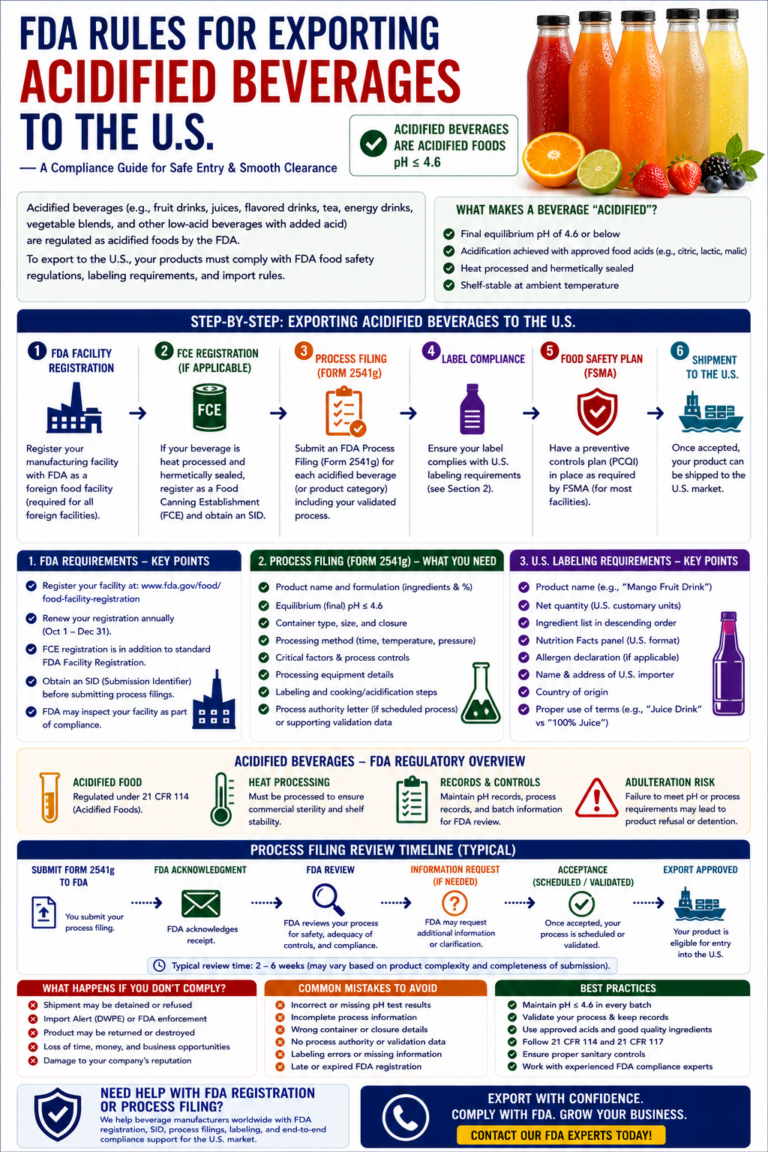
FDA Rules for Exporting Acidified Beverages to the U.S.
The classification that decides your rules — and the requirements for a true acidified beverage.
Key Takeaways
- Classification decides everything — not every acidified drink needs FCE/SID.
- True acidified beverage (still, non-juice, added acid, pH ≤ 4.6) → Part 114, FCE/SID.
- Carbonated drinks are excluded from acidified foods (21 CFR 114.3(b)).
- Juices follow Juice HACCP — Part 120, not Part 114.
- Naturally acidic drinks are acid foods — generally no FCE/SID.
- Alcohol (≥ 0.5% ABV) is primarily a TTB matter.
What Counts as an "Acidified Beverage"
Under 21 CFR 114.3, an acidified food is a low-acid food with acid added to bring it to a finished equilibrium pH of 4.6 or below and a water activity above 0.85. A beverage that fits that — and isn't carbonated, a juice, or kept refrigerated — is an acidified beverage, and it follows the acidified-food process-filing rules.
Which Rule Applies to Your Beverage?
This is the part that changes everything downstream. Find your beverage:
| Your beverage | FCE / scheduled process? | What governs it |
|---|---|---|
| Still, non-juice, acidified to pH ≤ 4.6 (added acid) | Yes | Acidified food Part 114 |
| Carbonated beverage | No | Excluded from acidified foods 114.3(b) — soft-drink rules |
| Juice or juice beverage | No | Juice HACCP Part 120 — incl. 5-log |
| Naturally acidic (pH ≤ 4.6, no acid added) | Usually no | Acid food 114.3(a) |
| Fermented, non-alcoholic (e.g. some kombucha) | Usually no | Excluded from acidified foods — other controls apply |
| Alcoholic (≥ 0.5% ABV) | No | Primarily TTB 27 CFR |
What the Filing Involves
If your drink lands in the Part 114 acidified-food category, here's the added layer beyond standard registration and labeling:
FCE + scheduled process
Register the canning establishment, then file a scheduled process for each formulation — the same mechanics as other acidified foods.
Process-authority validation
An expert validates that your acid addition and process reliably reach and hold pH ≤ 4.6 — the basis your filing rests on.
The Rest of the Requirements
Whatever the classification, every beverage still needs the standard set to enter the U.S.:
Registration + U.S. Agent
An active Food Facility Registration; foreign facilities appoint a U.S. Agent.
Labeling
Identity, Nutrition Facts, ingredients, allergens, net quantity — plus percent-juice and warnings where they apply.
FSVP importer
A U.S. importer running FSVP, with matching documentation.
Prior notice
Filed before each shipment arrives — usually by the customs broker or importer.
Export Your Beverage the Compliant Way
FDA Registration Assistance starts by classifying your beverage correctly — acidified, carbonated, juice, naturally acidic, or alcoholic — so you meet the right requirements, not the wrong ones. Then we handle the FDA side end to end: registration and U.S. Agent, FCE and scheduled process filings where they apply with process-authority coordination, and label and documentation review.
Contact us at info@fdaregistrationassistance.com or call +1 (928) 275-8333. Food Facility Registration is available starting at $858. Trusted by companies across 135+ countries, with 15+ years of experience.
Frequently Asked Questions
1. Do all acidified beverages need FCE and SID filings?
No — this is the key point most guides get wrong. A non-carbonated, non-juice beverage made from a low-acid base and acidified with added acid to a finished pH of 4.6 or below is an acidified food under 21 CFR Part 114, and that does need FCE and a scheduled process. But carbonated drinks, juices, naturally acidic drinks, and alcoholic beverages are handled under different rules. Classification decides it.
2. What exactly is an "acidified beverage" to FDA?
Under 21 CFR 114.3, an acidified food is a low-acid food to which acid or acid foods are added, with a water activity above 0.85 and a finished equilibrium pH of 4.6 or below. A beverage that fits this — and isn't carbonated, a juice, or refrigerated — is an acidified beverage and follows the acidified-food process-filing rules.
3. Are carbonated beverages acidified foods?
No. Carbonated beverages are specifically excluded from the acidified-foods regulation in 21 CFR 114.3(b). A carbonated soft drink acidified for flavor doesn't fall under Part 114's FCE/SID requirements on that basis — it's regulated as a soft drink instead. Assuming a carbonated drink needs an acidified-food process filing is a common misclassification.
4. What about juices — are they acidified beverages?
No. Juices and juice beverages are regulated under the Juice HACCP rule, 21 CFR Part 120, which requires a hazard analysis and a 5-log pathogen reduction — not the acidified-foods process filing. Even an acidic juice follows Part 120, not Part 114. If your beverage is juice-based, that's the framework that applies.
5. What if my drink is naturally acidic without added acid?
Then it's likely an acid food, not an acidified food. Foods with a natural pH of 4.6 or below (with no acid added to get there) are acid foods under 21 CFR 114.3(a) and are generally outside the acidified-food FCE/SID requirements. The distinction is whether acid was added to a low-acid base — a process authority can confirm it.
6. Do alcoholic beverages follow these rules?
No. Alcoholic beverages are excluded from the low-acid/acidified food framework, and beverages at or above 0.5% alcohol by volume are primarily regulated by the TTB, not under FDA's acidified-food rules. If your beverage is alcoholic, the path is different — though FDA facility registration can still apply in some cases.
7. Why does classification matter so much?
Because it determines your entire requirement set. Misclassifying — assuming a carbonated or juice product needs an acidified-food filing, or assuming a truly acidified beverage doesn't — either wastes effort or leaves a gap that can hold your shipment. Getting the category right is the single most important step for a beverage.
8. Do I need a process authority for an acidified beverage?
If your beverage is an acidified food under Part 114, yes. A process authority establishes and validates the scheduled process — the pH control and processing that keep it safe — and beverages often can't use typical hot-fill because of their packaging, so the validation approach matters. Your filing depends on that validation.
9. Is registration alone enough for a beverage?
No. Facility registration is the base requirement for any beverage, but an acidified beverage also needs FCE, a scheduled process, and process-authority validation, plus compliant labeling, an FSVP importer, and prior notice. Registration lets your facility be listed; the rest lets the product actually enter.
10. How long does compliance take for an acidified beverage?
It varies by product and readiness. Registration and FCE can be relatively quick, but process-authority validation and the scheduled process filing take longer, especially where pH control and packaging need careful validation. It shouldn't be assumed to be a matter of days — start well ahead of your ship date.
11. Does labeling differ for beverages?
The core requirements are the same — identity, Nutrition Facts, ingredients, allergens, net quantity, responsible party — and the label must match the formulation and any filing. Certain beverages have extra rules; juice, for example, needs percent-juice declaration and, when applicable, an unpasteurized warning. Match the label to your actual classification.
12. What are the most common beverage mistakes?
Misclassifying the beverage — treating a carbonated or juice product as an acidified food, or missing that a still, acidified drink is one — along with skipping process-authority validation, labels that don't match the filing, no FSVP importer, and prior notice errors. The classification mistakes are the ones specific to beverages.
13. Where do I go for the process filing details?
If your beverage is an acidified food, the process filing works the same way as for acidified foods generally. See the process filing explainer and the acidified foods guide for the FCE, scheduled process, and forms — and the FCE/SID checklist to confirm you're ready.
14. How does FDA Registration Assistance help?
We start by classifying your beverage correctly — acidified, carbonated, juice, naturally acidic, or alcoholic — so you meet the right requirements, not the wrong ones. Then we handle the FDA side end to end: Food Facility Registration and U.S. Agent, FCE and scheduled process filings where they apply, process-authority coordination, and label and documentation review. Starting at $858 for registration, for companies across 135+ countries. Contact info@fdaregistrationassistance.com or +1 (928) 275-8333.