
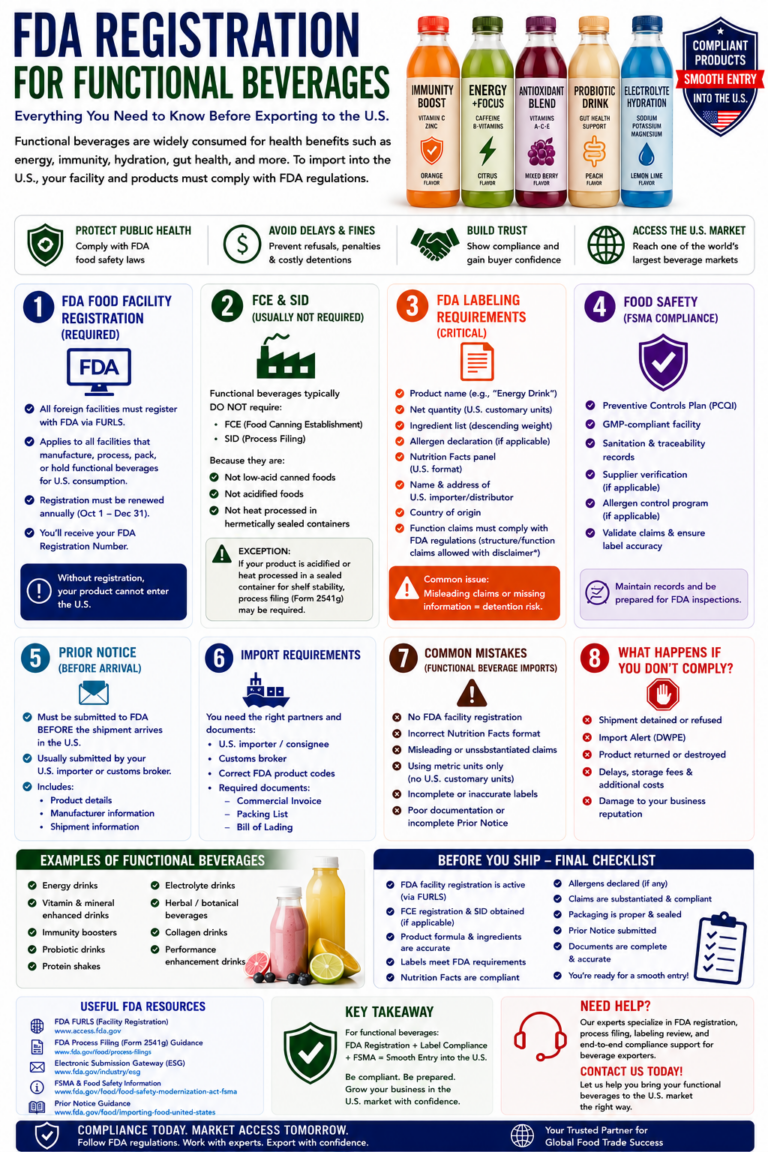
FDA Registration for Functional Beverages
The classification, ingredient, and claim rules that govern every functional drink — and where each beverage type's specifics live.
Key Takeaways
- "Functional beverage" isn't an FDA category — the product is regulated by what it is.
- A functional drink is a conventional food — Nutrition Facts, not Supplement Facts.
- You can't elect "supplement" for a drink — a beverage is a beverage to FDA.
- Every active must be food-legal — GRAS or approved; supplement-lawful ≠ food-lawful.
- Claims can't cross into disease — that turns a drink into an unapproved drug.
- pH & processing add LACF or Juice HACCP — "no filing" is often wrong.
The Three Realities Behind Every Functional Beverage
Whatever the marketing name, these three points govern the category — get them right and the rest follows:
Conventional food, not a supplement
A product represented and consumed as a beverage is a conventional food (Nutrition Facts) — you can't simply elect supplement status. See protein drinks.
GRAS or approved food additive
Every active must be lawful in food; the supplement "dietary ingredient" allowance doesn't apply to a drink. See herbal drinks.
Structure/function, not disease
A conventional food can make truthful nutritive claims but not disease claims — those make it an unapproved drug.
Supplement-Lawful Isn't Food-Lawful
This is the single most common reason functional beverages fail. Because the drink is a conventional food, every active ingredient must be GRAS or an approved food additive for that use — and the allowance that lets ingredients be "dietary ingredients" in supplements does not extend to conventional foods.
The Processing Overlays: LACF, Juice HACCP & Caffeine
The flat "functional beverages don't need process filing" is often wrong. Two overlays apply depending on the product:
- Low-acid & shelf-stable → LACF — a functional drink above pH 4.6 that's shelf-stable is a low-acid canned food needing FCE + a scheduled process (often aseptic)
- Contains juice → Juice HACCP — a juice-containing functional beverage needs a HACCP plan with a 5-log pathogen reduction
- Added caffeine → scrutiny — pure or synthetic added caffeine is a food-additive question, and high total caffeine draws FDA attention (especially energy drinks)
- Acidic or refrigerated products — may need neither filing, but that has to be confirmed, not assumed
Functional Beverage Types — and Where the Rules Live
Every type shares the framework above but emphasizes a different issue. Find yours for the specifics:
| Beverage type | What bites hardest | Where the rules are |
|---|---|---|
| Energy drink | Added caffeine; actives food-legal; food vs supplement | Ingredients / Supplements |
| Enhanced / vitamin water | Actives food-legal; conventional food, not supplement | Herbal drinks |
| Sports / electrolyte drink | Conventional food; claims; often low-acid | LACF / coconut water |
| Protein / recovery drink | Food vs supplement; PDCAAS protein claims | Protein drinks |
| Herbal / adaptogen / wellness | Botanical food-lawfulness; drug-claim risk | Herbal drinks |
| Smoothie / juice-based | Juice HACCP + 5-log reduction | Smoothies |
Registration, Labeling & Imports
- Facility registration — the maker/packer/holder registers; foreign facilities add a U.S. Agent
- Nutrition Facts label — as a conventional food: identity, full ingredient list naming every active, net quantity, responsible firm
- Allergens — milk, soy, tree nuts, and others common in these products must be declared
- No hidden actives — proprietary-blend labeling can't omit required disclosures
- FSVP for imports — verify actives are food-legal, process filing is in place, and claims are compliant before the shipment arrives
Get Your Functional Beverage U.S.-Ready
FDA Registration Assistance classifies the product (almost always a conventional food), vets each active for lawful food use, reviews claims to keep them out of drug territory, and identifies any process filing needed — LACF for shelf-stable low-acid, Juice HACCP for juice — then handles registration, U.S. Agent, labeling, and FSVP.
Contact us at info@fdaregistrationassistance.com or call +1 (928) 275-8333. Food Facility Registration is available starting at $858. Trusted by companies across 135+ countries, with 15+ years of experience.
Frequently Asked Questions
1. Do functional beverages need FDA registration?
Yes — any facility that manufactures, processes, packs, or holds a functional beverage for the U.S. market registers with FDA, with a U.S. Agent if foreign. But "functional beverage" isn't an FDA category, so registration is just the start. FDA regulates each drink by what it actually is — almost always a conventional food — and the real work is ingredient lawfulness, claims, and processing.
2. Is a functional beverage a food, a supplement, or a drug?
Almost always a conventional food. FDA's guidance treats a product represented and consumed as a beverage as a conventional food (using a Nutrition Facts panel), not a dietary supplement — regardless of how it's marketed. It becomes a drug only if it makes disease claims. So the default for a functional drink is "conventional food," and the supplement or drug labels are the exceptions, not options you can freely choose.
3. Can I label my functional beverage as a dietary supplement?
Generally not. FDA specifically watches for companies selling conventional beverages as "supplements" to gain claim flexibility or to use ingredients that aren't allowed in food. A product that's packaged, marketed, and consumed like a drink is a conventional food. Calling it a supplement doesn't change that and can make it misbranded. If you truly have a supplement, it's usually in a non-beverage form (capsule, powder, drops).
4. Can I put any active ingredient in a functional beverage?
No — and this is the biggest trap. Because a functional beverage is a conventional food, every active ingredient (botanical, amino acid, vitamin, or novel ingredient) must be GRAS or an approved food additive for that use in food. The "dietary ingredient" allowance that lets ingredients be used in supplements does NOT apply to conventional foods. An ingredient that's lawful in a supplement can be an unapproved food additive in a drink, making it adulterated.
5. Why does "supplement-lawful isn't food-lawful" matter so much?
Because it's the single most common reason functional beverages get into trouble. Companies see an ingredient used widely in supplements and assume it's fine in a drink — but conventional foods have a stricter ingredient standard (GRAS or approved food additive). Stevia, ginkgo, and various botanicals are classic examples of ingredients that were (or are) fine in supplements but not automatically lawful in conventional beverages. Confirm each active for food use first.
6. What claims can a functional beverage make?
As a conventional food, it can make truthful structure/function claims based on nutritive value and meet defined nutrient content claims — but it cannot claim to treat, cure, or prevent a disease. "Boosts immunity," "reduces stress," "detoxifies," and similar claims can turn the drink into an unapproved drug. The entire appeal of a functional beverage is its benefit story, which is exactly why claims are the highest-risk area for the category.
7. Do functional beverages need FCE or SID filing?
It depends on the product — the flat "no" many assume is wrong. A functional beverage that is low-acid (pH above 4.6) and shelf-stable is a low-acid canned food requiring FCE registration and a scheduled process (SID); many are aseptically packaged, which still needs an aseptic scheduled process. If it contains juice, Juice HACCP and a 5-log pathogen reduction apply. Acidic, refrigerated, or simple products may need neither. Processing and pH decide it.
8. How is caffeine handled in functional beverages?
Added caffeine draws scrutiny. Caffeine naturally present in an ingredient (coffee, tea, guarana) is treated differently from pure or synthetic caffeine added to a beverage, which is a food-additive question, and FDA has raised safety concerns about high total caffeine levels. If your functional beverage adds caffeine, the source and total amount matter for both safety and labeling. Energy drinks in particular attract attention here.
9. What's the difference between the beverage types?
They share the same core framework but emphasize different issues: energy drinks focus on caffeine and ingredient lawfulness; protein and recovery drinks on the food-vs-supplement question and PDCAAS-based protein claims; herbal and adaptogen drinks on botanical food-lawfulness and drug claims; sports and electrolyte drinks are often low-acid (LACF); and juice-based functional drinks trigger Juice HACCP. Identifying your type points you to the specific rules that bite hardest.
10. What labeling and allergens apply?
A functional beverage uses a Nutrition Facts panel (as a conventional food), with statement of identity, full ingredient list naming every active, net quantity, and responsible firm. Any major allergens present — milk, soy, tree nuts, and others common in these products — must be declared. And the ingredient list has to name the actual actives, not hide them behind proprietary-blend language that omits required disclosures.
11. Do imported functional beverages need FSVP?
Yes. The U.S. importer holds FSVP and must verify the foreign supplier meets U.S. standards, with prior notice before each shipment. For functional beverages, the verification should confirm the actives are lawful for food use, any process filing (LACF or Juice HACCP) is in place, and the claims are compliant — because ingredient or claim problems will surface as adulteration or misbranding at the port.
12. Does registration mean FDA approved my functional beverage?
No. FDA doesn't pre-approve food — registration just puts the facility on record. It doesn't certify your classification, your ingredients, or your claims. A functional beverage can be registered and still be adulterated (a non-food-legal active) or misbranded (a drug claim). Compliance is about meeting every applicable requirement, not obtaining an approval, and FDA enforces at import and in the marketplace.
13. What are the most common compliance mistakes for functional beverages?
Assuming a supplement-lawful active is fine in a drink (it often isn't); trying to label a beverage as a supplement; making disease/therapeutic claims; skipping LACF or Juice HACCP process filing on a shelf-stable low-acid or juice-containing product; and over-caffeination or proprietary-blend labeling gaps. Nearly all trace back to not classifying the product and vetting its actives against the conventional-food standard first.
14. How does FDA Registration Assistance help with functional beverages?
We classify the product (almost always a conventional food), vet each active ingredient for lawful food use (GRAS or approved food additive), review claims to keep them out of drug territory, and identify any process filing needed (LACF for shelf-stable low-acid, Juice HACCP for juice) — then handle facility registration, U.S. Agent, labeling, and FSVP for imports. Starting at $858 for registration, for companies across 135+ countries. Contact info@fdaregistrationassistance.com or +1 (928) 275-8333.