
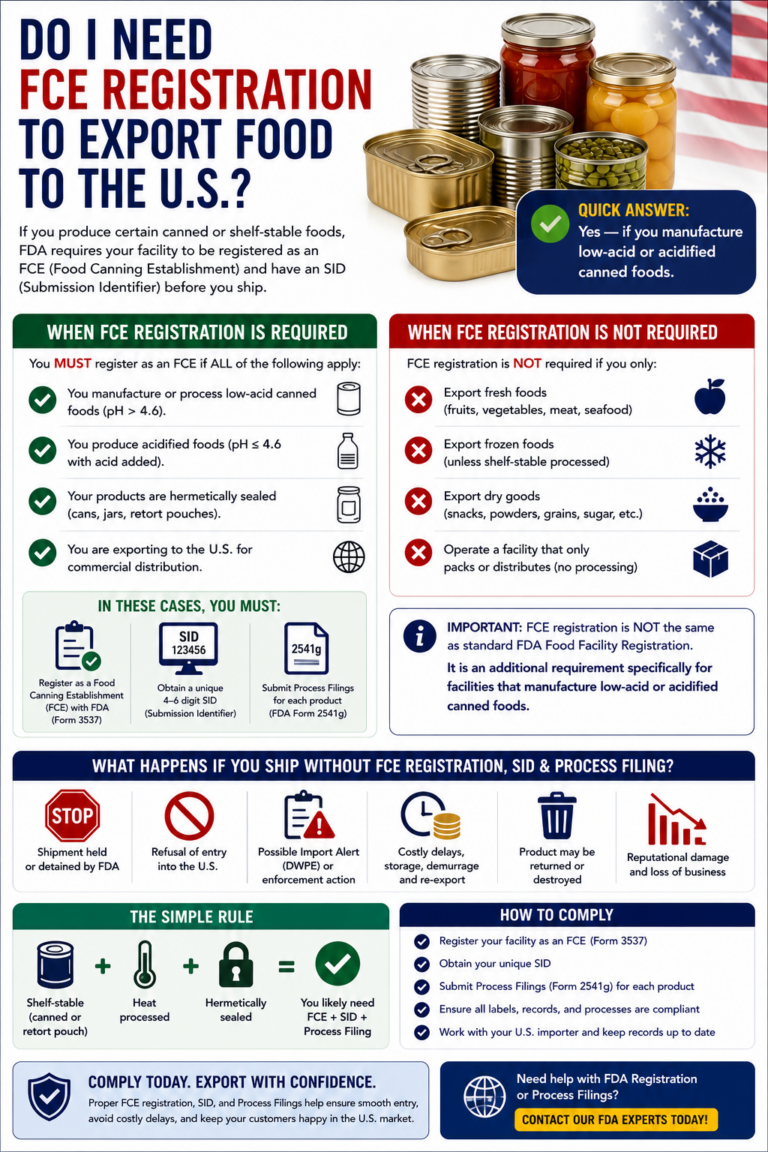
Do I Need FCE Registration to Export Food to the U.S.?
The two registrations people mix up, who actually needs FCE, and what you need instead if you don't.
Key Takeaways
- Most food exporters don't need FCE — it's a narrow requirement, not a general one.
- FCE ≠ Food Facility Registration — two different things people conflate.
- FCE applies only to low-acid canned foods and acidified foods.
- Food Facility Registration you almost always need — regardless of product.
- If FCE doesn't apply, you still have product-specific and labeling rules.
- Classification confirms it — pH, processing, packaging, shelf stability.
FCE vs. Food Facility Registration
Almost every "do I need FCE?" question is really this confusion underneath. They are two separate registrations, and for most exporters only one of them applies:
Food Facility Registration
- Who: essentially every facility that makes, processes, packs, or holds food for the U.S.
- What it does: identifies your facility to FDA
- When: required in almost all cases, whatever the product
- Foreign facilities: also need a U.S. Agent
FCE Registration
- Who: low-acid canned food and acidified food processors only
- What it does: registers the canning establishment and enables the scheduled process (SID) filing
- When: only when your product is LACF or acidified
- Plus: a scheduled process (SID) per product, if FCE applies
Who Actually Needs FCE
FCE and a scheduled process are required only if your product is one of these:
- Low-acid canned foods (LACF) — canned vegetables, meats, seafood, soups, ready meals with a pH above 4.6
- Acidified foods — pickles, many hot sauces, salsas, relishes (a low-acid base with added acid to pH ≤ 4.6)
- Shelf-stable products relying on validated thermal processing or acidification in hermetically sealed containers
What You Need Instead
"No FCE" doesn't mean "no requirements." Here's what actually applies to most food exporters:
Always: Facility Registration + U.S. Agent
The baseline for nearly every foreign food facility shipping to the U.S.
Registration & U.S. Agent →Juice & seafood: HACCP
Juice and seafood carry their own HACCP requirements, separate from FCE.
Juice HACCP → Seafood →Importers: FSVP
If you're the U.S. importer, you carry Foreign Supplier Verification obligations.
FSVP for importers →Everyone: Labeling
Every food must meet FDA labeling rules — identity, net quantity, ingredients, allergens, nutrition.
Export labeling →How to Tell Which Applies to You
Whether the FCE track is even relevant comes down to four things about your product:
- pH — is it low-acid (above 4.6) or acidified to 4.6 or below?
- Processing method — does safety depend on validated thermal processing or acidification?
- Packaging — is it in a hermetically sealed container?
- Shelf stability — is it shelf-stable, or does it rely on refrigeration?
Find Out Exactly What You Need
FDA Registration Assistance tells you plainly whether FCE even applies to your product, then handles what you actually need: Food Facility Registration and U.S. Agent, FCE and scheduled process (SID) filings only where required, and product-specific and labeling compliance — so you're not paying for, or missing, a requirement.
Contact us at info@fdaregistrationassistance.com or call +1 (928) 275-8333. Food Facility Registration is available starting at $858. Trusted by companies across 135+ countries, with 15+ years of experience.
Frequently Asked Questions
1. Do I need FCE registration to export food to the U.S.?
For most food exporters, no. FCE (Food Canning Establishment) registration applies only to a narrow subset — low-acid canned foods and acidified foods. If you don't make those, you don't need FCE. What you almost always do need is Food Facility Registration, a separate and broader requirement that people frequently confuse with FCE. So the real question is which of the two applies to you.
2. What's the difference between FCE and FDA Food Facility Registration?
They're two different things. Food Facility Registration identifies your facility to FDA and is required for essentially every facility that makes, processes, packs, or holds food for the U.S. FCE registration is a separate, additional step that applies only to low-acid and acidified canned food processors. Having one doesn't cover the other, and most exporters need only the facility registration.
3. If I don't need FCE, what do I actually need?
At minimum, Food Facility Registration and — for foreign facilities — a U.S. Agent. On top of that, product-specific rules may apply: juice and seafood have their own HACCP requirements, importers carry FSVP obligations, and every food must meet FDA labeling requirements. FCE simply isn't part of the picture unless your product is a low-acid or acidified canned food.
4. Which products actually need FCE?
Low-acid canned foods — canned vegetables, meats, seafood, soups, ready meals with a pH above 4.6 — and acidified foods such as pickles, many hot sauces, salsas, and relishes. These rely on validated thermal processing or acidification for safety, so they need FCE registration plus a scheduled process before export. If your product isn't one of these, FCE generally doesn't apply.
5. Is FCE required if I already have FDA registration?
Only if your product is a low-acid or acidified canned food. Food Facility Registration and FCE are separate requirements — having the facility registration doesn't add FCE, and it doesn't remove the need for it when your product falls into the regulated categories. They stack when both apply.
6. Do fresh, frozen, or dry foods need FCE?
Generally no. Fresh foods, frozen and refrigerated products, and dry goods like grains, powders, and spices typically don't rely on the validated thermal processing or acidification that triggers FCE. They still need Food Facility Registration and must meet their own safety and labeling rules, but FCE usually isn't among them.
7. Do I need a scheduled process (SID) too?
Only if FCE applies. For a low-acid or acidified canned food, FCE registers the establishment and then a scheduled process (SID) is filed per product, validated by a process authority. If your product doesn't need FCE, there's no scheduled process to file — the whole FCE-and-SID track simply doesn't apply to you.
8. What happens if I need FCE but don't have it?
Your shipment is likely to be placed on hold while FDA requests documentation, delays can run from days to weeks, and the shipment may be refused, with added costs. Shipping a product that needs FCE without it is a common and avoidable mistake — which is exactly why confirming whether it applies to you comes first.
9. How do I know for sure whether I need FCE?
It comes down to your product's pH, processing method, packaging, and shelf stability — and because the boundaries are technical, a process authority should confirm the classification. A quick review usually tells you plainly whether the FCE track applies or whether you only need Food Facility Registration and your product's own rules.
10. Can I complete FCE after shipping?
No. When FCE is required, it and the scheduled process must be complete before the shipment arrives, and a missing filing can't be resolved at the border. If it applies to you, it's a before-you-ship step — not something to sort out once the goods are in transit.
11. Do I still need labeling compliance if I don't need FCE?
Yes. FDA labeling requirements apply to essentially all food regardless of whether FCE does. A compliant label — correct statement of identity, net quantity, ingredients, allergens, and nutrition information where required — is part of getting any food shipment cleared, FCE or not.
12. Does registration mean FDA approved my food?
No. Neither Food Facility Registration nor FCE is an FDA approval or endorsement. FDA doesn't pre-approve foods or labels; registration puts your facility on record, and FCE plus a scheduled process establish that a canned product's process is validated. Your product still has to meet all applicable requirements at import.
13. I'm an importer, not a manufacturer — does this apply to me?
FCE is a manufacturer/processor requirement, so as an importer you generally wouldn't hold it yourself — but the foreign facility you buy from may need it, and you'll carry your own FSVP obligations. The safest approach is to confirm the manufacturer's FCE status where it applies and make sure your importer requirements are covered separately.
14. How does FDA Registration Assistance help?
We start by telling you plainly whether FCE even applies to your product, then handle what you actually need: Food Facility Registration and U.S. Agent, FCE and scheduled process (SID) filings only where required, and product-specific and labeling compliance — so you're not paying for or missing a requirement. Starting at $858 for registration, for companies across 135+ countries. Contact info@fdaregistrationassistance.com or +1 (928) 275-8333.